


Researchers from Indonesia and Japan have just revealed a fascinating discovery from the heart of Borneo’s rainforest: two new species of fanged frogs have been scientifically identified.
These frogs have been named Limnonectes maanyanorum and Limnonectes nusantara. They were discovered in the Meratus Mountains during a field survey conducted by a joint team from the Research Center for Biosystematics and Evolution (PRBE) of Indonesia’s National Research and Innovation Agency (BRIN), Palangkaraya University, Aichi University of Education, and Kyoto University. The discovery was published in the scientific journal Zootaxa on January 24, 2025.
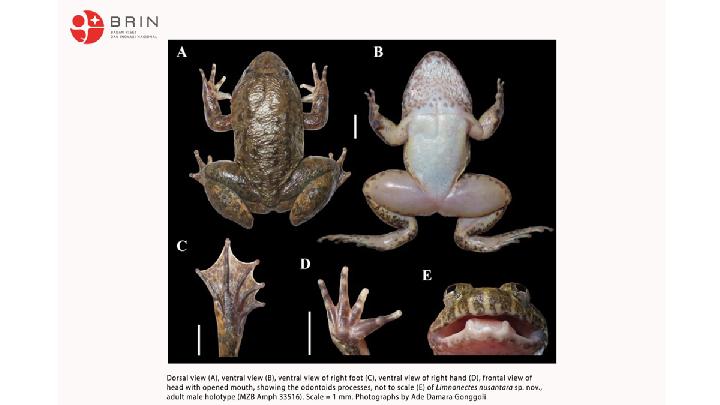
Identified Through Genes and Physical Traits
Morphologically, both frogs resemble Limnonectes kuhlii, a species already known to science. However, using a scientific approach that combined DNA analysis (specifically the 16S rRNA gene) with detailed physical observation, the researchers found that these frogs possess significant genetic differences, forming distinct evolutionary lineages.
They were confirmed as new species because the analysis revealed marked genetic divergence and strong statistical support for their status as monophyletic clades—that is, evolutionary groups consisting solely of descendants from a common ancestor.
Habitat and Cultural Significance
Limnonectes maanyanorum was found in the Mount Karasik area of Central Kalimantan. The species name honors the Dayak Maanyan people who live in the region. Locals refer to this frog as senteleng watu, or “stone frog.”
Meanwhile, Limnonectes nusantara was discovered in Loksado and Paramasan, South Kalimantan—territories associated with the Dayak Meratus community. The name “Nusantara” was chosen both as a symbol of national identity and to reference the location of Indonesia’s planned new capital city. Among locals, the frog is known as Lampinik.
Fangs on the Jaw, Bumps on the Skin
Both frog species are medium-sized and possess distinct traits that make them stand out and most notably, the presence of fangs on their lower jaws, especially in males. These “fangs” are actually bony projections, believed to play a role in mate competition or self-defense.
Other striking physical features include fully webbed toes, bumpy skin, and unique body patterns. While the two species appear similar at first glance, the shape of the skin bumps and the size of the fangs are key indicators for distinguishing L. maanyanorum from L. nusantara.
Conservation: An Urgent Call Amid Threats
The discovery of these two species serves as a critical wake-up call for conservation. Kalimantan —especially the Meratus Mountain region — is home to many endemic species that have yet to be fully documented. Unfortunately, this area is also under severe pressure from deforestation, climate change, biological exploitation, and the spread of diseases.
Professor Amir Hamidy from PRBE BRIN emphasized the urgent need for further exploration and research in these underexplored regions, "This discovery shows that Kalimantan still holds many biological mysteries. We must continue to explore and conduct research, particularly in areas that remain largely untouched."
Findings like this provide essential scientific foundations for developing data-driven conservation strategies and identifying priority areas that require protection.


