Compared to its other neighboring countries in the Southeast Asian region, the size of Singapore is relatively small. Singapore even ranks number 1 as the smallest country in Southeast Asia in terms of land size.
Despite its small size and dense population, Singapore is able to make the best out of its land through strategic urban and land planning. In this article, we will elaborate more on Singapore’s land size along with factual area data and interesting facts.
How big is Singapore?
According to the latest published report by the Department of Statistics Singapore, as of June 2025, Singapore’s land size is approximately 736,3 km2 or about 284,3 mi² long. Located between the latitudes of 1°09’N and 1°29’N and longitudes of 103°36’E and 104°25’E, Singapore’s main land stretches around 49 km from east to west and 28 km from north to south.
More insights about the size of Singapore
Having a mostly flat landscape, majority of the land in Singapore lies within 15 metres of sea level, with the highest point reaching 164 metres. Geographically, Singapore has three main areas: Bukit Mandai, Bukit Panjang, Bukit Timah—a central hilly region featuring granite-rich hills, and Bukit Batok comprising of the Pasir Panjang Ridge and Mount Faber on the west and Katong to Bedok and Changi that extends on the eastern coastal side.
Interestingly, the land size of Singapore that we know today is the result of a long-term reclamation effort carried out by the country over decades starting from the colonial era. Driven by rapid population growth and business-related purposes, Singapore started its reclamation journey to expand its land in 1822.
As explained by National Geographic, Singapore’s land reclamation first began from the south of Singapore River under the rule of Thomas Raffles who entered the country back in 1819. Singapore under the British colony continued to carry out land reclamation projects into the late 19th and early 20th century. After gaining independence, Singapore embarked on a new grand reclamation scheme, adding approximately 1,525 hectares of land to the southeast part of the island.
Ever since its independence in 1965 to 2017, Singapore’s land area has increased by more than 20%. The following table shows Singapore’s land size transformation over the last ten years:
| Time period | Land area |
| 2010 | 710,4 km2 |
| 2011 | 712,7 km2 |
| 2012 | 715,1 km2 |
| 2013 | 716,1 km2 |
| 2014 | 718,3 km2 |
| 2015 | 719,1 km2 |
| 2016 | 719,2 km2 |
| 2017 | 719,9 km2 |
| 2018 | 722,5 km2 |
| 2019 | 725,1 km2 |
| 2020 | 728 km2 |
| 2021 | 728,6 km2 |
| 2022 | 733,2 km2 |
| 2023 | 734,4 km2 |
| 2024 | 735,6 km2 |
| 2025 | 736,3 km2 |
Singapore size comparison with other countries and cities in the world
Countries with similar size as Singapore
To give a clearer picture of Singapore’s actual size, let’s compare Singapore with other countries in the world with a similar land size. For instance, there’s Bahrain—a small country located in the Persian Gulf. Being the third smallest nation in Asia, Bahrain has a slightly bigger land area than Singapore with a total land area of 760 km2.
Another example is the Maldives that comprises about 297,8 km2 of land. In between France and Spain, there’s also a landlocked country named Andorra, with a land area of 468 km2. Lastly, according to Bo Liao Singapore, a caribbean state known as Saint Kitts and Nevis is also relatively close in size to Singapore.
Singapore size comparison with big global cities
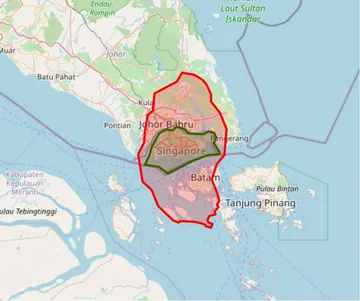
Now let’s see the comparison between Singapore’s land size with other major cities in the world. With a total area of 789 km2, New York has a quite similar land size with Singapore. But compared to Washington D.C, which comprises a land area of 177 km2, Singapore is 4.1 times larger.
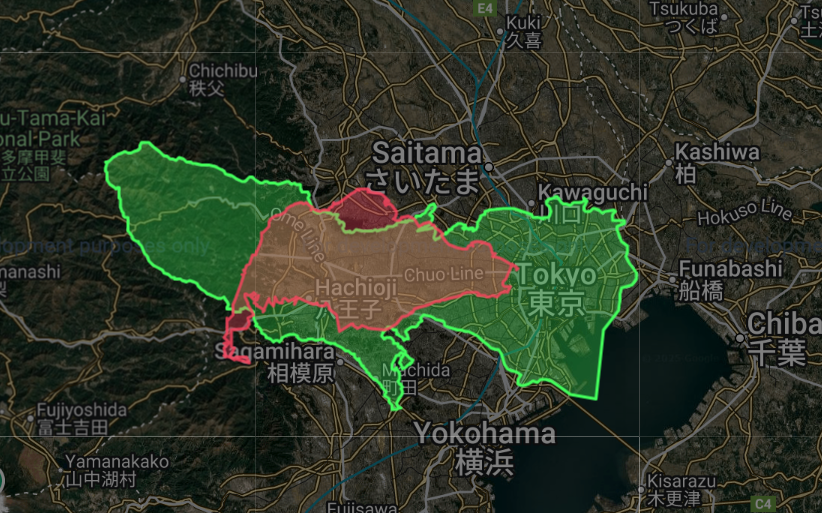
In comparison with other densely populated cities in the Asian region, Tokyo is 3 times much bigger than Singapore with an area of 2,194 km2, according to Prime Hub Magazine. Surprisingly, Jakarta, Indonesia is almost similar in size to Singapore with a total land area of about 661,5 km2.
Understanding Singapore’s size: Population density and strategic urban planning
As one of the most advanced countries in Southeast Asia, how Singapore manages its growth and development amidst its restricted land area can serve as a good example for other Southeast Asian countries. Below is an overview of Singapore’s efficient urban planning and population density.
Population density of Singapore
Over the years, Singapore has seen an increase in population. In 2025, Singapore is even considered by Worldostats and World Population Review as the third most densely populated country in the world. With a total population of nearly 6 million, the population density of Singapore reached 8,386 people per square kilometre in 2025.
Strategic urban planning
Strategic urban planning is the key to solving Singapore’s problems in terms of land scarcity because it provides a structured approach for the island city-state to maximize the use of limited land resources while ensuring sustainable development.
Given the country’s high population density, effective urban planning helps in shaping compact, well-connected neighborhoods and integrated infrastructure. This includes a robust public transportation system consisting of bus, trains, and taxis, as well as sustainable transportation methods like walking and cycling to reduce reliance congestion and reliance on private vehicles.
Moreover, according to Statista and Jimmy Sum Real Estate, Singapore’s well-planned land reclamation and careful zoning enables the city-state to effectively meet housing, economic, and environmental needs amidst limited space.
Most Singaporeans reside in apartments and public housing provided by the Housing Development Board. Rooftop gardens, tree-lined roadways, and green inventions like “breathing walls” and vertical farming is also an environmentally friendly way for Singapore to enhance the cityscape.
This article was created by Seasians in accordance with the writing rules on Seasia. The content of this article is entirely the responsibility of the author.