


The rivalry between the United States and China has redrawn global trade flows and pushed ASEAN to adapt quickly. Tariffs, supply chain reconfiguration, and emerging technologies are transforming how Southeast Asia positions itself in global production. The region is no longer a passive participant. It is emerging as a critical node in the world’s manufacturing and logistics networks.
The “China plus one” strategy has become the new standard for multinational firms seeking resilience. Data shared by industry experts shows that six of the ten fastest-growing global trade routes now originate from ASEAN. Routes such as Singapore–US, Thailand–US, Malaysia–US, and Vietnam–US illustrate how companies are relocating operations to reduce tariff exposure. In some cases, production lines were moved from Mexico and China to ASEAN countries within weeks of new tariffs being imposed. This agility and adaptability are shaping ASEAN’s new economic identity.
Tariff differences add further momentum. The average US tariff on ASEAN exports is 18.8 percent, compared with 29.9 percent on Chinese goods. This gives ASEAN a clear advantage as a manufacturing and export base for the US market. Yet, the real opportunity lies beyond tariffs. With 680 million consumers, rising incomes, and fast digital adoption, Southeast Asia is becoming an end market as well as a production base.
From Twinning Strategies to Policy Shifts
Multinational firms are adopting a “twinning” model—maintaining one operation in China for domestic supply and another in ASEAN for exports. Vietnam, Malaysia, and Singapore lead this trend, with Thailand and Indonesia catching up. Each country offers unique strengths. Indonesia attracts labor-intensive industries. Thailand provides affordable energy for data centers. Malaysia advances in semiconductors, while Singapore serves as the region’s logistics and financial hub. Together, these differences form a balanced and resilient production ecosystem.
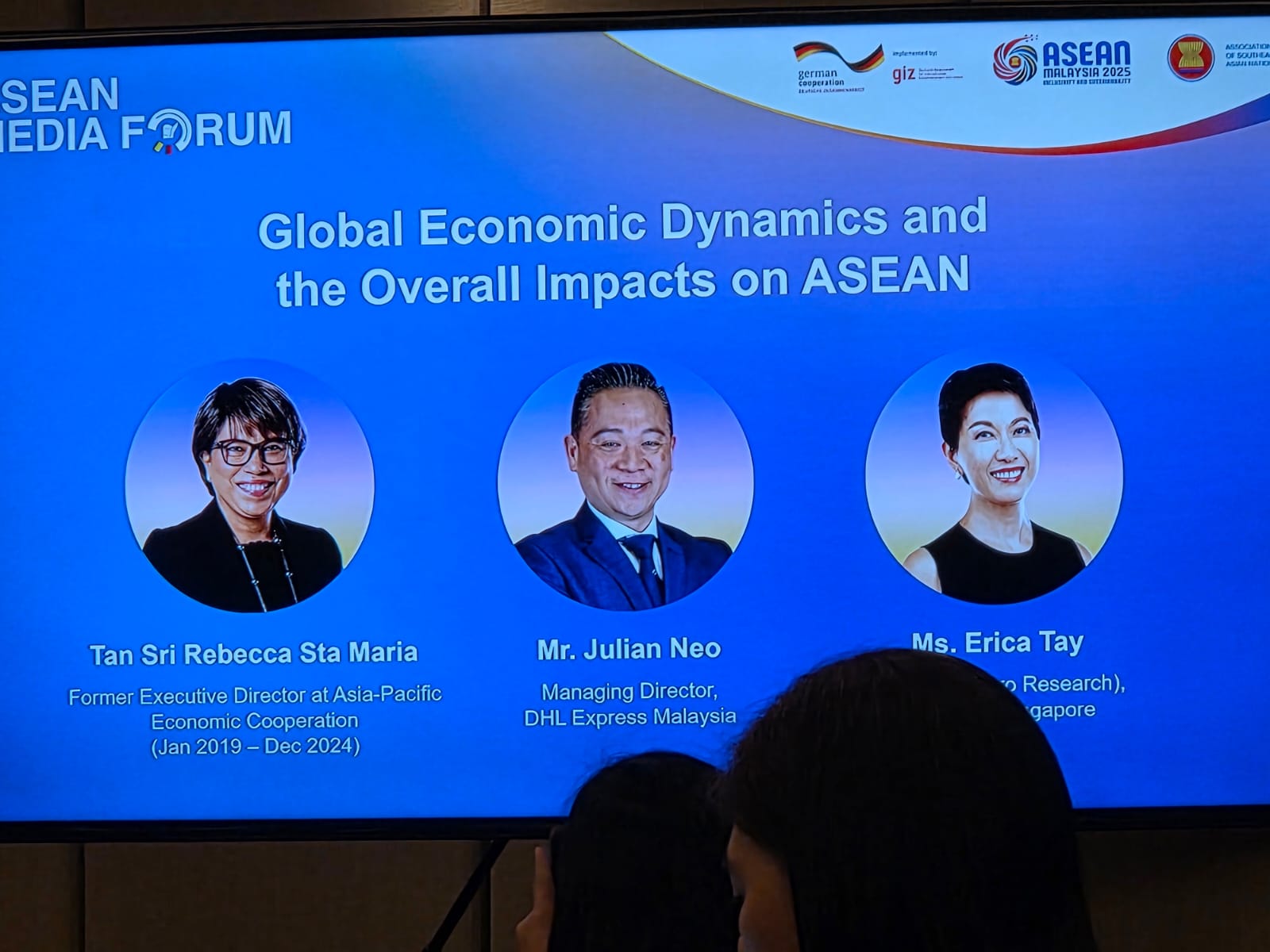
At the ASEAN Media Forum 2025 in Kuala Lumpur, this transformation was discussed by Tan Sri Rebecca Sta Maria, former Executive Director of APEC (2019–2024), Mr. Julian Neo, Managing Director of DHL Express Malaysia, and Ms. Erica Tay, Director of Macro Research at DBS Group Research Singapore. The speakers agreed that the US–China rivalry, while disruptive, is accelerating ASEAN’s repositioning through supply chain diversification, trade realignment, and digitalization.
Tan Sri Rebecca Sta Maria explained that ASEAN’s trade policy is adapting through the Regional Comprehensive Economic Partnership (RCEP), which connects the region with China, Japan, Korea, Australia, and New Zealand. RCEP simplifies overlapping trade rules and allows “cumulation,” meaning goods made with inputs from member countries can qualify for tariff benefits. Policymakers now aim for “full cumulation” to strengthen regional supply chains even further.
Challenges and the Road Ahead
Despite this progress, ASEAN still faces deep structural challenges. Non-tariff barriers continue to slow business, and consensus-based decision-making often delays policy implementation. Tan Sri Rebecca highlighted the need for the “ASEAN minus X” approach—allowing ready countries to move ahead while others join later. Businesses are also urging governments to simplify licenses and procedures to improve the ease of doing business.
Ms. Tay emphasized that success depends on how well governments prepare their economies for high-value industries. She cited Malaysia’s five-year plan to train thousands of engineers for its chip design hub in Puchong as a model for aligning skills with investment needs.
Mr. Neo added that digital tools and AI-driven tariff systems can help small firms manage complex trade regulations. By improving access to trade data and automation, small and medium enterprises can join cross-border markets more confidently.
The speakers concluded that ASEAN’s strength lies in neutrality and coordination. Rather than choosing sides between the US and China, the region is using their competition to build resilience and attract investment. By deepening integration, enhancing skills, and embracing digital transformation, ASEAN is turning global rivalry into a powerful engine for regional growth.


