


The animal kingdom is full of peculiarities and paradoxes. There is the mouse deer, which is neither a mouse nor a deer; the vampire squid, which is neither a true squid nor a vampire; and now, a sea snake that… doesn’t actually live in the sea.
Its name is Garman’s sea snake (Hydrophis semperi), a rare species found in only one place in the world—Lake Taal in the Philippines.
A Sea Snake That Doesn’t Live in the Sea
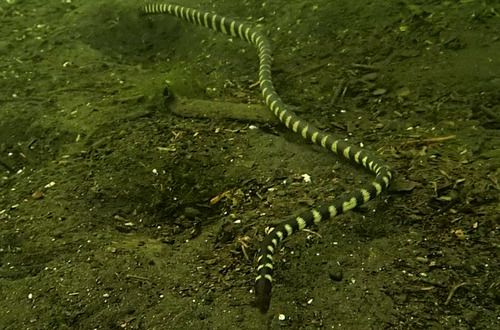
Although it belongs to the family Elapidae (the group of true sea snakes), Garman’s sea snake is unlike its relatives. Instead of living in saltwater, this species has fully adapted to freshwater.
It is one of only two sea snake species on Earth known to do so, alongside Laticauda crockeri. This makes Hydrophis semperi not only one of the rarest reptiles, but also one of the most scientifically fascinating.
Measuring about 50 to 70 centimeters in length, it is relatively small compared to most marine sea snakes. Its body is dark, black or deep blue, with white or yellow bands, and it has a paddle-shaped tail—a distinctive feature that helps it navigate gracefully underwater.
Origins and Discovery
The species was first recorded by German naturalist Carl Gottfried Semper in the mid-19th century. Its scientific name, Hydrophis semperi, honors his contribution.
Over time, it has also been known by several other names, including Lake Taal sea snake, Philippine freshwater sea snake, Luzon sea snake, and Duhol matapang among local communities.
The Formation of Its Unique Habitat in Lake Taal
The existence of this species is closely tied to the history of the massive Taal Volcano eruption of 1754. The eruption caused the collapse of the volcanic caldera and cut off the Pansipit River, which once connected the lake to the sea. As rainwater filled the caldera, the lake’s saltwater gradually turned into freshwater.
Many marine species became trapped in this closed-off ecosystem. Over hundreds of years in isolation, they underwent extreme evolutionary adaptation.
Experts believe that the ancestor of Hydrophis semperi was Hydrophis cyanocinctus, which evolved into a new form due to the lake’s unique environmental pressures. This serves as a clear example of the Founder Principle, where a small, isolated population develops distinctive traits different from its ancestors.
A Calm but Venomous Predator
Garman’s sea snake preys on small fish such as gobies and eels. It hunts along the lakebed, probing into narrow crevices in search of food.
Its venom is notably potent—two to five times more toxic than a cobra’s—yet the snake is known to be non-aggressive and will only bite when threatened.
Like other sea snakes, this species is fully aquatic and gives birth to live young in the water. It can hold its breath for long periods, but still needs to surface regularly for air.
A Rare Species on the Brink
Unfortunately, its uniqueness is overshadowed by serious threats. Lake Taal is the only natural habitat of Garman’s sea snake, and the lake lies atop an active volcano that could erupt at any time, potentially wiping out its entire ecosystem.
Beyond natural dangers, human activities have accelerated its decline. Water pollution from agriculture, tilapia fish farms, pesticides, and fuel runoff has degraded water quality in the lake.
Since 2009, the International Union for Conservation of Nature (IUCN) has listed this species as Vulnerable on the Red List.
Sightings have become increasingly rare. Reports from researchers and local fishermen mention only a few individuals being caught in nets in the past several years.
Because the snake holds little commercial value, locals often kill it when encountered—very different from the freshwater sardine known as tawilis, which is a vital economic resource.
Even more concerning, only five scientific studies on Hydrophis semperi have been documented from its initial identification in 1881 up to the early 2000s. With so little research, many aspects of its biology—including its reproductive patterns and ecological behavior—remain a mystery.


