


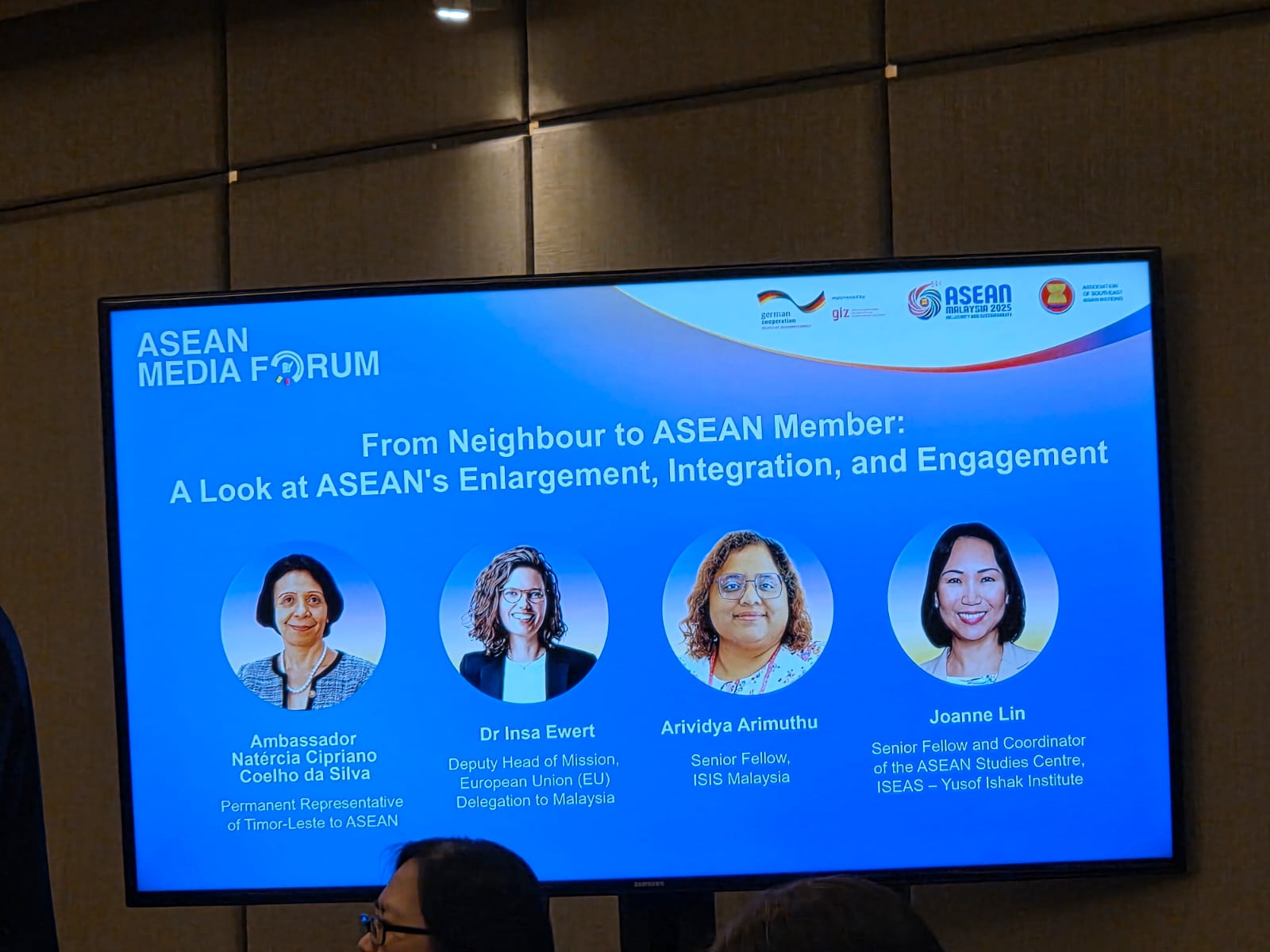
Timor-Leste’s long-awaited accession to ASEAN has moved from celebration to implementation. At the ASEAN Media Forum 2025 in Kuala Lumpur, diplomats, policymakers, and regional experts agreed that this milestone marks not the end of a journey, but the start of a complex phase of integration that will test ASEAN’s adaptability and solidarity.
A New Partner, Shared Responsibility
Timor-Leste’s ambassador expressed gratitude to ASEAN and Malaysia’s chairmanship, calling the country’s membership “a shared responsibility to shape our region’s future together.” She emphasized that Timor-Leste’s goal is to be a constructive partner that strengthens ASEAN’s unity, centrality, and regional impact.
She outlined key priorities: building institutions, strengthening governance, and adding value to ASEAN’s community-building efforts. Timor-Leste, she said, brings its experience in peacebuilding and democratic transition, elements that complement ASEAN’s vision of a rule-based and people-centered community.
The ambassador underlined the need for cooperation in emerging areas such as the digital economy, sustainable energy, and cybersecurity. She also highlighted Timor-Leste’s intention to serve as a bridge between ASEAN and the wider global community, connecting Southeast Asia to the Pacific and beyond.
From Celebration to Implementation
Panelists reminded that ASEAN membership comes with obligations, not just symbolic inclusion. Malaysian think tank representative Vidya K stressed that “the real work begins” after accession. She pointed out that while ASEAN may not operate like the European Union, its framework of treaties and trade agreements requires every member to align regulations and fulfill commitments.
Vidya noted that Timor-Leste’s recent accession to the World Trade Organization and its liberal investment policies show readiness for economic integration. Yet, she warned that non-tariff challenges; like customs harmonization, product standards, and labor mobility, will demand technical coordination and capacity-building.
From the European perspective, EU representative Dr. Insa Ewert said that enlargement is never easy but always worthwhile. She drew parallels with the EU’s expansion from 15 to 25 members in 2004, describing integration as a “journey of governments and people alike.” The lesson, she said, is that success depends on political will, mutual adaptation, and long-term commitment to shared goals.
During the open discussion, questions turned to connectivity and diversification. The ambassador admitted that Timor-Leste’s economy remains heavily dependent on oil and gas, but the government is now prioritizing tourism, agriculture, and fisheries. She mentioned improving air links between Dili, Bali, Malaysia, Singapore, and Australia as early signs of progress.
Participants agreed that ASEAN’s next challenge is to make integration tangible for citizens. Economic opportunities, regional connectivity, and people-to-people ties will determine whether ASEAN can turn its vision into lived reality.
As one participant concluded, “The real work begins after the applause stops. This is where ASEAN’s unity will be tested, and strengthened.”


