


Southeast Asia’s digital economy has moved into a new phase. The region is adding more than 200 million internet users and has attracted 120 billion dollars in private funding since 2016. Over the same period, revenue has grown more than eleven times and GMV has expanded more than seven times. Digital payments now exceed 60 percent of all transactions. Cash dominated only a few years ago.
Growth is broad based. Ecommerce remains the main engine and will push GMV in ASEAN toward 305 billion dollars by 2025. Food delivery, transport, travel, and online media also continue to rise. Each sector posts steady double digit growth. Companies are expanding in more disciplined ways. Better logistics, improved ad products, and new payment options lift margins. Video commerce has become a major force. It is reshaping how people shop and how sellers promote products.
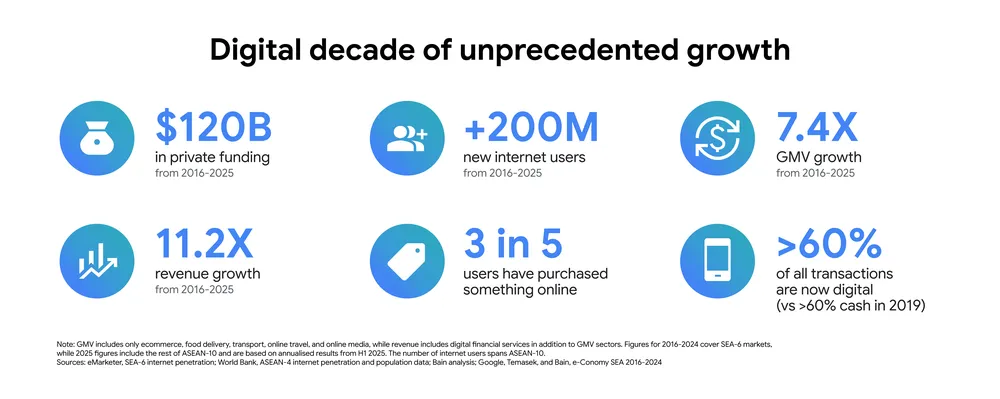
Investment behavior is changing. Capital is flowing back into the region, but with sharper focus. Private funding is recovering by about fifteen percent year over year to eight billion dollars. Investors prefer late stage deals and digital financial services. They want clearer paths to profit. ASEAN offers that. Recent revenue models keep pace with GMV and valuations look more realistic. A stronger IPO pipeline is also giving investors confidence in future exits.
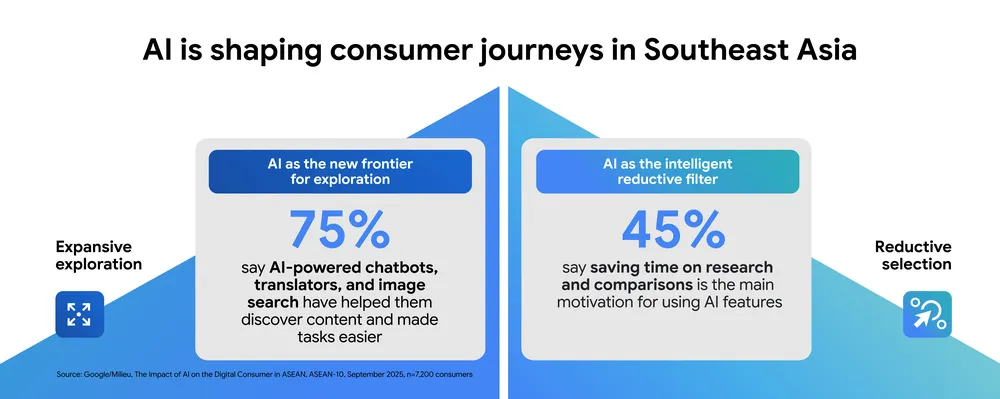
AI is becoming the next competitive edge. Consumers in Southeast Asia show unusually high interest in AI tools. Three in four users say chatbots, translators, and image search help them complete tasks. Nearly half use AI to save time in research and comparisons. This sets the stage for an AI driven shift in commerce, media, and payments. The region is expanding data center capacity at a faster rate than the rest of Asia Pacific. More than 2.3 billion dollars has already gone to local AI startups. ASEAN’s digital decade built the foundation. The next decade will be shaped by AI adoption at scale and by the region’s ability to turn digital depth into long term economic power.


