


Amid the bustle of modern Hanoi stands an ancient complex that for nearly a millennium served as the cradle of royal scholars. The Temple of Literature is more than a historical landmark; it is widely recognized as Southeast Asia’s first and oldest university. Founded in 1070, the site remains a lasting symbol of Viet Nam’s academic and intellectual legacy.
The Birthplace of Viet Nam’s Royal Scholars
The Temple of Literature was built by Emperor Ly Thanh Tong to honor Confucius, whose teachings formed the backbone of Viet Nam’s feudal education system. However, just six years after its establishment, the temple’s role expanded far beyond its original purpose.
In 1076, the royal court founded Quoc Tu Giam, Viet Nam’s first institution of higher education, adjacent to the temple. Initially reserved for members of the royal family and the nobility, the academy was later opened to commoners who demonstrated outstanding academic ability.
Operating for more than seven centuries, Quoc Tu Giam became the oldest university in Southeast Asia and one of the most influential centers of learning in the region during its time.
A Five-Courtyard Complex Rich in Educational Symbolism
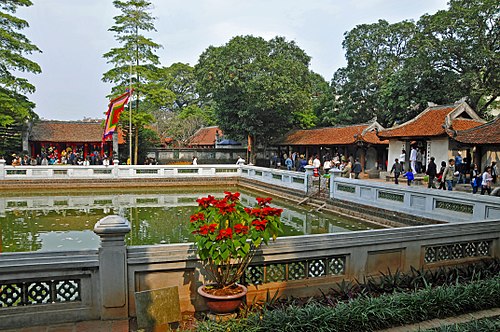
Covering an area of approximately 54,000 square meters, the Temple of Literature is designed like a traditional East Asian academy. Its five courtyards are deeply rooted in educational philosophy, making every step through the complex feel like a symbolic journey through the stages of learning in Viet Nam’s royal era.
a. First Courtyard – The Great Gate and the “Carp Turning into a Dragon” Philosophy
The journey begins at the Great Middle Gate, crowned with fish motifs. According to legend, a carp that succeeds in leaping over towering waves transforms into a dragon.
This imagery represents the struggles faced by students in overcoming rigorous examinations—a reminder that success is achieved through perseverance and discipline.
b. Second Courtyard – Khue Van Cac, the Star of Learning
This courtyard is home to Khue Van Cac, a small pavilion supported by brick pillars with a wooden structure above. Its circular windows symbolize the light of knowledge illuminating the world.
Beyond its academic meaning, the pavilion has become an official symbol of Hanoi and is featured on the 100,000 VND banknote.
c. Third Courtyard – A Serene Pond and 82 Doctoral Stelae
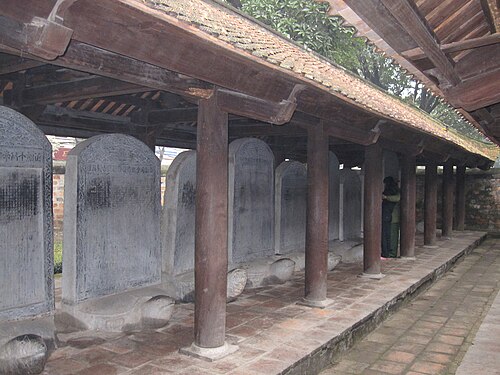
The Well of Heavenly Clarity is a square pond that mirrors the pavilion above. Surrounding it are 82 stone turtles bearing stelae engraved with the names of 1,307 scholars who passed the imperial examinations between 1442 and 1779.
These stelae were recognized by UNESCO in 2010–2011 as part of the Memory of the World program for their exceptional value to the history of education in Asia.
d. Fourth Courtyard – The Gate to Great Success and the Hall of Learning
This section serves as a place of veneration for Confucius, his disciples, and Chu Van An—a revered master teacher celebrated for his integrity and devotion to education. The area is also used by the Hanoi government to honor outstanding students.
e. Fifth Courtyard – Thai Hoc, Where Scholars Were Formed
The innermost courtyard was once the heart of academic life. On the first floor of the Thai Hoc building stands a statue of Chu Van An, while the second floor is dedicated to the emperors who played key roles in preserving the academy over centuries.
A Long Journey Through Dynasties
Over the centuries, the Temple of Literature has passed through many significant historical phases:
- 1070: Built to honor Confucius and to begin educating the Crown Prince.
- 1076: Quoc Tu Giam established as Viet Nam’s first university.
- 1253: Renamed Quoc Tu Vien.
- 1483: Renamed Thai Hoc Duong.
- Nguyen Dynasty: Its academic role declined after the capital was relocated to Hue.
- 1999–2000: Major restoration efforts were carried out to preserve its historical value.
- 2010–2011: The 82 doctoral stelae were recognized by UNESCO as part of the Memory of the World documentary heritage.
With a history spanning nearly 1,000 years, the Temple of Literature stands as clear evidence that education has been a fundamental pillar of Vietnamese society since the feudal era.
How to Visit the Temple of Literature
The site enjoys a strategic location, just 2 kilometers from Hanoi’s Old Quarter and close to Hoan Kiem Lake. Visitors can reach it on foot or by taxi/Grab, with fares typically ranging from 60,000 to 70,000 VND (US$2.28 - US$2.66).
There are two visiting options:
• Day Tour
Opening hours: 7:30 AM – 6:00 PM
Entrance fee: 30,000 VND (US$1.14)
• Night Tour
Opening hours: 6:30 PM – 10:30 PM
3D mapping shows: 7:45 PM and 8:45 PM
Entrance fee: 199,000 VND (US$7.55) for adults, 99,000 VND (US$3.76) for children
Important note: Visitors are required to dress modestly and respect the site’s sacred areas.
Now Open to All Visitors
After centuries as an educational institution reserved for the elite, the Temple of Literature is now open to the public as a major historical and cultural attraction.
The complex allows visitors to experience firsthand Southeast Asia’s oldest educational heritage—a place that once shaped generations of royal scholars and today stands as one of Hanoi’s greatest sources of pride.


