


The Vietnamese government has officially launched the construction of Trống Đồng Stadium, a grand venue designed to seat 135,000 spectators and projected to become the largest stadiums in the world.
The project took center stage during the groundbreaking ceremony of the Olympic Sports Urban Area, an integrated sports complex in southern Hanoi with an investment value of up to VND 925 trillion.
The development also sets a record as the largest investment in Viet Nam’s history and highlights the dominance of the private sector, which accounts for 82 percent of total project funding.
Built to Become the World’s Largest Stadium
With a planned capacity of 135,000 spectators, Trống Đồng Stadium is expected to surpass most iconic stadiums worldwide and position Viet Nam within the global elite of sports infrastructure.
At present, the title of the world’s largest stadium is held by Rungrado 1st of May Stadium in North Korea, with a capacity of around 150,000 seats, according to data from the International Olympic Committee. Michigan Stadium in the United States ranks next, with a capacity exceeding 107,600 spectators.
At the national level, Viet Nam’s largest stadium is currently My Dinh National Stadium in Hanoi, which accommodates approximately 40,000 spectators. This comparison underscores the significant leap in scale, as Trống Đồng Stadium is designed to be nearly four times larger than the country’s existing largest venue.
Trống Đồng Stadium will be built on a 73.3-hectare site and designed to meet FIFA standards, enabling Viet Nam to bid to host major international sporting events, ranging from the Asian Games to the Olympic Games.
Construction of the stadium is scheduled for completion in August 2028.
Next-Generation Stadium Technology
Beyond its sheer scale, Trống Đồng Stadium stands out for its architectural design and advanced technology. The stadium’s architecture is inspired by the motifs of the Đông Sơn bronze drums—symbols of Viet Nam’s ancient civilization that represent strength and national identity.
From a technological standpoint, the stadium is conceived as a smart and environmentally sustainable facility. Core features include AI integration, 5G-enabled smart seating systems, and real-time security and crowd management technologies.
One of the most striking innovations is its ability to replace the playing surface within 6 to 10 hours, offering exceptional flexibility for hosting a wide range of events.
Advanced rainwater management and recycling systems are designed to reduce freshwater consumption by up to 70 percent. These systems are complemented by heat- and UV-resistant technologies and natural ventilation to enhance overall energy efficiency.
The stadium will also feature VVIP areas built to international diplomatic standards, designed to host heads of state and distinguished guests at major global events.
Olympic Sports Urban Area: Viet Nam’s New Sports City Hub
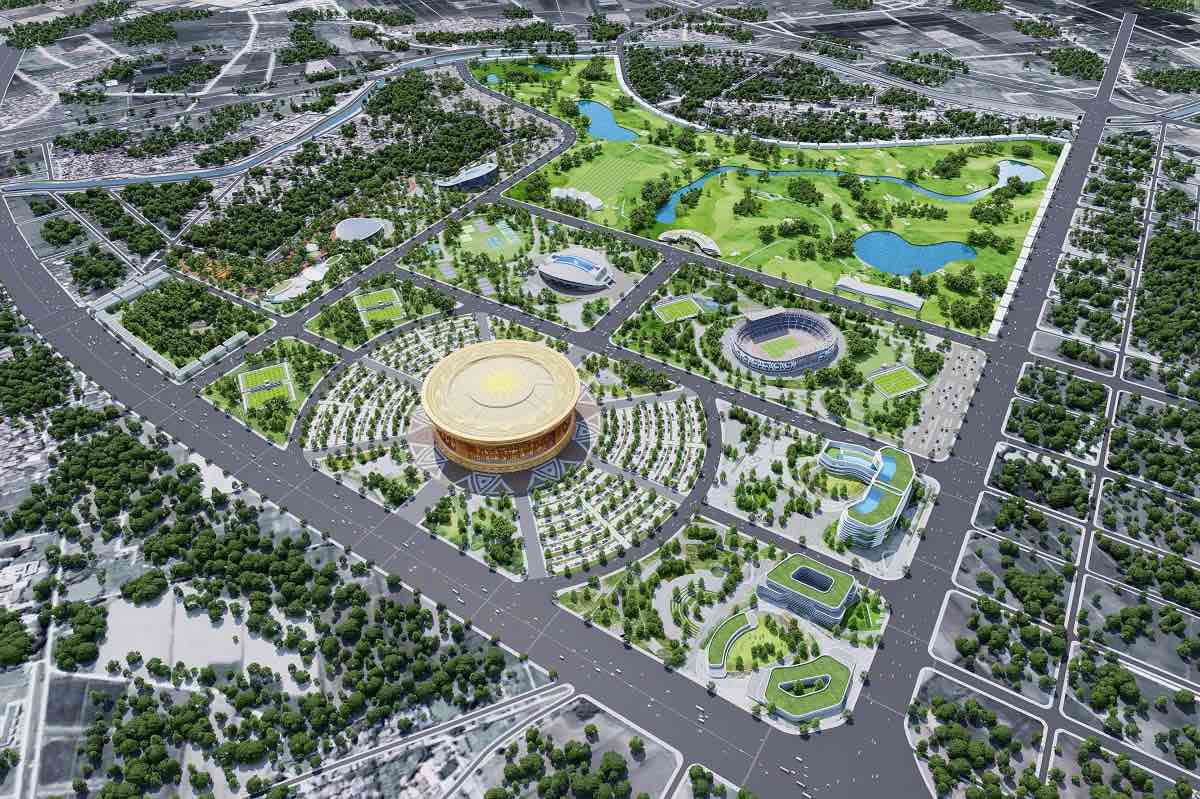
Trống Đồng Stadium serves as the centerpiece of the Olympic Sports Urban Area, a 9,171-hectare integrated sports and urban development encompassing 11 communes on the southern outskirts of Hanoi. The area is envisioned as a comprehensive sports and services city, with an estimated population of 751,000 residents.
Strategically located at the intersection of key national transportation routes, including Ring Roads 3.5 and 4, National Highway 1A, and the Pháp Vân–Cầu Giẽ Expressway, the area benefits from strong connectivity. Its proximity to Ngọc Hồi Station creates opportunities for Transit-Oriented Development (TOD), supporting sustainable urban growth.
Led by Vingroup, the project is part of 234 national projects launched simultaneously to commemorate the 14th National Congress of the Communist Party of Viet Nam (Desember 19).


