Long before travel reels, booking apps, and algorithm-driven itineraries, Southeast Asia was explored in a slower, more human way. Backpackers arrived chasing ancient temples, tropical beaches, and cheap freedom. What they didn’t expect was that a humble plate of banana pancakes would end up mapping one of the region’s most influential travel routes.
This unwritten route became known as the Banana Pancake Trail, not a government project, not a tourism campaign, but an organic network of places shaped by travelers, locals, and shared stories. Over decades, it quietly defined how Southeast Asia was discovered, experienced, and remembered.
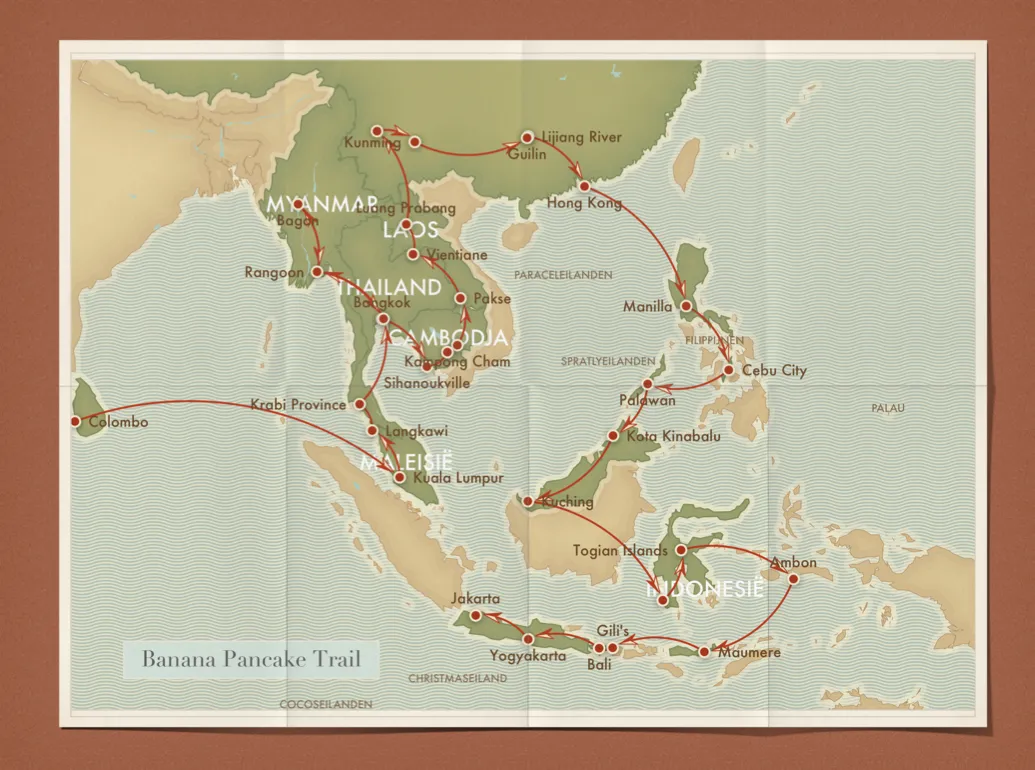
From the Hippie Trail to a New Frontier
The roots of the Banana Pancake Trail can be traced back to the collapse of an older journey: the Hippie Trail. In the 1960s and 1970s, adventurous travelers crossed overland from Europe through Turkey, Iran, and Afghanistan toward Nepal and India.
Political instability in the late 1970s and 1980s made that route increasingly dangerous, forcing travelers to look elsewhere.
Their gaze shifted eastward. Southeast Asia offered something rare at the time: relative safety, cultural depth, affordability, and warm hospitality. Thailand became the main gateway, followed by Laos, Cambodia, Viet Nam, and Indonesia.
What emerged was not a single road, but a loose constellation of towns, islands, and border crossings connected by word of mouth and curiosity.
This was the beginning of a new adventure corridor, one that favored boats, night buses, and long conversations over rigid schedules.
Why Banana Pancakes Became a Cultural Signal
The name “Banana Pancake Trail” may sound playful, but it carries deep cultural meaning. As budget travelers arrived in unfamiliar towns, local guesthouses and small cafés began adapting. Traditional rice and noodle dishes remained, but one item quietly appeared on menus: banana pancakes.
The dish was simple, cheap, and familiar. More importantly, it became a sign. If a place served banana pancakes, it usually meant the owner understood backpackers. English was spoken, travel tips were exchanged, and transport information was available.
The pancake wasn’t the attraction, it was the signal that you had entered a safe, welcoming zone for travelers.
Over time, banana pancakes became shorthand for an entire ecosystem: budget accommodation, relaxed rules, shared itineraries, and cultural exchange. A breakfast plate turned into a social passport.
A Route Built by Stories, Not Maps
Unlike historic trade routes such as the Silk Road, the Banana Pancake Trail was never planned. It emerged from conversations on hostel balconies and scribbled notes in travel journals.
A traveler would recommend Pai after Chiang Mai. Someone else would insist on Luang Prabang. Another would swear that Hoi An or the Gili Islands were unmissable. These recommendations spread from person to person, slowly turning quiet villages into international meeting points.
Guidebooks later reinforced the flow, but they followed the trail rather than creating it. The real infrastructure was human memory, stories repeated until destinations became inevitable stops on a shared journey across Southeast Asia.
An Economic and Cultural Legacy
The impact of the Banana Pancake Trail went far beyond travel culture. Entire local economies grew around it. Remote towns gained guesthouses, cafés, scooter rentals, and transport services. For many communities, backpackers became the first sustained link to global tourism.
This form of travel also shaped Southeast Asia’s reputation as a region that rewards slow exploration. Travelers didn’t rush; they stayed. They learned customs, picked up local phrases, and built temporary communities. The trail helped define Southeast Asia not just as a destination, but as a rite of passage.
Is the Banana Pancake Trail Still Alive in 2026?
Travel has changed. Social media now dictates trends, and digital nomads prioritize Wi-Fi speed over handwritten bus schedules. Some once-quiet stops are now crowded, polished, and expensive.
Yet the spirit of the Banana Pancake Trail remains intact. It lives in the idea of moving slowly, trusting recommendations over rankings, and valuing human connection over efficiency. It survives every time a traveler chooses a roadside café, shares a tip with a stranger, or lingers longer than planned.
The trail was never about pancakes. It was about how Southeast Asia taught the world to travel differently and that lesson, even in 2026, still holds.