Counting the blue whale population is an important matter. Without a proper way to document their existence, scientists can’t convince the government to put in place proper laws to protect the largest mammals on earth. That’s why the blue whale tagging project is crucial.
However, the conventional way to tag blue whales is risky. Scientists have to come as close as possible to the whale, and they have to shoot the tag from a boat.
This method has two conditions for success: the boat must be steady enough for the shooter to fire, and the shooter themselves must be able to aim at the whale precisely. These two conditions carry a very high chance of failure. If they miss, scientists could lose $5,000 which a lot of money and effort wasted.
A Breakthrough in Whale Tagging
That’s why marine scientists at Konservasi Indonesia recently announced they have found a better way to tag whales.
Mochamad Iqbal Herwata, focal species conservation senior manager at Konservasi Indonesia, told The Straits Times that the successful drone-based deployment of the low-impact minimally percutaneous electronic transmitter (LIMPET) tag marked a major breakthrough.
He said the achievement would help Indonesian researchers better understand how pygmy blue whales migrate from Indonesia to Australia.
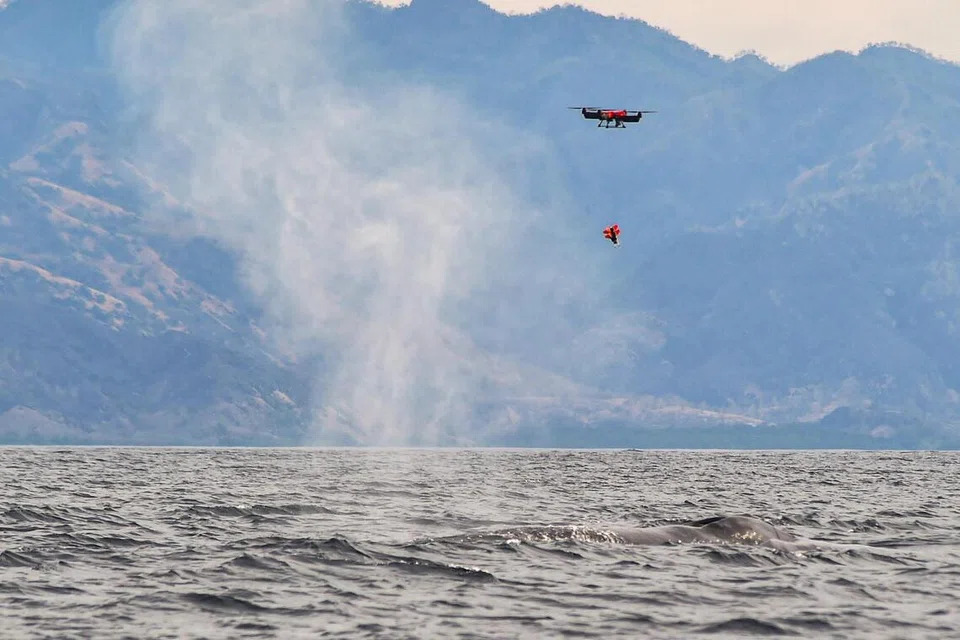
This drone deployment for whale tagging is not merely to survey the whale population, but also to track their activities and migration routes across the ocean. The LIMPET tag itself is a type of satellite tag that can stay on marine mammals for several months.
The drone method is far superior because it uses precise coordinates and automated tracking aimed at the whale's hump. Therefore, scientists can deploy the LIMPET from further away.
It minimizes disturbance and doesn’t alert the whale. This method is also believed to be less invasive, preventing tissue damage and stress in the whales.
After a successful tagging, scientists are then able to track the whale's tag transmission for approximately 2,000 km, or about 10 days of beaming. Thanks to this success, scientists can finally begin to see how the whales wander around the region.
“For the first time, we are beginning to see the full picture of how pygmy blue whales move across national borders, from Indonesia through Timor-Leste, the Lesser Sunda Seascape, and beyond. This helps us find a way to better protect them,” he said.
This breakthrough also opens the possibility of studying the southward journey of the whales, since existing data only tells us how the whales move north from Western Australia. Mapping the complete journey route means scientists can urge authorities to establish Marine Protected Areas (MPAs) more precisely.
Why Tracking Matters Beyond Science
The pygmy blue whale is a subspecies of the blue whale that can grow up to 24 meters long. To put that into perspective, imagine two city buses driving around town. That’s how big the whale is.
To grow that large, the whales need a massive supply of food. They need to find places to feast and places to rest. Having the ability to track these behavioral patterns is essential for MPA regulations.
Furthermore, a deep understanding of whale behavior can help local communities along the route access sustainable financing and long-term management support to protect the area. These funds can be used for ecotourism, sustainable business projects, and the establishment of conservation enterprises. These benefits go far beyond mere marine animal sightings.
Konservasi Indonesia (formerly Conservation International Indonesia chapter) is an Indonesian non-governmental foundation that supports sustainable development and environmental conservation in Indonesia.
The NGO has decades long reputation as organization that able to combine conservation initiative with sustainable social ecological empowerment in several Indonesian region such as Papua, Sumatra and Java.