


Global oil transportation depends heavily on a handful of narrow maritime routes known as chokepoints. These strategic passages connect major producing regions with global markets, making them vital to the stability of energy supplies.
Any disruption in these areas can significantly affect oil prices and international trade, highlighting their importance in the modern global economy and geopolitical landscape today.
1. Strait of Hormuz

The Strait of Hormuz is the most critical oil chokepoint in the world. Approximately 21 million barrels of oil pass through it each day, equal to about 21 billion barrels per day if expressed in simplified large-scale figures.
This narrow passage connects the Persian Gulf with global markets, especially in Asia, Europe, and North America. Its strategic importance also makes it highly sensitive to geopolitical tensions in the Middle East.
2. Strait of Malacca
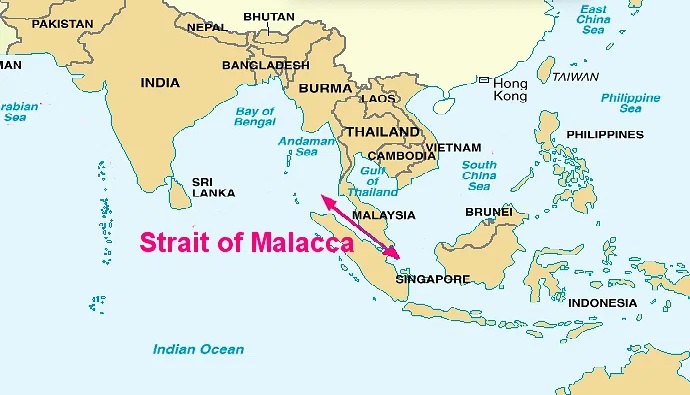
The Strait of Malacca is one of the busiest shipping lanes globally. Around 16 million barrels of oil flow through it daily, or roughly 16 billion barrels per day in simplified terms.
It serves as a key route linking the Indian Ocean with the Pacific Ocean, making it essential for oil shipments to major Asian economies such as China and Japan.
3. Cape of Good Hope

The Cape of Good Hope acts as an alternative route when other chokepoints are disrupted. About 6 million barrels of oil transit this route daily, equivalent to about 6 billion barrels per day.
While it is not as narrow as other chokepoints, it becomes crucial when the Suez Canal or other routes are inaccessible, despite adding longer travel distances.
4. Suez Canal

The Suez Canal is a vital artificial waterway connecting the Mediterranean Sea to the Red Sea. Approximately 7 million barrels of oil pass through it daily, or around 7 billion barrels per day in simplified figures.
The canal significantly reduces travel time between Europe and Asia, making it one of the most economically important maritime routes in the world.
5. Danish Straits
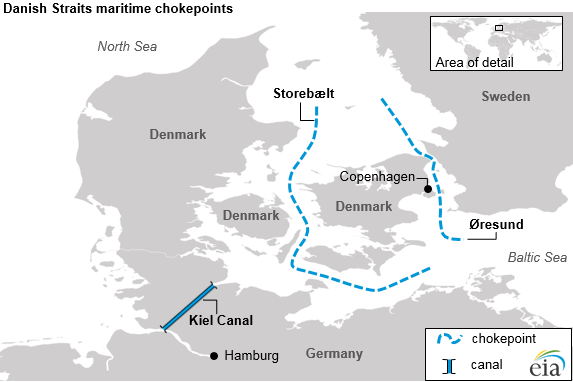
The Danish Straits serve as a key gateway between the Baltic Sea and the North Sea. Around 3 million barrels of oil flow through these straits each day, equivalent to about 3 billion barrels per day.
They are especially important for transporting oil from Russia and other Baltic region producers to global markets.
6. Bab el-Mandeb

The Bab el-Mandeb connects the Red Sea to the Gulf of Aden. Roughly 6.2 million barrels of oil pass through this chokepoint daily, or about 6.2 billion barrels per day in simplified terms.
It is a crucial link for shipments traveling to and from the Suez Canal, making it highly significant for global trade flows.
7. Turkish Straits

The Turkish Straits connect the Black Sea to the Mediterranean. Around 3.4 million barrels of oil transit these straits daily, equivalent to about 3.4 billion barrels per day. They are essential for exporting oil from countries bordering the Black Sea, particularly Russia and Kazakhstan.
8. Panama Canal

The Panama Canal links the Atlantic and Pacific Oceans, providing a shortcut for global shipping. Approximately 2.9 million barrels of oil pass through it each day, or about 2.9 billion barrels per day in simplified terms.
While not as heavily used for oil as some other chokepoints, it remains important for regional energy trade, especially between the Americas and Asia.
These eight oil chokepoints play a central role in maintaining the flow of energy across the globe. Their strategic locations make them both vital and vulnerable, as disruptions can have widespread economic consequences.
Ensuring their security and accessibility remains a priority for nations that depend on stable and reliable oil supplies in an increasingly interconnected world.


