Mount Mayon stands as a breathtaking yet formidable icon on the island of Luzon, Philippines. Rising 2,462 meters above sea level in Albay province, this stratovolcano is globally renowned for its near-perfect symmetrical cone.
Recent satellite imagery from the European Union’s Copernicus Sentinel-1 highlights the volcano's intricate radial drainage patterns and lava channels in sharp detail. Such data is crucial for monitoring one of the most active volcanoes in the world, especially as it continues its lengthy period of volcanic unrest.
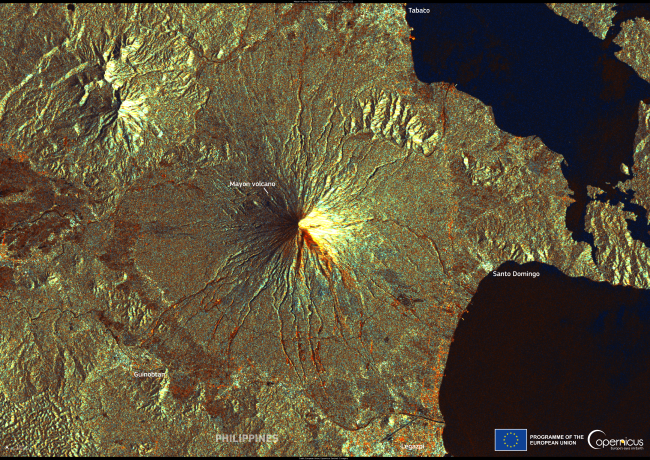
Ongoing activity has now reached a significant milestone, marking over 83 consecutive days of effusive eruption as of late March 2026. Frequent ash clouds and minor Strombolian explosions continue to remind nearby communities of the mountain's volatile nature.
While the fertile slopes support diverse ecosystems and local agriculture, the persistent threat of lava flows and ashfall remains a daily reality for thousands of residents. This dual nature of Mayon, being both a source of life and a potential bringer of destruction, defines the resilience of the Bicol region.
A Geographic Masterpiece in the Pacific Ring of Fire
Location plays a vital role in Mayon’s frequent activity, as it sits directly on the Pacific Ring of Fire. This tectonic positioning makes it a centerpiece of the Philippine National Integrated Protected Areas System, recognized for its unique geological and ecological value.
Unlike many other volcanoes that have jagged or collapsed peaks, Mayon’s steep, uniform slopes are a result of centuries of layered lava and ash.
This structural perfection is what draws tourists from around the world, yet it also facilitates the rapid descent of volcanic materials during an eruption.Lava flows and pyroclastic density currents, locally known as "uson", are the primary hazards during these active phases.
According to recent reports from the Philippine Institute of Volcanology and Seismology (Phivolcs), these flows can extend several kilometers down the gullies, threatening anything in their path.
The current Alert Level 3 status indicates a high level of unrest, meaning that magma is actively pushing toward the crater. Maintaining a strict six-kilometer Permanent Danger Zone (PDZ) has become a mandatory safety measure to protect lives from sudden explosions or rockfalls.
Technology and Resilience in the Shadow of Mayon
Monitoring such a restless giant requires the best available technology, including radar imagery from satellites like Copernicus Sentinel-1. These open-data systems provide essential information for early warning systems, allowing authorities to track changes in the volcano's shape and temperature.
By analyzing these digital maps, scientists can predict which areas are most at risk during an effusive eruption. This scientific oversight acts as a digital shield for vulnerable populations living within the shadow of the peak.
Community resilience in Albay has been forged through generations of living beside a "marathon" eruptor.
Local government units and disaster response teams have perfected evacuation protocols, ensuring that even during 80-plus days of continuous activity, casualties are kept to a minimum. This cultural adaptation to volcanic life is a testament to the Filipino spirit, where traditional knowledge meets modern geological science.
Even as ash drifts southwest and the glow of lava illuminates the night sky, the people of Bicol continue to manage their lives with remarkable composure.
The Future of the World’s Most Active Cone
Protecting the future of the region involves a constant balance between tourism and safety. Mayon remains a protected landscape, but its frequent outbursts often lead to the cancellation of major festivals and a temporary halt in local travel.
However, the international community continues to watch Mayon with fascination, as it serves as a living laboratory for volcanic studies. Each eruption cycle provides new data that helps researchers understand the behavior of stratovolcanoes globally.
Sustainability for the surrounding towns depends on long-term diversification of their economies to withstand these periodic shutdowns. While the volcano’s beauty is a permanent draw, its unpredictable temperament requires a society that is always prepared for the next "uson."
Ultimately, Mount Mayon remains a symbol of natural power, a perfect cone that demands respect and constant vigilance from those who call its fertile slopes home.