


Every 1,000 gallons of raw water flowing from the Johor River to Singapore is still priced at 3 sen, exactly as agreed on September 29, 1962. By comparison, households in Johor now pay Ranhill SAJ around RM1.05 per cubic meter for the first 20 cubic meters of water consumed. In Singapore, households have paid S$3.24 per cubic meter for treated water since April 2025.
Using the same unit of measurement, the price Singapore pays for Johor's raw water is equivalent to about RM0.0079 per cubic meter. That is roughly 133 times cheaper than the tariff Johor residents pay for tap water in their own homes.
On November 28, 2025, Singapore's Foreign Minister, Vivian Balakrishnan, confirmed that discussions with Malaysia on the 1962 Water Agreement were ongoing. However, he did not disclose the details.
A week later, during a joint press conference in Kuala Lumpur on December 4, 2025, Anwar Ibrahim said the water issue was "no longer controversial." He also stated that Malaysia would consider Singapore's proposal to jointly develop water infrastructure in southern Johor.
Neither statement, however, addressed the 3 sen price itself. The rate specified in the agreement remains unchanged, 64 years after it was signed.
Locked by the Constitution, Not the Market
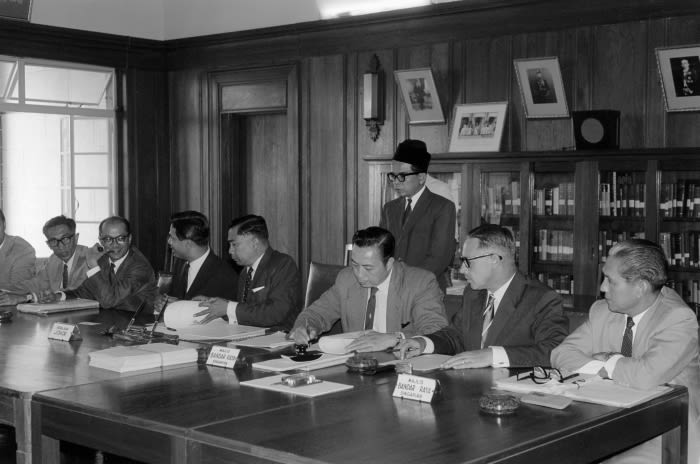
The 1962 Water Agreement grants Singapore the right to draw up to 250 million gallons of raw water per day from the Johor River. In return, Johor is entitled to buy back treated water equivalent to up to 2 percent of the imported volume at a price of 50 sen per 1,000 gallons.
The agreement is valid for 99 years and will expire in 2061. Its predecessor, the 1961 Water Agreement, granted Singapore unlimited rights to draw water from the Tebrau and Skudai Rivers. Under that agreement, Singapore was required to return 12 percent of the water as treated water.
The 1961 agreement expired on August 31, 2011. After its expiration, all related water facilities were transferred to the Johor state government at no cost.
What makes these agreements difficult to amend is not only their wording, but also their legal status. Both are guaranteed under the 1965 Separation Agreement, the document governing Singapore's separation from Malaysia. They are also incorporated into the Malaysian Constitution and registered with the United Nations.
The agreement did include a price review window in 1987, 25 years after it was signed. However, Malaysia never exercised that right. Since then, Singapore has maintained that Malaysia's right to review the water price has lapsed.
From 45 Sen to RM6.25: A Revision That Never Happened
The most serious attempt to revise the water price took place between 1998 and 2003. During that period, Malaysia and Singapore negotiated a broader package that also covered the Johor–Singapore Causeway, sand exports, and airspace issues.
As part of those negotiations, Malaysia gradually increased its proposed price for raw water. The proposal rose from 45 sen per 1,000 gallons in 2000 to RM6.25 per 1,000 gallons in 2002. That was more than 200 times the price set under the 1962 agreement. The negotiations ultimately ended without a deal.
The issue resurfaced in July 2024. Malaysia's Deputy Prime Minister, Fadillah Yusof, announced that the government would review all water agreements with Singapore.
However, in December 2024, another Malaysian official said there would be no review of the raw water price for the time being. The reason was that Johor still depends heavily on treated water purchased back from Singapore each day.
The volume supplied far exceeds the 2 percent allocation stipulated in the agreement. Singapore has continued to provide the additional supply as a gesture of goodwill while charging the same 1962 price.
Johor Faces Water Pressure Amid the Data Center Boom
While the water price has remained unchanged, pressure on Johor's own water supply has increased rapidly.
According to the Institute of Strategic and International Studies Malaysia, as of early 2025, Johor hosted 72 of the 101 data centers operating across Johor, Selangor, and Negeri Sembilan. Yet only 17 had received full approval for their water requirements.
BIMB Research projects that water demand from Johor's data centers will increase eighteenfold. Daily consumption is expected to rise from 20 million liters to 368 million liters by 2030.
The growing pressure prompted the Johor state government to tighten its policy in November 2025. It suspended approvals for Tier 1 and Tier 2 data centers, which can consume up to 50 million liters of water per day. The move marked one of the state's most significant water policy restrictions to date.
Toward 2061: One Deadline, Two Milestones
For Singapore, dependence on the Johor River, which supplies about 40 percent of the country's water needs, has been accompanied by a long-term diversification strategy known as the "Four National Taps." These consist of local catchment water, imported water, recycled water (NEWater), and desalinated water.
NEWater currently provides around 30 percent of Singapore's water supply. The government aims to increase that share to 50 percent by 2060, supported by five operating desalination plants.
Singapore's national water agency, PUB, says the country aims to achieve full water self-sufficiency by 2061. That is the same year the 1962 Water Agreement is set to expire.
Until then, both governments remain bound by the same figure agreed upon in 1962: 3 sen for every 1,000 gallons of raw water flowing from Johor to Singapore.


