


Ten years after the first ASEAN Media Forum was held in Manila, the gathering returned to the same city on July 29, 2026, to mark its 10th edition, a milestone organizers and speakers repeatedly described as a "full circle" moment. The opening ceremony at the Hilton Manila Newport World Resorts brought together senior editors, media executives, policymakers and academics from across Southeast Asia for a two-day dialogue running through July 30, with remarks from ASEAN Secretary-General Dr. Kao Kim Hourn, German Ambassador to the Philippines Dr. Andreas Michael Pfaffernoschke, and Philippine Undersecretary for Foreign Affairs Leo M. Herrera-Lim.
The anniversary carries added weight this year: it coincides with 10 years of the Germany-ASEAN development partnership, and organizers say 35 journalists from all 11 ASEAN member states are taking part, including, for the first time, journalists from Timor-Leste, which is set to become ASEAN's newest member.
Media as Partner, Not Just Observer
In his opening remarks, Kao Kim Hourn described the AMF as a flagship platform, running since 2017, for dialogue between ASEAN institutions and the media. He noted that the media landscape has changed radically over the past decade, with instant digital distribution, social media and artificial intelligence reshaping how news is produced and consumed, alongside growing risks from misinformation, disinformation and deepfakes.
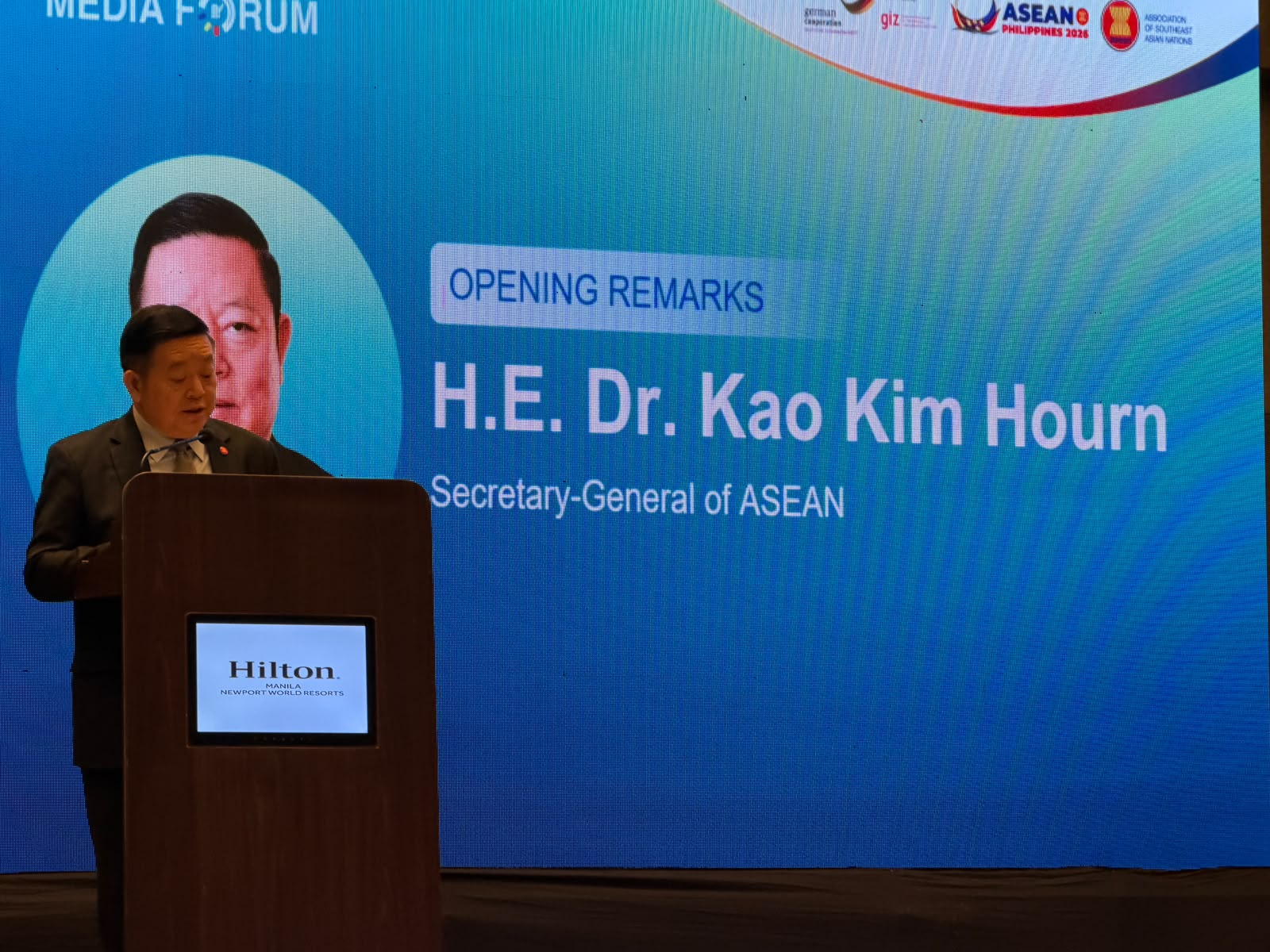
Kao Kim Hourn framed media not merely as a reporter of events but as an interpreter that connects ASEAN's negotiated, often technical outcomes to the everyday lives of citizens. He said public trust, once lost, is difficult to rebuild, and urged journalists to commit to rigorous verification, invest in in-depth reporting over headline-chasing, and use new technologies such as AI responsibly while maintaining editorial accountability. He also thanked Germany and its development agency GIZ for their long-standing support of the forum and of ASEAN public diplomacy.
Ambassador Pfaffernoschke, delivering welcome remarks on behalf of Germany, called the AMF's return to Manila a "full circle" moment. He described the forum's decade-long growth as roots that have deepened and branches that have widened, and credited the Philippines for hosting both the first and 10th editions and the ASEAN Secretariat for sustaining the platform since its founding. He linked the anniversary to 10 years of Germany-ASEAN cooperation on trade, climate change and energy transformation, and reaffirmed that shared commitments to international law and a rules-based international order underpin the partnership. Like Kao Kim Hourn, he pointed to AI-generated content and disinformation as pressing challenges, and called on journalists to keep producing accurate, locally grounded reporting that connects across a diverse region.
Manila's Diplomatic Week and Vision 2045
Undersecretary Herrera-Lim's remarks tied the forum to a busy diplomatic week in Manila, which had just hosted the 59th ASEAN Foreign Ministers' Meeting and commemorations marking the 50th anniversary of the Treaty of Amity and Cooperation. He noted that 2026 is the first year of implementing the ASEAN Community Vision 2045, the bloc's long-term blueprint for a resilient, innovative and people-centered region, and argued that media coverage is embedded in all three ASEAN pillars: political-security, economic, and socio-cultural.
Herrera-Lim called for a "whole-of-society" approach to regional communication, in which media collaborate with fact-checking initiatives and government communicators to counter misinformation and foreign information manipulation, while also highlighting successes in consensus-building rather than only diplomatic friction. He asked journalists to continue closely covering the Philippines' ASEAN chairmanship through the rest of 2026.
Beyond the opening ceremony, this year's programme includes a Morning Interface session between forum participants and Kao Kim Hourn, and a separate dialogue session with Philippine Foreign Affairs Secretary Ma. Theresa P. Lazaro, according to prior reporting on the event. Panel discussions over the two days are expected to take up themes previewed in the opening remarks, including climate change, energy transformation and the information integrity challenges posed by AI.
Taken together, the three opening speeches struck a common note: that ASEAN's media landscape has grown more complex and more consequential at once, and that the region's media and its institutions need each other to make ASEAN's often slow, negotiated work legible and trusted by the publics it is meant to serve. A decade on from that first Manila gathering, the forum's return to where it began was framed less as nostalgia than as a marker of how much more is now riding on the partnership between ASEAN and its press.


