


MANILA, Philippines. Younger audiences across Southeast Asia are increasingly getting their news from AI chatbots and short-form video platforms like TikTok rather than from search engines or print. That shift was one of the central concerns raised as the ASEAN Media Forum marked its 10th edition on July 29 and 30, bringing media leaders and practitioners from across the region back to Manila for two days of discussion on how journalism should evolve alongside artificial intelligence, changing audience habits, and a more competitive digital information space.
Since it began in 2017, the forum has served as a recurring checkpoint for ASEAN's media community: a chance to review the bloc's priorities and achievements, and to weigh them against wider regional and global shifts. ASEAN Secretary-General Dr. Kao Kim Hourn opened this year's edition by tying that mission directly to the current moment, describing a landscape shaped by geopolitical tension, economic uncertainty, and fast-moving technological change. He argued that in such conditions, journalism's job goes well beyond simply reporting events. It means verifying claims, providing context, and giving citizens what they need to make informed decisions.
Kim Hourn also pointed to the particular weight this carries for ASEAN specifically, where regional cooperation tends to unfold slowly and its benefits are not always immediately visible to the public. How that process gets covered, he suggested, shapes whether citizens see ASEAN as relevant at all. He was direct about what is now at stake for the industry as a whole: "Public trust, once lost, is difficult to rebuild, making credibility one of the media's most valuable, but also vulnerable, assets."
AI as tool, not author
The AI conversation ran through nearly every session, but it found its sharpest focus during a July 30 panel on media's role in shaping ASEAN's future. The panel brought together Jaemark Tordecillia, former head of digital media at GMA News in the Philippines; Akhyari Hananto, founder of Good News from Indonesia and Seasia; and Noel Hidalgo Tan, senior officer at the ASEAN Secretariat's Culture and Information Division.
Hananto described how his organization has folded AI into multiple stages of content production, from research to translation to formatting, and has seen readership grow substantially as a result. But he was equally clear about where he draws the line. Editorial decisions, he said, stay with people. Every piece of content passes through human review and verification before publication, precisely because AI systems are prone to fabricating details and citing sources that do not exist, most often in the form of broken or invented links. His team now cross-checks outputs across multiple AI models and treats human sign-off as non-negotiable. He summed up the distinction his outlets try to hold onto: "We are an AI-assisted media, not AI-generated."
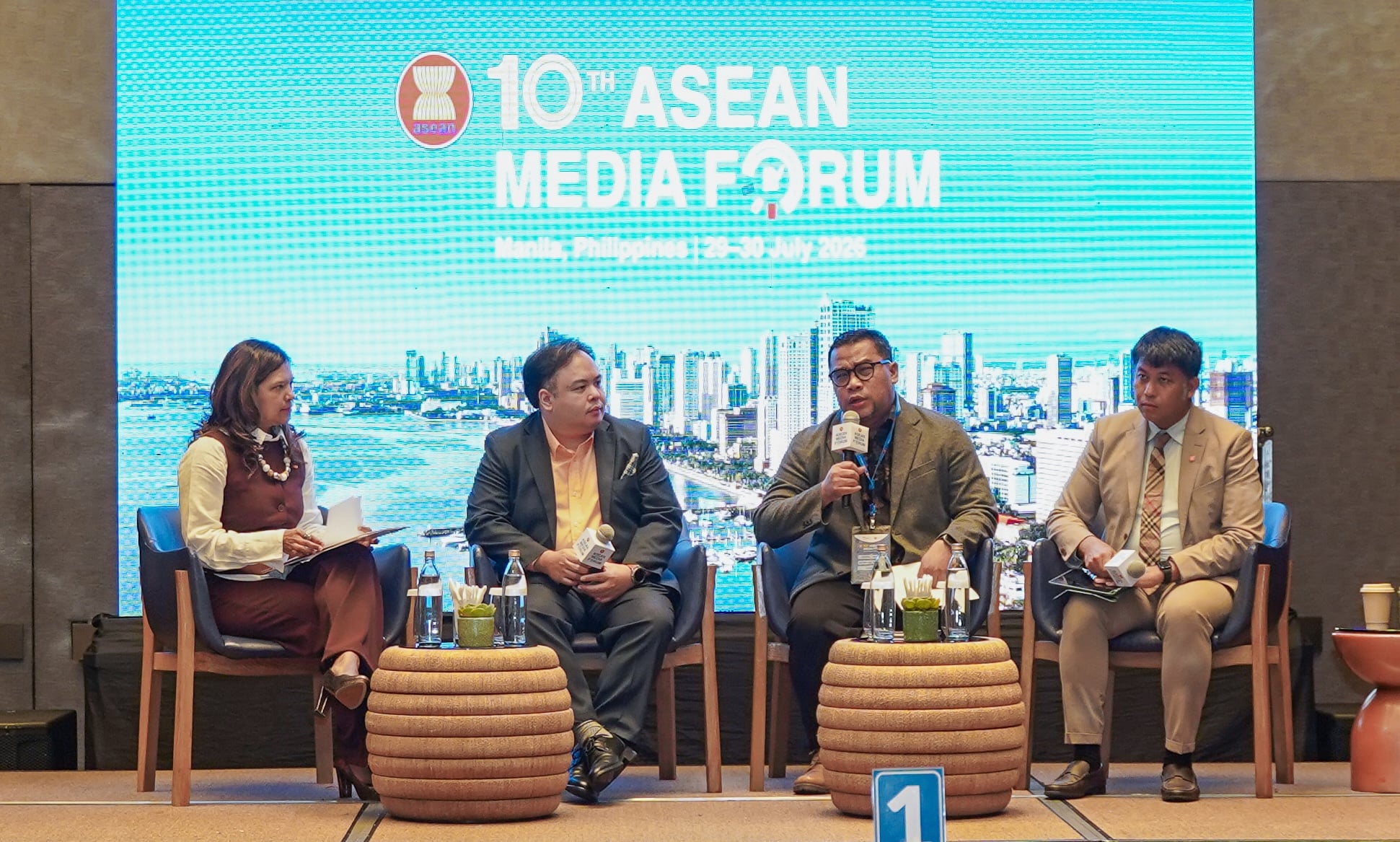
Tordecillia framed the shift in more structural terms, arguing that regional newsrooms have reached a point where keeping pace with AI tools is no longer optional. Much of the current work, he said, is about efficiency: faster workflows, more stories produced with the same resources. But he sees the more interesting opportunity elsewhere, in using these tools to tell stories that would previously have been out of reach, and to reach audiences that traditional formats never touched.
Tan brought a regional policy lens to the discussion, noting that generative AI did not invent disinformation. What has changed is the economics of producing false content at scale, which has become far cheaper and faster. He located the deeper problem not in the technology itself but in a broader erosion of public trust, one that extends to institutions as much as to media.
Adapting without losing the plot
Beyond AI, panelists returned repeatedly to the question of audience behavior. Tordecillia noted that younger demographics are now about as likely to get their news through AI chatbots as through print, a shift that leaves media outlets little choice but to adjust their strategies.
Hananto pointed to a related pattern: younger audiences increasingly skip search engines altogether in favor of visual, short-form platforms like TikTok. In response, his outlets have leaned into interactive and video-driven formats built specifically for that audience, a shift that helped push their combined channels to nearly 5 billion views over the past year.
He was candid about the tradeoff this involves. Social platforms optimize for engagement, not accuracy, and there is little media organizations can do to change that calculus directly. What they can control is how they adapt their own output to work within it, without surrendering editorial standards in the process.
Worth noting separately: the panel itself named TikTok specifically as the platform pulling younger audiences away from search. Instagram was not part of that discussion, though GNFI and Seasia's own carousel-driven strategy across both platforms is part of the broader "adapting to algorithms" story their outlets have been telling.
Tan tied these individual adjustments back to policy, referencing the ASEAN Work Plan for Information and Media 2026 to 2035, which sets out five strategic pillars: information access, integrity, content production, digital transformation, and cross-cutting collaboration. He also cautioned against treating digital transformation as a full replacement for older channels, noting that television and radio remain essential for emergency communication and for reaching communities with limited digital access.
Delegates additionally called for closer cross-border cooperation among ASEAN media organizations, pointing out that audiences across the region still consume mostly domestic news, with limited coverage of neighboring countries. Building a more integrated regional information space, several speakers argued, will require more shared reporting, joint projects, and direct collaboration between newsrooms.
Ten years in, the forum's throughline has not changed much: technology will keep reshaping how journalism gets made, but the industry's value still rests on the same foundation it always has, verified information, delivered by people willing to stand behind it.


