


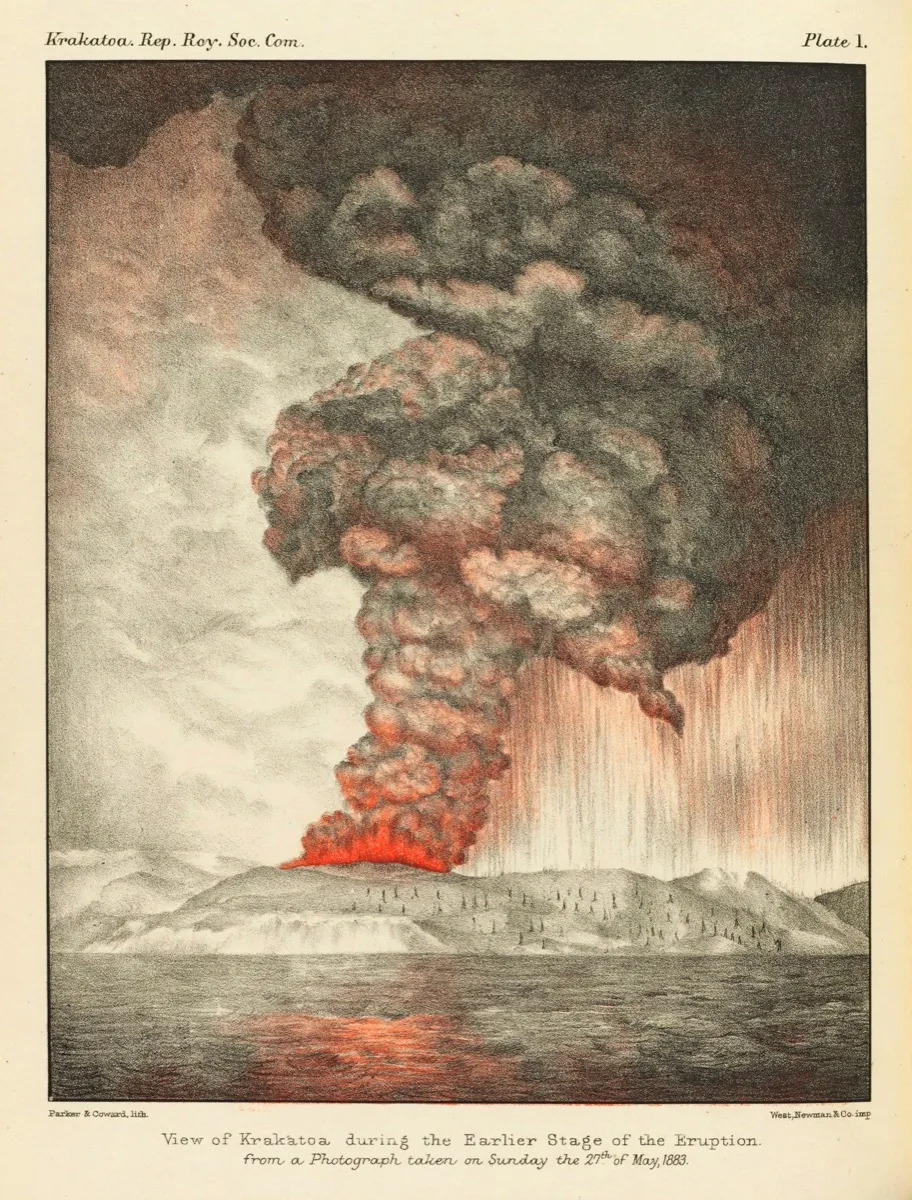
At 10:02 a.m. on August 27, 1883, Krakatoa erupted in the Sunda Strait with such force that it produced the loudest sound ever recorded in modern history. According to the U.S. National Oceanic and Atmospheric Administration (NOAA), the eruption was heard across more than 10% of Earth's surface.
The massive explosion was actually the climax of a series of eruptions that had begun on the afternoon of August 26. But the blast at 10:02 a.m. was by far the most powerful. It tore apart most of Krakatoa Island and sent shockwaves across distances that are almost impossible to imagine.
A Sound That Took Four Hours to Reach Africa
Residents of Rodrigues Island in the Indian Ocean, about 4,800 kilometers from Krakatoa, heard the eruption roughly four hours after the explosion, describing it as distant cannon fire.
The same sound was also heard in Perth, Australia, around 3,000 kilometers away, and in the Andaman and Nicobar Islands, about 2,000 kilometers from the volcano.
NOAA reports that the eruption was audible as far away as Australia and Mauritius, more than 4,500 kilometers from Krakatoa.
The Number That Is Often Misquoted
Many popular articles claim that the Krakatoa eruption reached 310 decibels. However, this figure does not appear in credible scientific sources and is physically implausible.
Under normal atmospheric conditions, sound waves have a theoretical limit of about 194 decibels before they become shock waves rather than sound in the conventional sense.
The actual recorded measurement came from a barometer in Batavia, about 160 kilometers from Krakatoa.
The instrument registered an atmospheric pressure spike of more than 2.5 inches of mercury. Scientists later converted this to an equivalent sound pressure level of approximately 172 decibels at that distance, far exceeding the human pain threshold of around 130 decibels.
The eruption's atmospheric pressure waves were so powerful that they circled the Earth three to four times in each direction over the following five days. They were recorded by barometers at more than 50 weather stations worldwide, with the waves reappearing at intervals of roughly every 34 hours.
Tens of Thousands of Lives Lost Within Hours
The eruption was classified as VEI 6 on the Volcanic Explosivity Index, making it one of the most powerful volcanic eruptions in modern history.
Official records from the Dutch colonial government reported 36,417 deaths. More than 34,000 of those fatalities were caused by the tsunamis that struck the coasts of Java and Sumatra. Some sources suggest the true death toll may have exceeded 120,000.
The highest tsunami reached 41 meters in parts of Banten. Meanwhile, pyroclastic flows raced across the Sunda Strait at speeds of more than 80 kilometers per hour. With temperatures ranging from 200°C to 700°C, they traveled up to 40 kilometers before reaching the coast of Sumatra.
Skies Darkened for Days
The eruption column is estimated to have reached an altitude of around 80 kilometers, penetrating deep into the stratosphere. Volcanic ash blanketed an area of roughly 300,000 square miles. It left the skies around the Sunda Strait in complete darkness for two and a half days.
Ash particles dispersed throughout the global atmosphere also produced striking halos around the Sun and Moon. These optical effects were observed worldwide for months after the eruption.
According to NOAA, the eruption lowered the global average temperature by about 0.5°C. Global temperatures did not return to normal until 1888, five years after the eruption.
The Krakatoa eruption also became one of the first natural disasters to be documented simultaneously by a global scientific observation network.
Meteorologists across Europe, Asia, and Australia had already installed barometers at their weather stations. Many of them recorded the same atmospheric pressure surge.
By tracing the timing of these measurements backward, scientists identified a single source: Krakatoa. Records collected from more than 50 cities later enabled researchers to reconstruct how a single atmospheric disturbance propagated around the Earth multiple times within just a few days.


