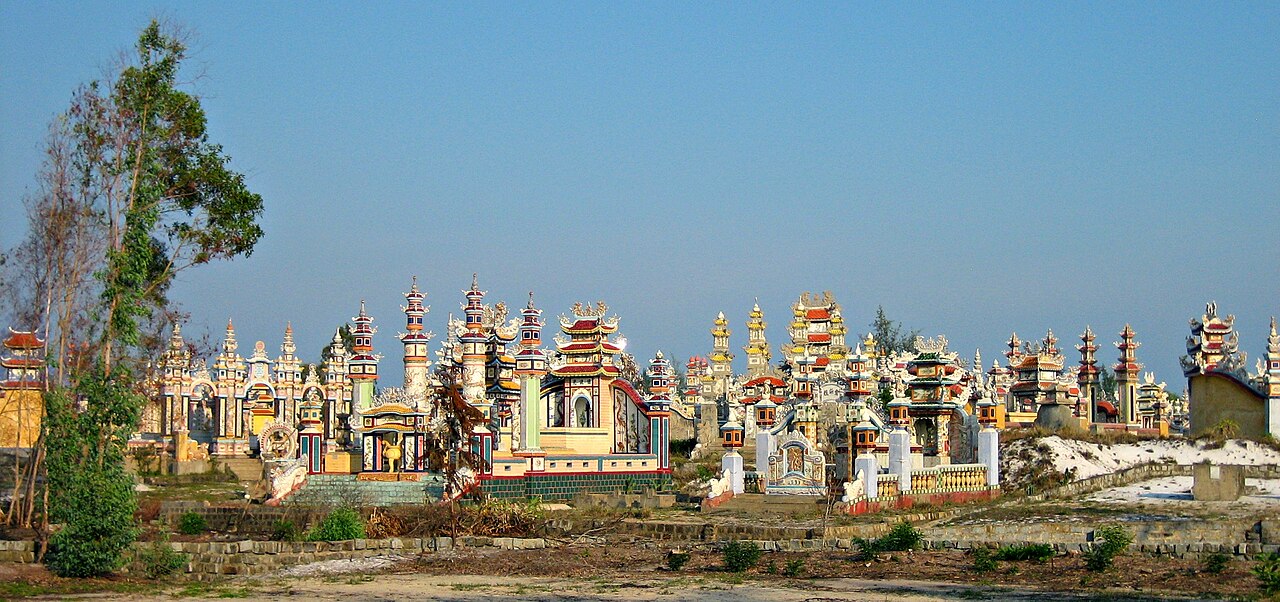
In central Viet Nam, there is a village where some family tombs are larger than the homes of the living.
About 20 kilometres east of Hue lies An Bang, a quiet coastal village in Phu Vang district, Thua Thien Hue province, often called the "City of Ghosts." Instead of rows of simple graves, visitors find elaborate mausoleums decorated with dragons, stone lions, colourful mosaics, and ornate gates.
Some resemble small palaces more than cemeteries. According to Lonely Planet's Viet Nam travel guide, the cemetery covers roughly 250 hectares, while travel researchers at Southeast Asia Backpacker and Adventure Journey report that it stretches for about 3 kilometres along the coast near Thuan An Beach, making it one of the largest burial grounds in the country.
The unusual landscape reflects more than architecture. It is shaped by Viet Nam's long tradition of ancestor veneration, decades of overseas migration, and the remittances sent home by families living abroad.
Migration, Remittances, and The Price of Honouring Ancestors
An Bang was once a modest fishing village, its economy built mainly around small boats and nearshore fishing.
After national reunification in 1975, many residents left Viet Nam and settled abroad, particularly in the United States and Australia. From around the early 1990s, as Viet Nam eased restrictions on money sent home from overseas, construction of larger, more elaborate tombs in An Bang began to pick up.
Many mausoleums are reported to cost between US$25,000 and US$50,000, with some accounts citing figures as high as US$70,000, far above the average household income in the area. Despite this, many of the houses occupied by living family members remain comparatively modest.
Ancestor Worship remains central to Vietnamese Culture
This kind of investment is closely tied to ancestor veneration, one of Viet Nam's most enduring cultural traditions.
According to a 2024 Pew Research Center survey covering East Asian societies, 96% of adults in Viet Nam said they had burned incense for their ancestors in the previous year, the highest share among the places surveyed, while 90% said they had offered flowers or lit candles in their honour.
The same survey found that 73% of Vietnamese adults said they had offered money or other goods believed to be needed in the afterlife, and 84% said their family maintains a gravesite.
These practices are common across religious groups. The survey found that 86% of Vietnamese Christians reported burning incense for ancestors in the past year, and 81% said they had offered flowers or lit candles, rates far higher than those recorded for Christians elsewhere in the region.
Home altars are also nearly universal in Vietnamese households, and are commonly found in businesses and offices as well, where incense and offerings are placed during important occasions.
Architecture shaped by Many Traditions
The mausoleums themselves combine multiple influences.
According to Nguyen Huu Thong, former director of the Institute for Vietnamese Culture and Art in Hue, many tombs incorporate elements inspired by Buddhism, Taoism, Catholicism, Vietnamese royal architecture, Chinese decorative traditions, and Western styles.
Some structures are said to draw on the design of the Khai Dinh Tomb, the mausoleum of the twelfth Nguyen emperor, while others replicate features associated with the Nguyen Dynasty's royal tombs more broadly. This mix of influences has made An Bang one of Vietnam's most distinctive funerary landscapes.
Today, An Bang draws visitors interested in Vietnamese culture and architecture, and is sometimes included in day trips between Hue and Hoi An or Da Nang.
For local families, however, the tombs remain sites of remembrance rather than tourist monuments. As overseas migration continues to connect Vietnamese communities abroad with their hometowns, An Bang illustrates how cultural traditions and remittances have reshaped one small village into one of the country's most distinctive landscapes.