


The gateway to the spirit world, according to beliefs held by Chinese communities in Singapore, Malaysia, Taiwan, Hong Kong, and several other parts of Asia, is set to open again on August 13, 2026.
This year’s Ghost Month will last until September 10, following the seventh month of the Chinese lunar calendar. Its peak will come on August 27, the 15th day of the lunar month.
The day is known as the Zhongyuan Festival in Taoist tradition and Yulanpen in Buddhist tradition. Throughout the month, ancestral spirits as well as wandering spirits without descendants are believed to roam freely among the living.
The Legend That Started Ghost Month
The story begins with Mulian, a close disciple of the Buddha whose name appears in the Ullambana Sutra, translated into Chinese from an Indian source around the third or fourth century CE.
Using his spiritual powers, Mulian searched for his deceased mother and found that she had been reborn as a hungry ghost in hell. He sent her a bowl of rice, but the food was snatched away or caught fire before she could eat it.
The Buddha then taught him the only way to save his mother: making offerings to Buddhist monks on the 15th day of the seventh lunar month. This became the foundation of the festival, while Mulian came to symbolize filial devotion in Chinese culture, a meaning he retains to this day.
In Taoist tradition, the same period is known as Zhongyuan Jie. It is associated with Di Guan, or the “Earth Official,” who judges human deeds and grants forgiveness to spirits.
The Rituals That Welcome the Spirits
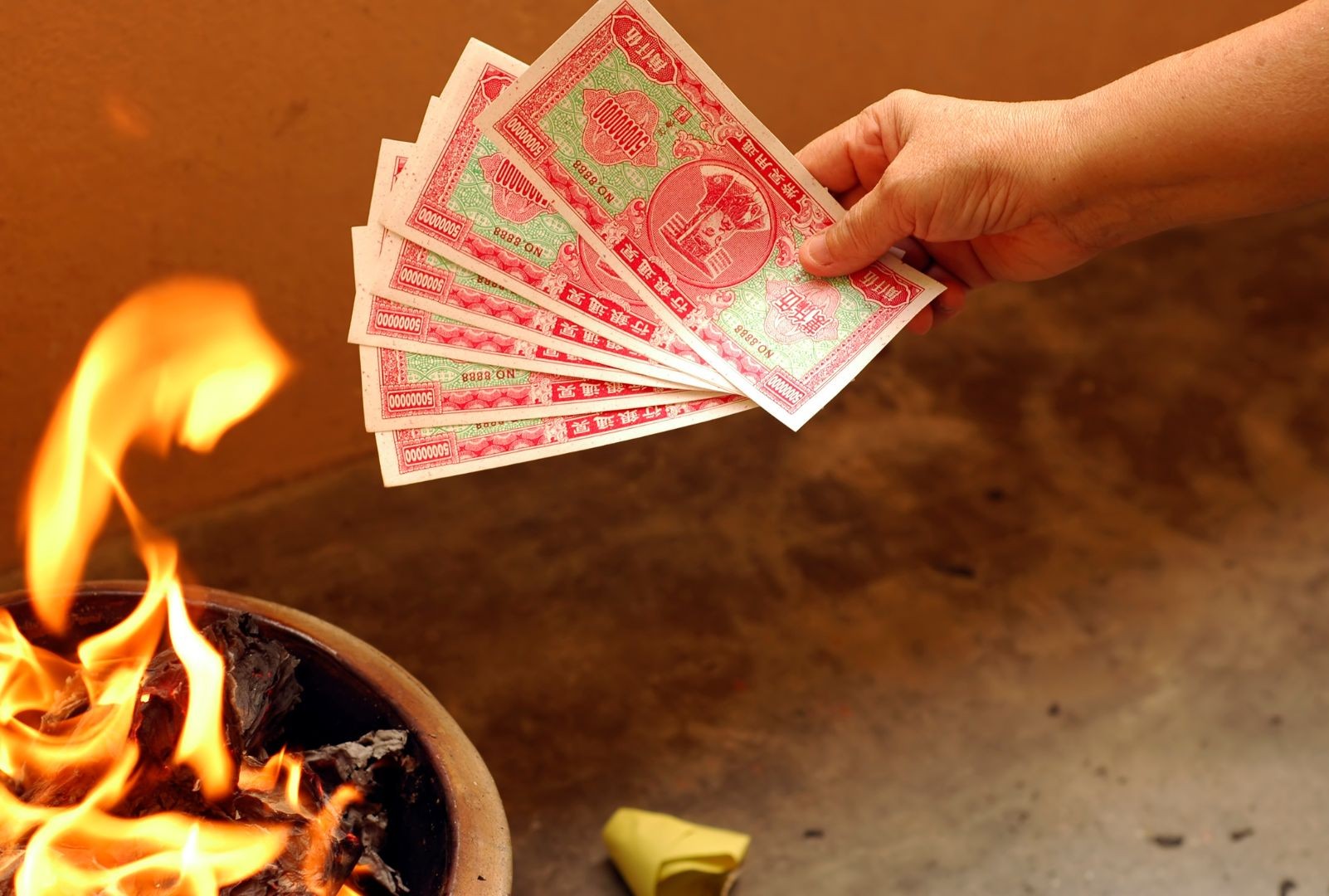
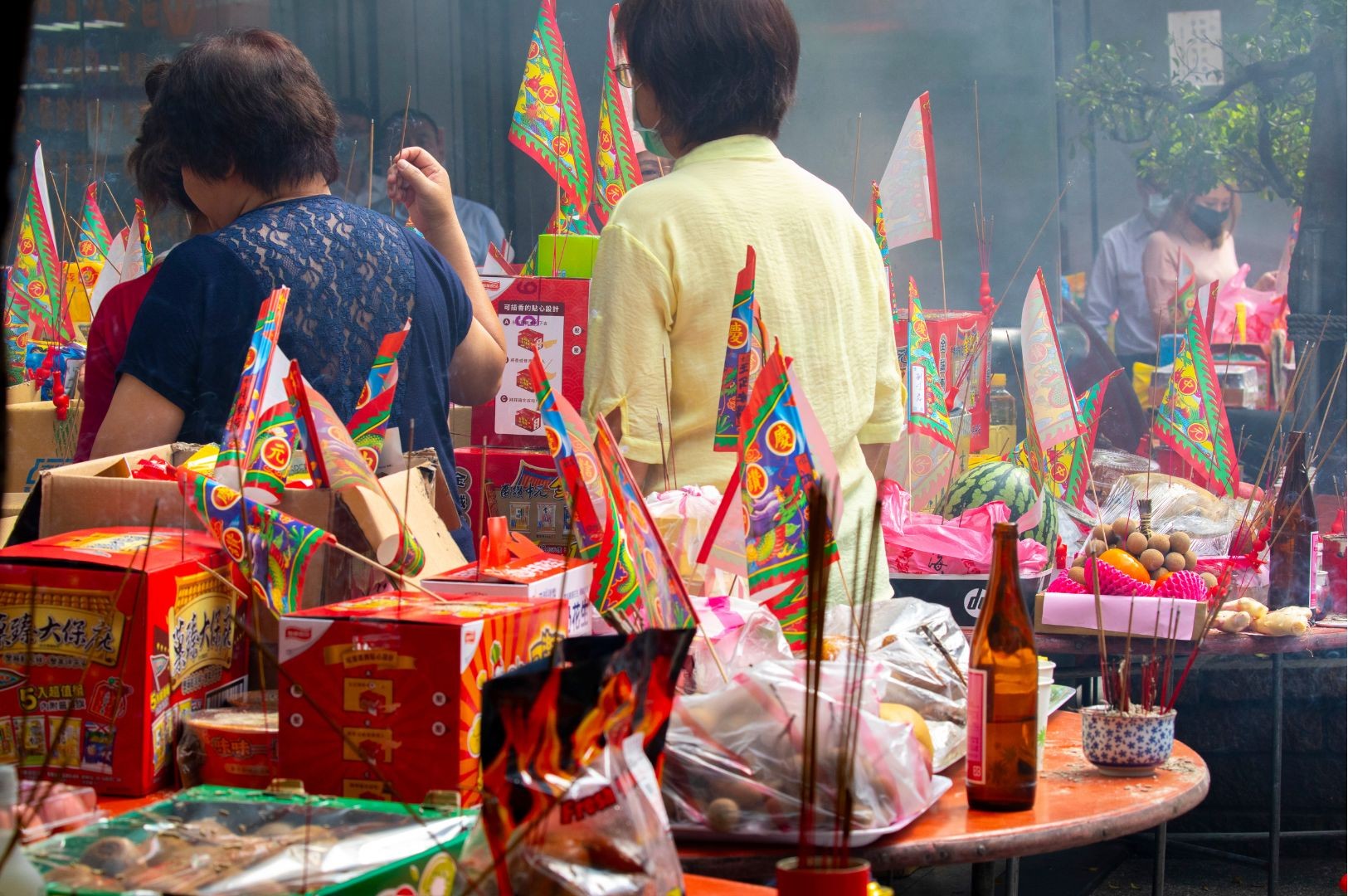
Daily rituals center on ancestral altars in family homes. Food, fruit, tea, candles, and incense are arranged as offerings, while “Hell Money,” paper offerings representing currency, is burned so that ancestral spirits have provisions in the afterlife.
Outside the home, food is also left along roadsides or in front of shops. These offerings are not for one's own ancestors, but for wandering spirits who no longer have descendants to care for them, in the hope that they will not disturb the living.
In Singapore and Malaysia, the festivities extend to public stages. Getai (歌台), featuring music and street opera performances, is held in open spaces throughout the month.
But the shows are not meant only for human audiences. The front row is deliberately left empty, reserved as an honored seating area for “spectators” from the other world who are believed to be there watching the performances.
The list of taboos is long, and most follow the same logic: do not attract the attention of wandering spirits. Swimming or whistling after dark, leaving wet clothes outside at night, standing beneath large trees after sunset, and even moving house, getting married, or taking long trips are all traditionally avoided during Ghost Month.
Fun Fact: What the Markets Say About Ghost Month
The most common claim about Ghost Month is that property developers in Singapore and Taiwan quietly delay new project launches during this period. The claim is partly true, but it also needs some clarification.
ERA Singapore, one of the country’s largest property agencies, confirmed that the practice does exist. Developers delay launches because they know potential buyers are more likely to hold back during Ghost Month.
But ERA itself, citing data from the Urban Redevelopment Authority covering the past three years, found that the number of new homes sold during Ghost Month remained consistent and did not decline compared with other months.
Its conclusion was that modern homebuyers are more influenced by location and price than by cultural beliefs, while Singapore’s religious diversity may further dilute the effect.
The stock market shows a similar pattern, but with more specific details. A 2023 study published in the IIMB Management Review examined five Asian stock markets between 2011 and 2020. It found that Ghost Month did affect volatility in countries with significant Chinese populations, but described the evidence as “inconclusive” across all markets.
A separate study published in the Proceedings of the 17th International Symposium on Management (INSYMA 2020) examined five years of closing-price data from the Taiwan Stock Exchange. It found that stock prices were more likely to end in 8, considered a lucky number, and avoid 4, whose pronunciation resembles the Mandarin word for “death.”
This pattern became more pronounced around culturally significant periods in the Chinese calendar, including Ghost Month. Interestingly, the tendency was much weaker among stocks heavily traded by institutional investors, who tend to rely more on analysis than cultural beliefs.
So the picture is fairly clear: avoiding Ghost Month in property and stock markets is a real practice for many people, but the evidence behind its economic effects is much weaker than the beliefs themselves. And those most influenced by the tradition tend to be individual investors rather than large institutions.


