


Try typing “countries that ban chewing gum” into a search engine. Dozens of articles will immediately give you a list of five or more countries: Singapore, Turkmenistan, Rwanda, Thailand, and sometimes India gets thrown in as well.
But trace each claim back to its source, and the list quickly falls apart. Only one name has a clearly traceable legal basis: Singapore. The rest are simply claims copied from one listicle to another.
Singapore Banned Selling It, Not Chewing It
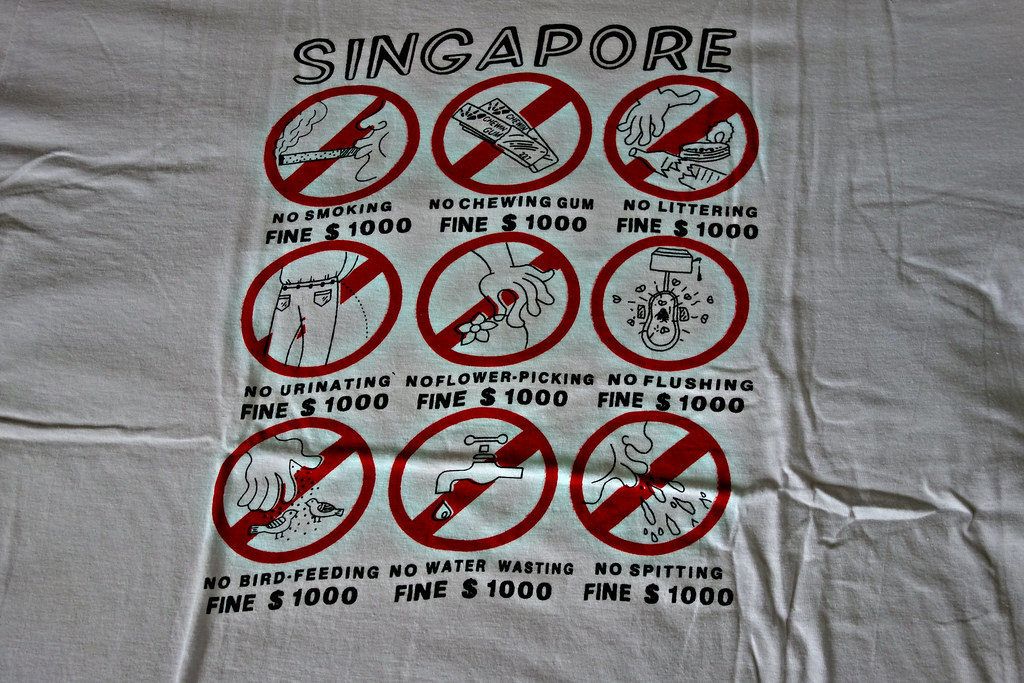
The story began earlier than most people think. Since the early 1980s, Singapore’s Ministry of National Development had already brought concerns about chewing gum to Prime Minister Lee Kuan Yew, although the response at the time was limited to a ban on television advertising.
The full ban only took effect on January 3, 1992, following a series of incidents in July and August 1991 that caused widespread frustration. Chewing gum residue stuck to MRT train doors prevented them from closing properly. As a result, affected trains had to be taken out of service, and their passengers were transferred to the next train.
The Housing and Development Board also recorded spending around S$150,000 a year simply removing chewing gum from pavements, keyholes, and public transport seats. From 1992 to 2004, there were no exceptions.
The Ban Was Strict, But Never Absolute
This is where the most common misconception emerges, and it has several layers. What was banned was not the act of chewing gum itself, but its sale, import, and production.
This means gum already in someone's possession could be chewed in public without violating the ban. But bringing chewing gum into Singapore is subject to stricter rules than is often assumed.
The official Singapore Customs website states that the import of chewing gum is “absolutely prohibited,” with no written exception for small quantities or personal consumption. Tourists carrying one or two small packs in their bags are rarely prosecuted in practice. But that reflects enforcement tolerance on the ground, not a right guaranteed by law.
Even since 2004, there has been a loophole. Therapeutic chewing gum, such as nicotine gum for smoking cessation or sugar-free gum for dental health, can be purchased through registered doctors or pharmacists.
This exception did not emerge by chance. It followed lobbying by chewing gum company Wrigley with U.S. negotiators, just as the United States and Singapore were negotiating their free trade agreement.
The penalties for those who still break the rules are also widely misunderstood. Contrary to the claim most often repeated on internet forums, the punishment is not caning.
Instead, violations can result in fines and imprisonment, with penalties more serious than commonly assumed. Selling chewing gum can result in a fine of up to S$2,000. Importing it carries a much heavier penalty: up to S$100,000 and/or two years in prison for a first offense, rising to up to S$200,000 and/or three years in prison for repeat offenses.
The Gum Ban That Never Went Away
This is not an outdated rule from another era. And it is not even contained in a single law.
The import ban is governed by the Regulation of Imports and Exports (Chewing Gum) Regulations, the production ban by the Control of Manufacture Act, and the sales ban by the Sale of Food (Prohibition of Chewing Gum) Regulations.
These are three separate regulations that work together, and all three remain listed as active on Singapore Statutes Online, the Singapore government's official legislation portal.
There have been no major changes since the therapeutic exemption was introduced in 2004, and so far, there is no indication that the Singapore government intends to repeal the restrictions.
So if anyone asks whether chewing gum is still banned in Singapore today, the answer is yes. The rules remain largely the same as they were in 1992, with the only major exception still being therapeutic use.
Most of the “Gum-Banning Countries” Never Banned It
Outside of Singapore, the countries that are commonly featured on these lists have much more varied stories. Their inclusion often stems from circumstances that are not as apparent as the lists suggest.
- Turkmenistan
Turkmenistan usually appears on these lists because the country's reputation is already strange enough. Under former president Saparmurat Niyazov, who ruled from 1991 until his death in 2006, the country really did ban opera, gold teeth, and lip-syncing on television.
All of these restrictions are well documented. But when it comes to chewing gum, this investigation found no official legal record supporting such a ban.
It appears to have been pulled into the list because one compilation of “strange Turkmenistan laws” included the claim, which was then copied without being independently checked.
- Rwanda
Rwanda has a more plausible reason to raise suspicion because the country is genuinely one of the world's most aggressive opponents of plastic waste.
In 2008, it introduced a total ban on plastic bags. Under Law No. 17/2019, the restrictions were expanded to include straws, bottles, and single-use food packaging. But read the law itself, and chewing gum is never mentioned as a prohibited item.
- Thailand
Thailand is a different story. The country does have an official regulation that specifically mentions chewing gum: Notification of the Ministry of Public Health (No. 228) B.E. 2544, issued in 2001 and listed on the official Thai FDA website.
But it does not ban the import of chewing gum or require a special import permit, as is often claimed online. Instead, it sets food safety and labeling requirements.
Chewing gum and confectionery are even classified as foods that do not require the same level of product registration as other food categories. They simply need to carry Thai-language labels before entering the country.
So the claim that “Thailand requires a special permit to import chewing gum” is not entirely fabricated, but the actual regulation has been exaggerated into something resembling a ban.
- India
India's case is even simpler. There is no national law specifically concerning chewing gum. What does exist are local regulations in cities such as Mumbai and Bengaluru that prohibit spitting in public places. These are general public hygiene rules and do not specifically target chewing gum.
So among all the names that routinely appear on lists of “countries that ban chewing gum,” only Singapore actually has laws that prohibit it, complete with an effective date and documented enforcement.


