The archerfish is a fish capable of shooting water jets to knock down its prey. It belongs to the family Toxotidae and inhabits the mangrove waters of Southeast Asia and South Asia. This fish species has developed a truly specialized way of hunting
The archerfish does not simply wait for prey to fall into the water. Instead, the fish fires precise water jets to dislodge insects perched on overhead branches.
The archerfish remains accurate even when hitting targets high above the water.
How the Archerfish Controls Its Water Jets
The secret behind the archerfish's shot power lies in its mouth anatomy, which functions much like an active nozzle. When preparing to shoot, the fish presses its tongue against the roof of its mouth to form a narrow channel for water.
Water is then pushed out by utilizing a precisely timed mouth-opening maneuver. The mouth opening widens slowly and begins to close even before the entire water stream has fully exited.
As the fish shoots, the water behind travels faster and merges with the water ahead in mid-air.
The accumulation of water mass creates a dense focal point right before impact. Consequently, the water blow delivers immense force to dislodge insects with strong grips.
The archerfish is remarkably smart with its energy use. Increasing the speed of its water jet takes a lot of effort.
Instead of shooting faster, the fish simply fires more water when targeting larger prey. This way, the archerfish keeps its shots powerful enough without draining its strength.
The Ability to Calculate Water Light Refraction
Hunting from underwater toward the air requires the archerfish to overcome optical illusions. Light bends when it passes from air into water. As a result, the insect position appears displaced from its actual location.
The eyes and nervous system of the archerfish automatically calculate the refraction angle. The brain of the fish can also easily correct the visual displacement.
An archerfish often shoots from a lateral angle relative to the target's position. Shooting from an oblique angle causes the airborne water stream to curve due to gravitational forces.
The archerfish takes the shooting trajectory curvature into account when releasing its shot. Corrections for gravity and light refraction keep the water jets consistently on target.
Strategic Hunting in the Mangroves
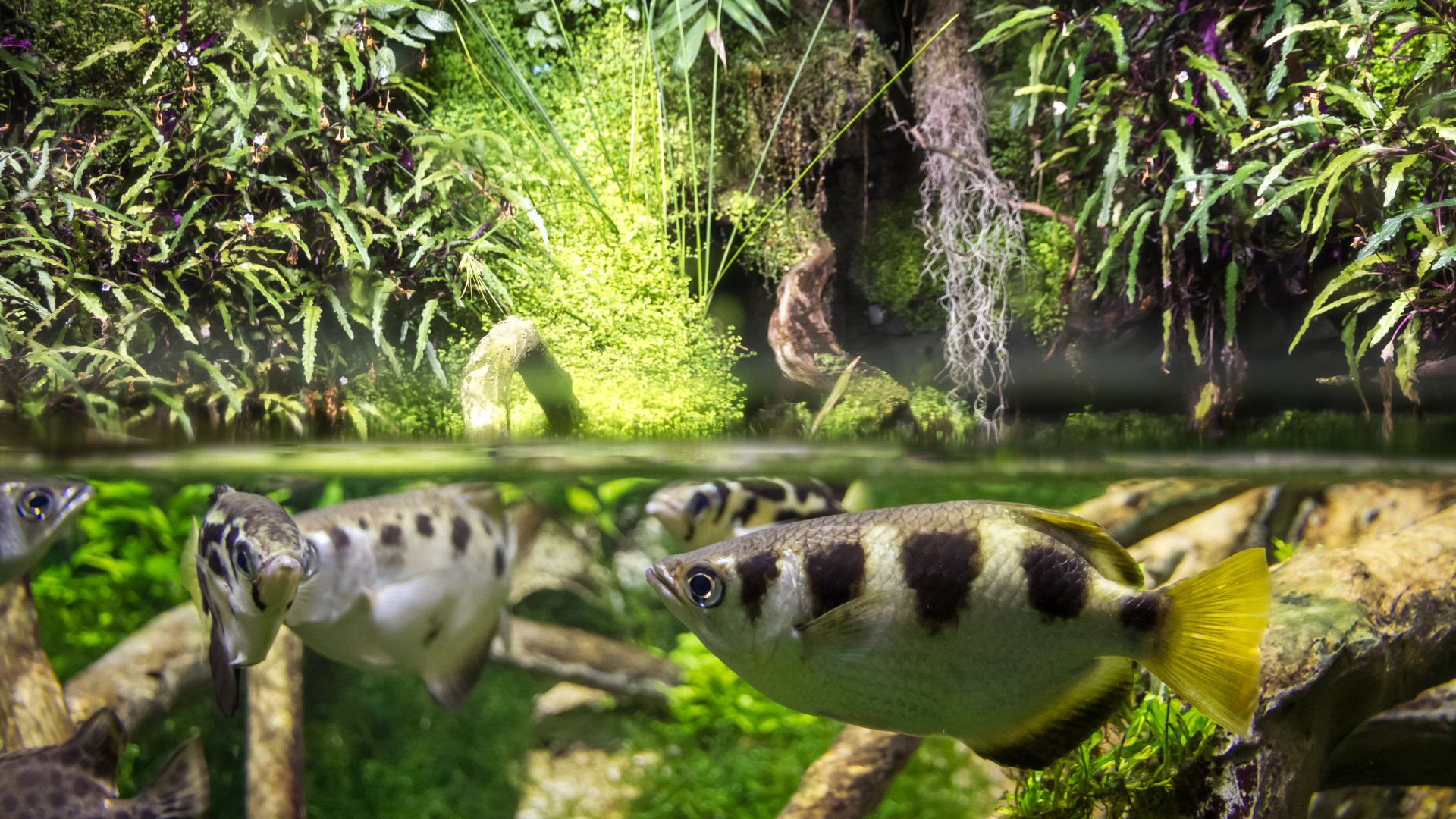
The archerfish naturally lives in waters surrounded by mangrove trees. In the coastal estuaries, wind gusts and moving currents frequently ripple the water surface.
The archerfish maintains a stable body position below the surface while aiming at prey. Surface waves do not obstruct its vision when locking onto insects behind leaves.
The ability to shoot water jets gives the archerfish a distinct advantage in its ecosystem. While other fish can only feed on targets inside the water, the archerfish can hunt insects perched high on overhead leaves.
To make its hunting even more effective, the archerfish relies on quick reaction times. The moment an insect is knocked off a branch, the fish immediately calculates where it will land and swims toward that exact spot.
Beyond target shooting above the surface, the water jet technique has a secondary function. The archerfish can also fire water jets underwater to flush out prey hiding in the mud.
Reference:
Schuster, S. (2018). Hunting in archerfish: An ecological perspective on a remarkable combination of skills. Journal of Experimental Biology, 221(12), jeb159723. https://doi.org/10.1242/jeb.159723