


Across the Philippines, identity is shaped by movement: waves crossing turquoise channels, communities rebuilding after storms and traditions travelling between islands. From Palawan’s limestone lagoons to Mindanao’s woven heritage, the archipelago draws strength from its enduring relationship with nature.
A Nation Drawn by Water and Fire
The Philippines comprises 7,641 islands and possesses an exclusive economic zone of approximately 2.2 million square kilometres. Beneath this maritime expanse lies another defining force: the country sits along the Pacific Ring of Fire and has 24 active volcanoes. Together, sea and geology have created a landscape of fertile mountains, coral-rich waters and dramatically sculpted coastlines.
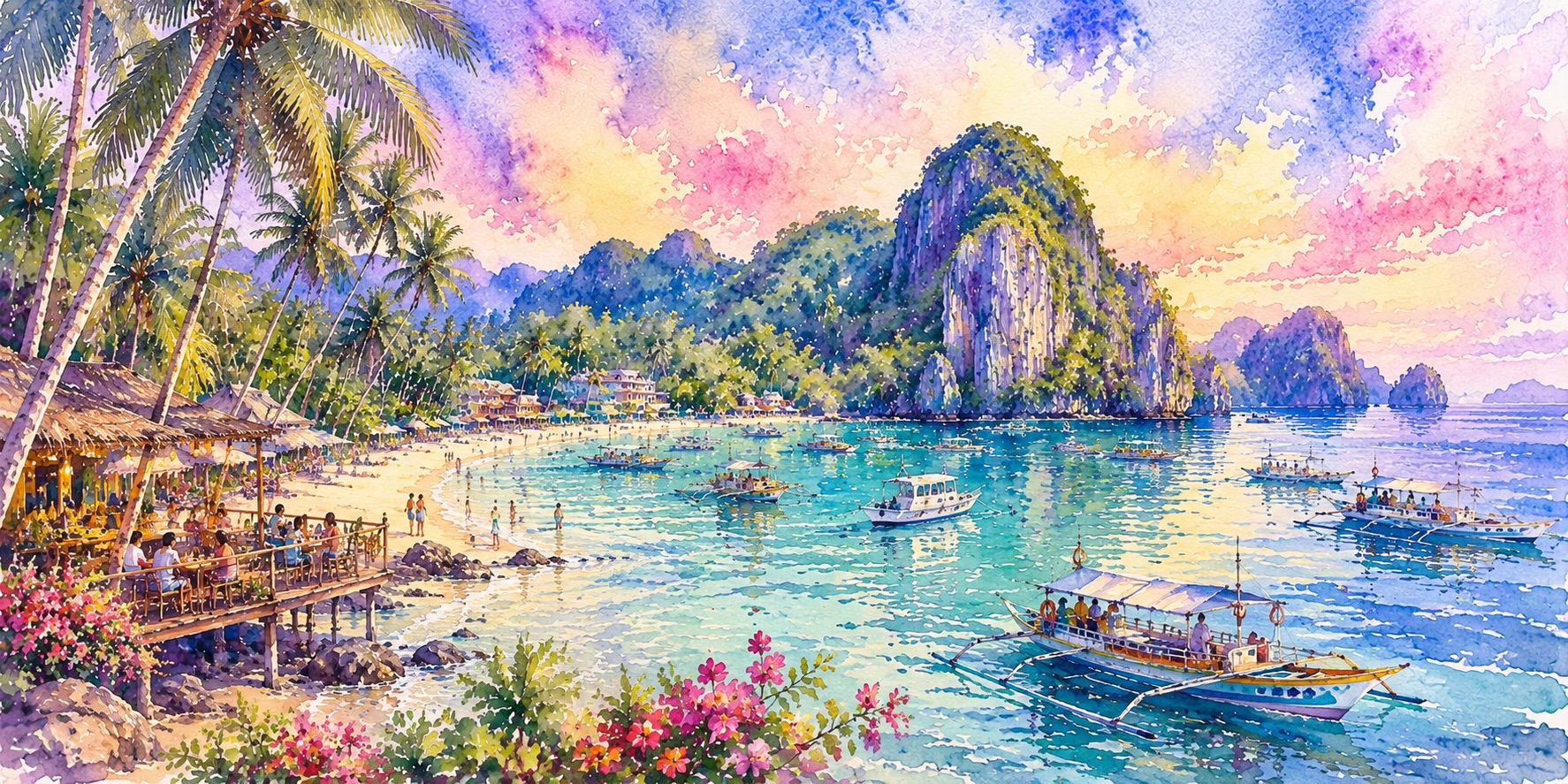
In Palawan, the limestone cliffs of El Nido and Coron rise almost vertically from clear lagoons. Traditional bangka outrigger boats navigate between white-sand beaches, fishing settlements and reefs, while Coron’s submerged wartime vessels have become internationally known diving sites. These journeys reveal that water is not the country’s edge; it is the passage connecting its communities.
Tourism Secretary Christina Garcia Frasco described the Philippines as “a country of 7,641 islands, each a doorway to beauty, opportunity, and connection.” The description captures an archipelago whose fragmented geography has produced remarkable cultural variety while sustaining a shared maritime outlook.
Lives Moving with the Tides
Across the southern Philippines, Sama-Bajau communities preserve generations of knowledge in fishing, navigation and boat-building. Elsewhere, coastal families organize their working days around tides, monsoon winds and the arrival of fishing boats at communal landing places.
That maritime inheritance continues in new forms on Siargao. The coconut-fringed island has grown from a quiet fishing community into an international surfing destination centred on breaks such as Cloud 9. Surf schools, locally owned cafés and creative businesses now coexist with fishing and farming, linking island traditions with global tourism and digital work.
The sea is also an economic foundation. In 2025, ocean-based activities generated approximately ₱1.08 trillion, equivalent to 3.8 percent of national GDP. Yet this dependence makes the protection of reefs, mangroves and fishing grounds essential to both livelihoods and cultural continuity.
Creativity Shaped by Change
An average of 20 tropical cyclones enters or forms within the Philippine Area of Responsibility each year, with eight or nine crossing the country. Communities have consequently developed traditions of cooperation, preparedness and rebuilding that complement the celebratory energy of local fiestas.
Filipino creativity reflects the same adaptability. Manila’s ornamented jeepneys transform public transport into moving folk art, even as the system modernizes. In South Cotabato, T’boli women preserve T’nalak weaving, translating patterns associated with ancestral memory and dreams into abaca cloth. These practices demonstrate how heritage can evolve without surrendering its roots.
Protecting the Living Archipelago
In the Sulu Sea, the 97,030-hectare Tubbataha Reefs Natural Park protects around 360 coral species and almost 700 fish species. Its success illustrates what sustained conservation can achieve when science, government and local commitment work together.
National Scientist Angel Alcala expressed the stakes plainly: “If there are no more coral reefs, there will be no more fish.” His warning connects environmental protection with food security, livelihoods and the survival of coastal culture.
The soul of the Philippines lives in this constant negotiation between fire and water, vulnerability and renewal. Its strength lies not only in the beauty of its islands, but in the people who continue to navigate, protect and reimagine them.


