China spans a massive geographical area that naturally covers five distinct time zones. Despite this vast geographical width, the entire nation officially operates under a single time zone known as Beijing Time (UTC+8). This centralized system means that clocks read the exact same hour across all provinces regardless of local daylight.
Before 1949, China recognized five separate geographical time zones established during the Republican era. These historical zones ranged from Kunlun time in the far west to Changpai time in the far northeast.
While designed to reflect natural solar hours, these zones were mainly observed in coastal areas and along major railway lines, while many rural regions still relied on local solar time. The decision to abandon these regional zones in favor of a single national standard changed how time was managed across the country.
The major shift occurred in 1949 when the Chinese Communist Party took power under Chairman Mao Zedong. The central government abolished the multi-zone setup and mandated Beijing Time set at UTC+8 as the single standard.
Read also: How Xinjiang Became China’s Largest Autonomous Region
China's Time Zone History
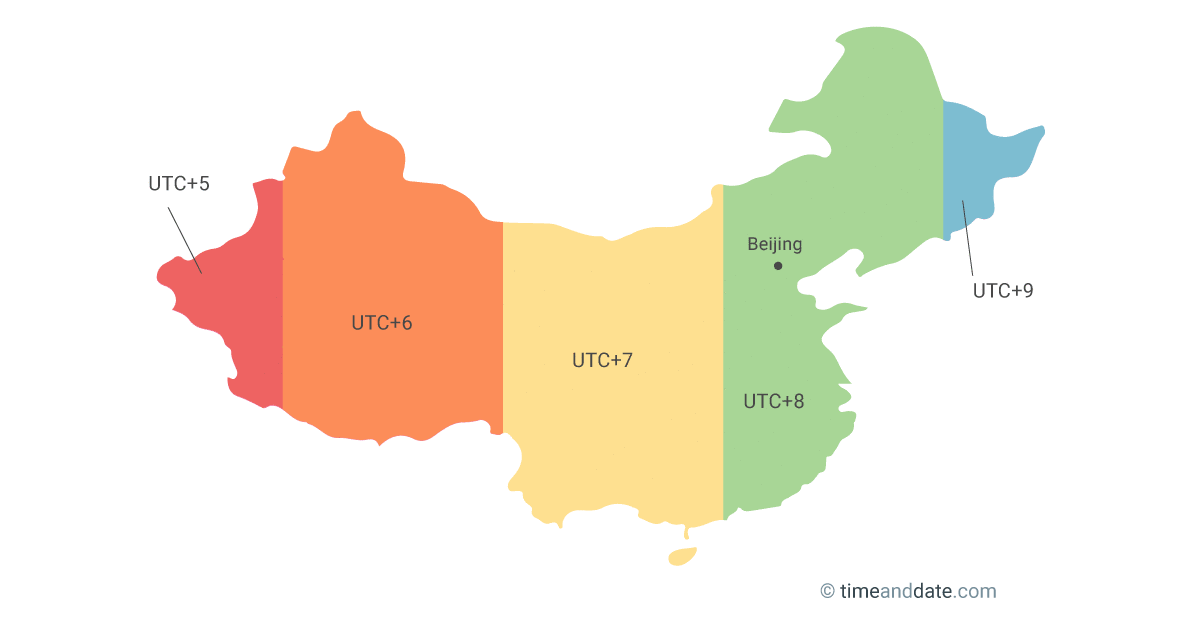
The original five-zone plan was proposed in 1918 by the Central Observatory in Beijing under the Beiyang government. The five standard zones included Kunlun (UTC+5:30), Sinkiang-Tibet (UTC+6), Kansu-Szechwan (UTC+7), Chungyuan (UTC+8), and Changpai (UTC+8:30). Each zone was designed to align local clock time with the natural movement of the sun in that region.
In practice, implementation was inconsistent across the country. During the war against Japan, the Nationalist government temporarily adopted Kansu-Szechwan time centered in Chongqing as the primary wartime administrative standard. After World War II ended in 1945, the five distinct time zones were officially restored nationwide on paper, though regional timekeeping remained fragmented due to ongoing civil conflict.
Following the Chinese Civil War in 1949, Chairman Mao Zedong decreed the creation of a single national time zone. Decades of regional conflicts and political division created an urgent need to unify the country under one central authority.
Adopting Beijing Time served as a symbolic marker of national cohesion and a break from the previous Republican administration. Establishing a single clock centered on the new capital of Beijing reinforced central state authority across all regions, turning standardized timekeeping into an instrument of political integration.
Simplifying Governance and Collective Life
Beyond political symbolism, a single time zone provided major practical advantages for managing a massive country. It simplified government administration, national railway timetables, and communication systems across distant provinces. Transport networks and state offices could operate on a synchronized schedule without timezone confusion.
The single standard also enabled the government to organize national work schedules, collective labor units, and synchronized radio broadcasts. Official radio announcements from Beijing reached the entire population at the exact same hour every day. Although this uniform system created unusual daylight schedules in western regions, it successfully streamlined national administration.
Read also: Unveiling the World's Highest Gondola: The Dagu Glacier Gondola in China
Moreover, because China spans thousands of miles, a single clock creates dramatic differences in daily daylight. In western cities like Kashgar and Ürümqi, the sun can rise as late as 10:00 AM in the winter and set near midnight in the summer. To adapt to this daylight disparity, working hours and school schedules in western areas naturally start later in the morning.
To handle daily routines more naturally, an unofficial local time known as Xinjiang Time (UTC+6) operates two hours behind Beijing Time. Many local residents use this two-hour offset for personal schedules while relying on Beijing Time for official travel, banking, and government business. China also briefly experimented with nationwide daylight saving time between 1986 and 1991, but dropped it due to minimal energy savings and widespread scheduling confusion.