


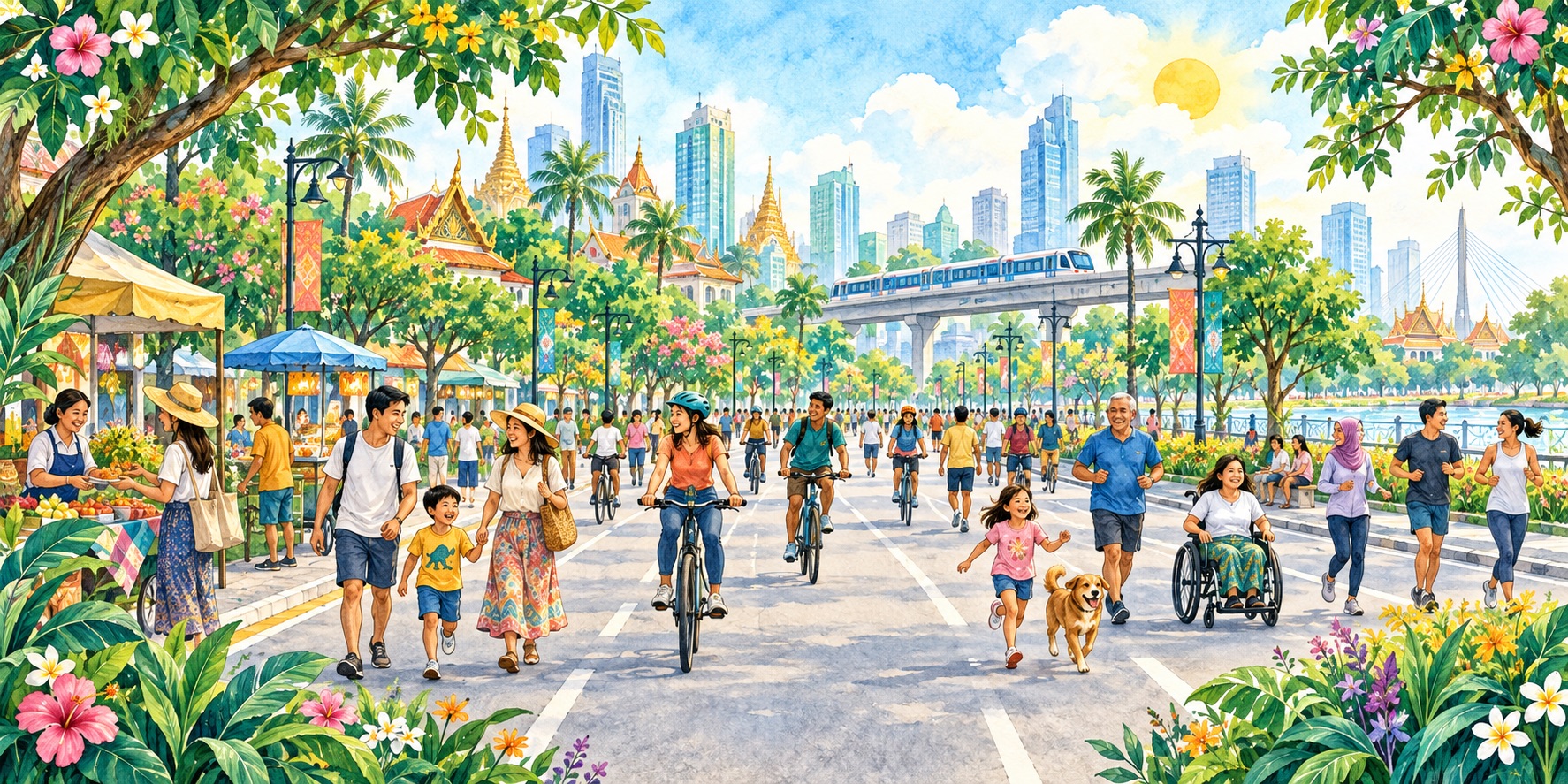
At sunrise on a Sunday, Jakarta’s Sudirman–Thamrin corridor sounds different. Engines give way to bicycle bells, running shoes and conversations as families, exercise groups and street performers occupy one of the capital’s busiest avenues.
Observed on September 22, World Car Free Day asks Southeast Asian cities to imagine that change beyond a few protected hours. In a region shaped by congestion, motorcycle dependence and uneven public transport, the occasion has become a practical demonstration of how streets can support health, cleaner air and community life.
When a Sunday Ritual Becomes a Regional Model
Jakarta has held traffic-free periods since 2002, turning its weekly Car Free Day into one of Indonesia’s most recognisable urban rituals. Its popularity also helped inspire a regional approach. At the 2018 launch of ASEAN Car Free Day, more than 65,000 people performed the Poco-Poco dance along a 15-kilometre traffic-free route, while Brunei Darussalam and Malaysia staged simultaneous activities.
That launch connected mobility with the prevention of non-communicable diseases and encouraged ASEAN cities to establish regular traffic-free spaces. The result is larger than an environmental campaign: a road normally reserved for vehicles becomes a temporary park, sports ground, marketplace and cultural stage. It allows residents to experience, rather than merely debate, a more people-friendly city.
Road Space Reveals Who a City Serves
The strongest argument for car-free streets is also about fairness. A 2026 World Resources Institute profile reported that only 6 percent of people in Manila own private vehicles; most residents walk, cycle or depend on public transport. Yet transport planning and budgets have historically prioritised the minority travelling by car.
“Transportation policy used to talk about cars as if they were the default user,” said Manila transport advocate Robert Siy. The statement captures a regional imbalance visible in dangerous crossings, disconnected pavements and long waits for buses or jeepneys.
Change is possible when commuters help shape it. The Philippines’ Move As One Coalition brings together 142 civil-society organisations and more than 77,000 individuals. Its advocacy has helped support over 1,200 kilometres of bicycle lanes nationwide and people-friendly projects including a Pasig River pedestrian boulevard and a car-free zone in historic Intramuros. Coalition adviser Ken Abante described the foundation simply: “Data and research are crucial to our advocacy work.”
Cities Become Laboratories for Better Movement
Singapore is using World Car Free Day 2026 as a season of participation rather than a single closure. From September to November, its Land Transport Authority is running The Invisible City, a mobile experience that encourages participants to reach neighbourhood destinations by walking, cycling and public transport. A September challenge rewards users who record at least 10,000 steps for four consecutive days.
On October 3, part of Joo Chiat Road will close for six hours, creating space for cycling, fitness, heritage activities, local food and live performances. This neighbourhood-scale approach shows that car-free planning can strengthen small businesses and cultural identity while reducing traffic.
Jakarta presents a different challenge. Around 91 percent of the province is within a five-to-ten-minute walk of public transport, according to ITDP, yet public transport accounts for only about 22 percent of trips, well below the city’s 60-percent target for 2029. Coverage alone is therefore insufficient. Safe pavements, shade, protected bicycle routes, affordable fares and dependable first-and-last-mile connections determine whether residents can realistically leave private vehicles behind.
From Annual Celebration to Daily Choice
World Car Free Day should not be understood as a campaign against every driver. Many people still depend on cars because alternative transport remains inaccessible, unsafe or unreliable. The more useful goal is to make walking, cycling and public transport the easiest choices for more journeys.
Cities can begin by measuring pedestrian use, air quality, local business activity and public-transport ridership during street closures, then using the findings to guide permanent improvements. Programmes must also include people with disabilities, older residents, informal workers and communities beyond city centres.
A few quiet hours cannot solve Southeast Asia’s mobility pressures. They can, however, reveal what is possible: streets where children can move safely, neighbours can meet and progress is measured not by the number of cars accommodated, but by how freely people can reach the places that shape their lives.


