Garuda is Indonesia’s national emblem. Almost everywhere you go, from government buildings and passports to the walls of every classroom, you will always find this majestic symbol on display.
Many people wonder whether Garuda exists in the real world as a living creature. Strictly speaking, Garuda lives in ancient mythology rather than in the natural wild.
Indonesian culture links this legendary bird to a real raptor called the Javan Hawk-eagle. The physical appearance of this endangered eagle directly inspired the modern coat of arms.
Indonesia chose Garuda as its national symbol to unify a vast archipelago of diverse cultures. The emblem reflects ancient historical roots while expressing key republican principles.
Garuda Is a Mythological Figure
According to Museum Sonobudoyo Yogyakarta, Garuda is a mythological figure that inspired the national symbol of Indonesia.
Ancient Hindu and Buddhist traditions created the lore of Garuda as a superpowered flying deity. Hindu literature depicts Garuda as the divine vehicle of Lord Vishnu and the formidable enemy of serpents.
Classical art traditionally portrayed Garuda as an anthropomorphic creature with a human torso and avian wings. Modern zoologists recognize that no giant hybrid bird flies through real skies.
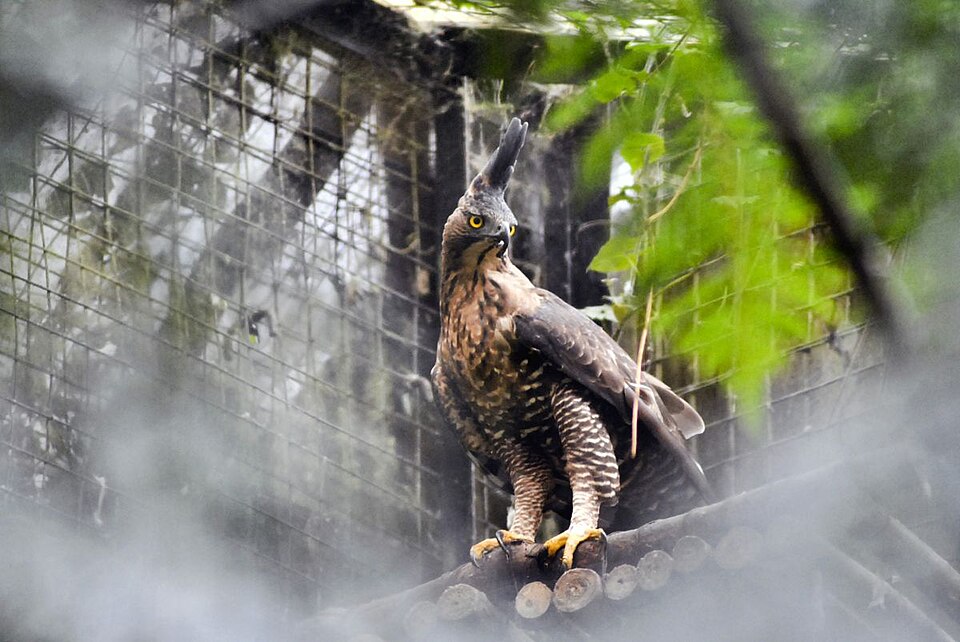
Nevertheless, Indonesians associate the legendary bird with the Javan Hawk-eagle (Nisaetus bartelsi), a raptor endemic to the rainforests of Java. This rare eagle possesses a prominent vertical crest and chestnut plumage that mirror the emblem's design.
The Presidential Decree (Keppres No. 4/1993) declaring the Javan Hawk-eagle (Elang Jawa) as Indonesia's National Rare Animal (Satwa Langka Nasional). This decree was signed by 2nd President of Indonesia, Soeharto. This legal status grants strong environmental protections to the endangered species across Java.
Why Is Garuda the National Symbol of Indonesia?
Garuda has served as a symbol of power, nobility, and protection in the Indonesian archipelago for centuries. Ancient Javanese and Balinese kingdoms embedded Garuda motifs into temple stone reliefs, royal seals, and classical dances.
King Airlangga of the eleventh-century Kahuripan Kingdom famously used the Garudamukha Lancana seal as his royal emblem. Modern Indonesian founders drew inspiration from this rich historical legacy when building a new republic.
Beyond royal history, Garuda symbolizes core virtues such as courage, loyalty, discipline, and knowledge. Founding leaders viewed these moral qualities as essential values for a developing independent nation.
The government established the Committee of State Seal in January 1950 to create an official emblem. Sultan Hamid II of Pontianak designed the winning coat of arms, combining cultural heritage with state philosophy.
Sultan Hamid II originally drew Garuda in a human-like form, but political leaders requested a naturalistic eagle design. Palace artist Dullah refined the final image by adding a head crest under President Sukarno's supervision.
The cabinet officially adopted Garuda Pancasila as the national emblem on February 11, 1950. President Sukarno presented the finalized national coat of arms to the public four days later in Jakarta.
The feathers on Garuda Pancasila numerically celebrate August 17, 1945, the day Indonesia proclaimed independence. Each wing contains 17 feathers, the tail has 8, the lower tail base has 19, and the neck holds 45 feathers.
Garuda carries a central shield containing five distinct symbols that represent the principles of Pancasila. The bird grips a white scroll bearing the Old Javanese motto "Bhinneka Tunggal Ika," which translates as "Unity in Diversity".