Banteay Srei stands roughly twenty-five kilometers northeast of the primary Angkor archaeological park in Cambodia. Local people refer to this historic monument as the Citadel of Women because of its remarkably delicate stone carvings.
The original founders dedicated this tenth-century Hindu sanctuary primarily to the god Shiva. Ancient stone inscriptions name the original complex Tribhuvanamahesvara, which translates to the great lord of the threefold world.
Unlike the colossal stone pyramids throughout Angkor, this temple complex features a charming, miniature layout. Travelers and historians widely celebrate the site as the supreme jewel of Khmer art.
The warm pink sandstone structures display deep, three-dimensional reliefs that remain remarkably sharp after more than a millennium. The entire sanctuary offers a striking testament to the spiritual devotion and artistic genius of the medieval Khmer Empire.
The History of the Temple
Court dignitary Yajnavaraha and his brother Vishnukumara founded the temple during the reign of King Rajendravarman II. Yajnavaraha served as a trusted royal counsellor and later educated the future monarch Jayavarman V.
Foundation steles record that priests consecrated the inner sanctuary on April 22 in the year 967. This royal court origin makes Banteay Srei the only major temple in Angkor that a monarch did not commission.
Inscribed pillars praise Yajnavaraha as a generous scholar who actively aided subjects suffering from illness, poverty, and injustice. The founders established the temple at the heart of an ancient provincial town named Ishvarapura near the Siem Reap River.
Later generations expanded and embellished the sacred grounds throughout the eleventh and twelfth centuries. Devotees maintained worship at the shrines until the fourteenth century before dense jungle vegetation gradually enveloped the courtyards.
Pink Sandstone Architecture
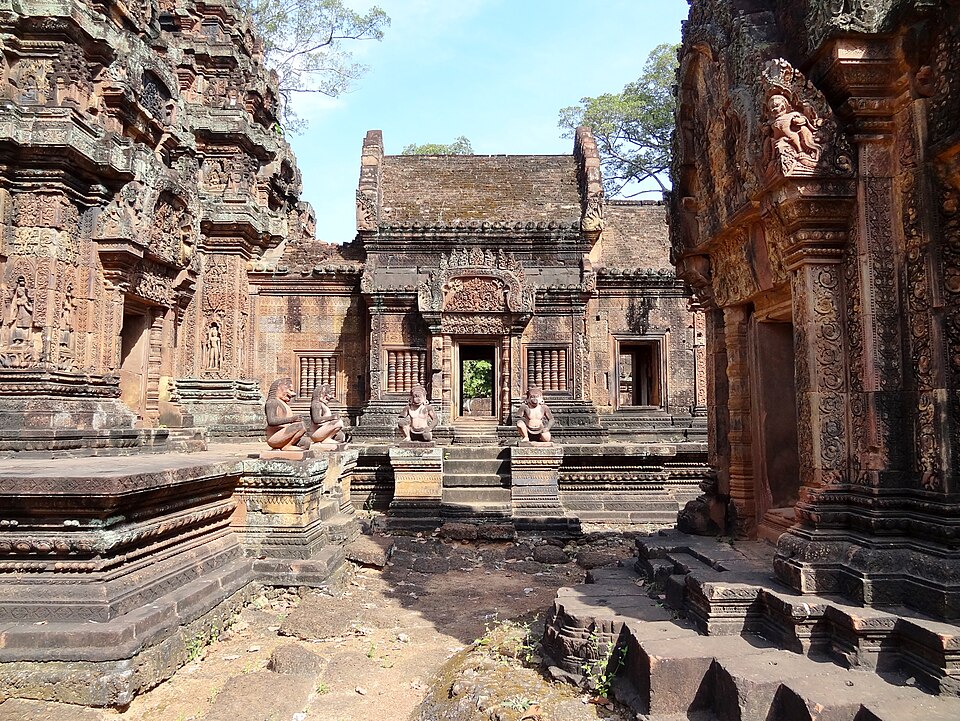
Masons quarried fine-grained pink sandstone from the Phnom Kulen mountains to construct the towers and ornate doorways. This resilient stone enabled sculptors to cut deep, intricate patterns that resemble delicate wood carvings.
The architectural plan organizes the sacred compound along an east-west axis within three concentric enclosures and a moat. Shrines south of the central axis venerate the god Shiva, while northern structures honour the god Vishnu.
Banteay Srei pioneered the use of expansive triangular pediments that depict entire narrative mythological scenes rather than isolated decorative motifs. Master artisans chiseled famous episodes from the Ramayana and Mahabharata across the library gables and door lintels.
One famous southern pediment shows the multi-headed demon king Ravana violently shaking Mount Kailasa beneath Shiva and Parvati. Graceful female devatas holding lotus flowers and sculpted animal guardians protect the thresholds of the inner towers.
Conservation Legacy
French researchers rediscovered the overgrown ruins in 1914 concealed beneath heavy forest cover. A sensational 1923 art theft by French novelist André Malraux brought urgent international attention to the unprotected site.
Archaeologist Henri Marchal restored the crumbling buildings during the 1930s using the pioneer restoration method of anastylosis. Conservators meticulously dismantled the collapsed blocks and rebuilt the monuments using original stone elements.
The APSARA National Authority and Swiss conservation teams later installed modern drainage channels to protect the foundations from tropical rain damage. Faithful concrete replicas of monkey and lion guardians now stand on site to safeguard original statues from black-market looters.
The soft morning and late afternoon sunlight illuminate the pink walls with a warm, radiant glow. Visitors consistently admire this sacred sanctuary as a timeless masterwork that holds a unique place in world heritage.