


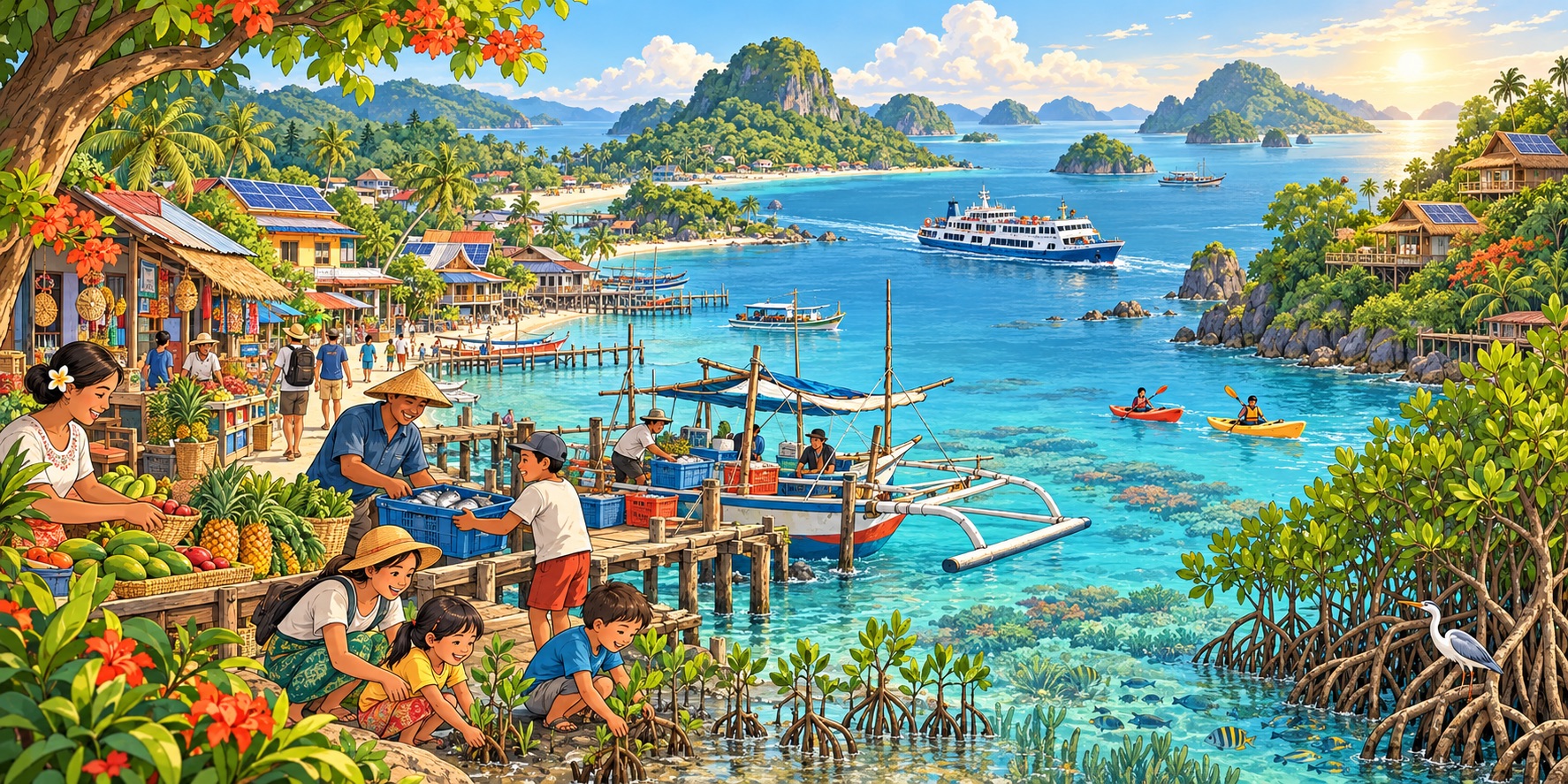
For Southeast Asia’s island communities, the sea connects daily life: the ferry carrying vegetables to market, the fishing boat returning before a storm, the visitors arriving at a village homestay. Behind the region’s celebrated coastlines lies a more demanding story of keeping communities connected, economies productive and ecosystems healthy.
Indonesia recorded 17,380 named and geographically identified islands in 2024, while the Philippines’ tourism authorities cite 7,641 islands. Together, they illustrate the scale of a region where development depends as much on crossing water as building roads.
Connecting Islands, Expanding Opportunity
Southeast Asia’s islands occupy very different economic positions. Singapore serves international shipping and commerce, while Java and Luzon concentrate major cities, industries and markets. Smaller islands often face higher costs simply because fuel, building materials and everyday supplies must travel farther through several transport links.
For a fishing community, those costs extend beyond a boat ticket. Without reliable electricity, ice and regular cargo services, a valuable catch can lose quality before reaching buyers. Better connections therefore need to include storage, power and market access alongside ports.
The Philippines’ roll-on/roll-off system offers a practical example. Introduced in 2003, it links roads through ferries that carry vehicles with their cargo aboard, reducing repeated loading and unloading. An Asian Development Bank Institute study published in 2017 cited shipping-cost reductions of about 30 percent associated with the system and found improvements in household income and school attendance in connected areas. These were findings from the Philippine experience, rather than a guaranteed outcome for every ferry route.
The wider lesson applies across the region: a dependable crossing can help farmers reach customers, students reach classrooms and small businesses serve markets beyond their home island.
Building Prosperity Around Living Seas
Island economies depend on the condition of surrounding waters. Coral reefs support fisheries and tourism, seagrass meadows provide marine habitats, and mangroves help stabilise shorelines. Damage to one ecosystem can affect livelihoods well beyond its immediate boundaries.
In Kupang, East Nusa Tenggara, ecotourism practitioner Cessy Anakay described that connection in a 2023 World Bank feature. Speaking about the ocean, she said, “it is a source of life for my community.” Anakay coordinated ecotourism activities for the local organisation Bukan Sekedar Pasiar.
That perspective gives the blue economy a clear purpose: earning income from marine resources while maintaining the ecosystems that make those earnings possible. It also places residents’ access to fishing grounds, coastal space and decision-making at the centre of development.
In the same feature, Udhi Eko Hernawan, then identified as head of Indonesia’s BRIN Research Center for Oceanography, said managing coral reefs, seagrasses and mangroves “requires care, synergy, and harmonized approaches.” His observation highlighted why coastal protection needs coordination across research, government and communities.
Creating Tourism That Supports Island Life
Bali, Phuket, Langkawi and Boracay have helped make Southeast Asia internationally recognisable. Yet visitor growth brings practical demands: more freshwater, sewage treatment, housing, transport and waste collection.
Boracay demonstrated the cost of allowing those demands to outpace infrastructure. The Philippine government closed the island to tourists for six months in 2018 to address waste management and other environmental problems. Research by the Philippine Institute for Development Studies examined the resulting economic disruption, underlining that rehabilitation also carried consequences for workers and businesses.
Raja Ampat offers another lesson. A World Bank feature published in 2021 documented how the pandemic’s tourism collapse affected dive operators and community homestays. Residents explored gardening and fish processing as alternative income sources, while plastic pollution continued despite the decline in visitors. Protecting the destination required waste management beyond tourist facilities, including in neighbouring urban centres.
These experiences suggest a broader measure of tourism success: whether residents gain dependable livelihoods and functioning services while the destination retains its ecological health. Local purchasing, community accommodation and properly managed visitor activities can contribute, but they need effective infrastructure and oversight.
Powering Possibilities on Smaller Islands
Reliable electricity can transform island opportunities as directly as a new ferry connection.
On Malalison, a 55-hectare island in the Philippines’ Antique Province, residents previously relied on diesel-generated electricity for only four hours a day. A solar hybrid project inaugurated in 2019 combined a 50-kilowatt solar installation, battery storage and an existing diesel generator to provide round-the-clock service for approximately 160 households.
The practical benefits extended to refrigeration for fishers, accommodation services and household tasks. The project also illustrated an important distinction: renewable energy can reduce diesel dependence without immediately eliminating it. Storage, maintenance, financing and backup supply remain essential to dependable island power.
Digital connections need similar attention. Undersea cables and telecommunications infrastructure can connect island enterprises with customers, education and public services, but their usefulness depends on affordable access and reliable electricity at the household level.
Planning for Coastlines That Change
Climate pressures add urgency to these development choices. The Intergovernmental Panel on Climate Change identifies rising seas, storm surges, drought and coral bleaching among the threats already affecting small islands. Freshwater supplies are particularly vulnerable, with changing rainfall and saltwater intrusion adding pressure to limited resources.
Risks differ between islands and coastlines. A low-lying settlement, an exposed fishing harbour and a mountainous island’s inland villages require different responses. Planning therefore needs local evidence, safer infrastructure locations, protected water supplies and workable emergency transport arrangements.
Healthy coastal ecosystems can support adaptation, but they cannot remove every hazard. Conservation works best alongside building standards, early warnings and sustained investment in public services.
Southeast Asia’s island future will be shaped by decisions that residents experience every day: a reliable ferry, affordable power, clean water and a productive sea. Keeping those priorities together offers a stronger foundation for prosperity across the region’s extraordinary maritime landscape.


