The Bǎi Zì Zàn, or Hundred-Word Eulogy, is a rare classical Chinese poem that praises the Prophet Muhammad. Tradition credits Zhu Yuanzhang, the founding Hongwu Emperor of the Ming Dynasty, with issuing these one hundred characters around 1368, though the earliest surviving stone inscriptions date from later Ming dynasties.
The poem presents fundamental Islamic beliefs through an elegant style of four characters per line. Chinese Muslims still recite these lines today and display them in ancient prayer halls across the country.
The text honors Muhammad as a great sage whose moral teachings bring peace and safety to ordinary people. It marks an important historical moment when Islam gained lasting acceptance within Chinese civilization.
The emperor commissioned stonemasons to carve this praise onto stone stelae inside major regional mosques. These carved monuments provided local Muslim communities with clear proof of royal favor and protection.
The Core Message
The poet opens with cosmic history by describing the heavenly tablet where God recorded the Prophet's name before creation began. Islamic theology calls this record the Preserved Tablet, which contains the divine knowledge of all things.
The poem notes that Muhammad received thirty volumes of heavenly scripture to guide and transform all created beings. This line matches the thirty parts, or juz, that make up the Islamic holy book, the Quran.
The verse highlights the five daily prayers where the Prophet silently asked God for peace and protection. It also emphasizes his deep concern for poor people, his rescue of the distressed, and his complete freedom from sins.
The closing lines express pure monotheism by urging believers to renounce false ways and return to the One True Lord. The poem identifies this faith as Qingzhen, a Chinese term meaning "Pure and True" that became the standard title for Islam in China.
Here is the whole English translation of the poet:
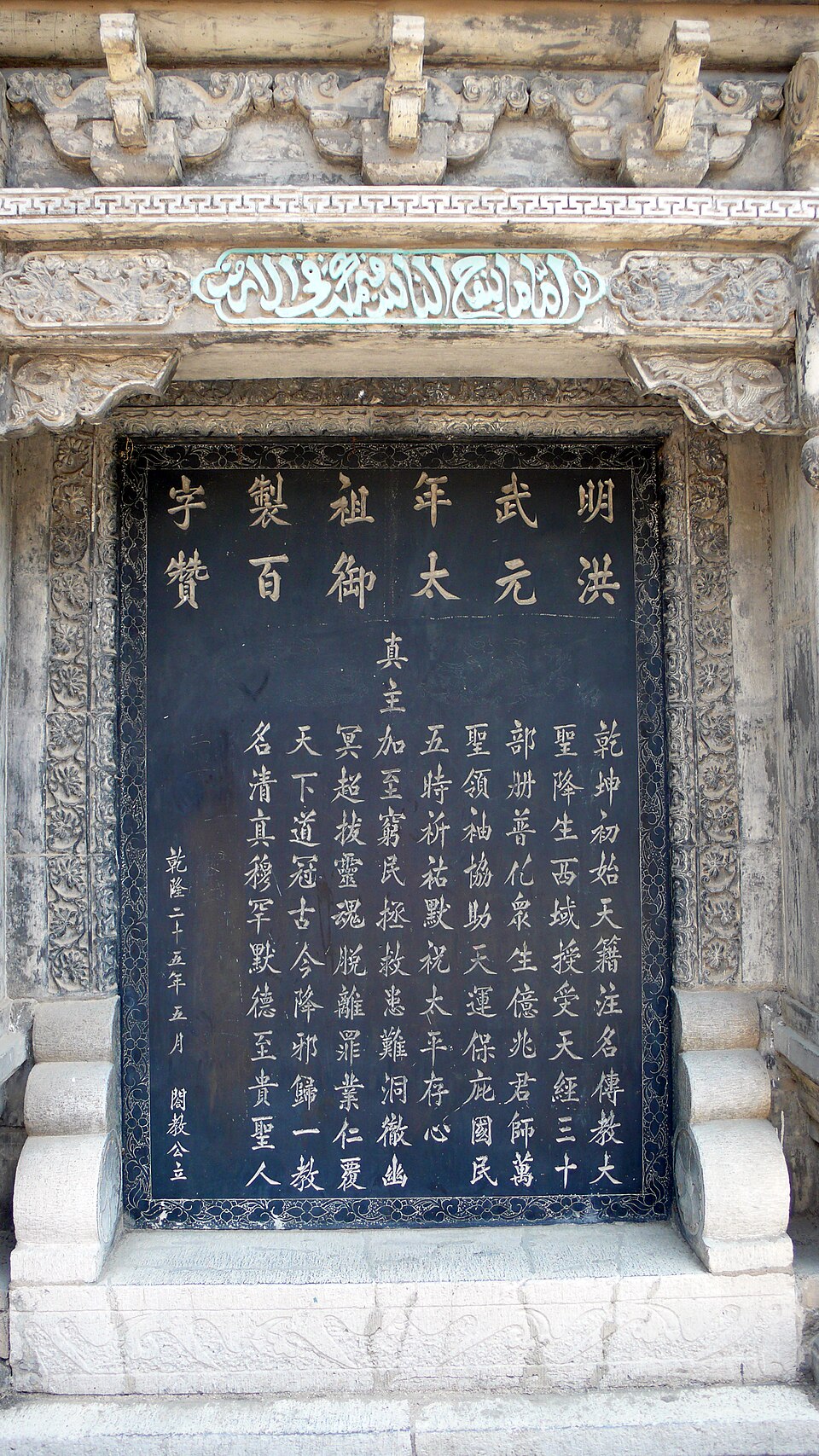
At the dawn of creation, his name was registered in the Heavenly Book. The Great Sacred Teacher of the Faith was born in the Western Regions.
He received and transmitted the Heavenly Scripture, thirty volumes in total, To guide and transform all living beings. Teacher and leader to millions of sovereigns, supreme head of tens of thousands of sages.
Assisting the Divine Will, protecting and blessing the nation and its people. Five times a day he prayed for blessings, silently invoking peace and tranquility. His heart dedicated to Allah, his will committed to comforting the poor. Rescuing humanity from suffering and adversity, penetrating the deep mysteries of the spiritual realm.
Elevating the soul, liberating mankind from sin and transgression. His benevolence covers all under Heaven, his teachings surpass all throughout history.
Subduing evil and returning to the One, the faith is named Qingzhen (Islam).
Muhammad, the Most Noble Prophet.
Historical Motives
Hongwu fought intense military campaigns to defeat the Mongol Yuan Dynasty and establish the Ming Dynasty. Skilled Muslim generals, including Hu Dahai and Chang Yuchun, led key frontline units that helped him win the throne.
Hui community history honors these commanders as the famous Muslim defenders who protected the founding emperor. Hongwu rewarded their loyal military service by issuing protective edicts and building new mosques in Nanjing and Xi'an.
The eulogy therefore fulfilled a sharp political strategy alongside its spiritual respect. The emperor used royal verse to secure Muslim loyalty and weave the community into his new imperial system.
His administration also created an Islamic Astronomical Bureau where Muslim scholars translated Persian and Arabic texts for the court. These cooperative policies laid the groundwork for an era that Chinese Muslims often remember as a golden age.
The Legacy of the Hundred-Word Eulogy
Historic mosques, including the Jingjue Mosque in Nanjing, still preserve tall stone stelae that display this eulogy.
Later Muslim scholars, including Liu Zhi and Wang Daiyu, preserved the poem in their books during the Qing Dynasty. Modern historians point out that no surviving document from 1368 proves that Hongwu personally picked up the brush to write it.
Many researchers conclude that educated Muslim advisors or court scribes helped compose the text under royal instruction. Regardless of who held the brush, the poem remains a remarkable bridge of harmony between traditional Chinese culture and Islam.