


ASEAN needs to add around 26 gigawatts (GW) of renewable energy capacity every year until 2030 to achieve its target of a 45 percent share of renewables in installed power capacity. This is nearly four times the average annual additions recorded over the past decade.
This means the region needs to accelerate the development of clean power plants while preparing the infrastructure needed to transmit and store the electricity they generate.
The challenge is evident in developments between 2015 and 2024. During this period, ASEAN added around 62 GW of renewable energy capacity. However, fossil fuel capacity grew even more, increasing by 91 GW.
So, is the 2030 target still realistic? In our interview with Dato' Ir. Ts. Razib Dawood, Executive Director of the ASEAN Centre for Energy (ACE), he explained that the target remains achievable.
“The 2030 target is demanding, but still within reach,” he said.
The Target Is Still Within Reach, but Time Is Running Out
Although projections show that the target can still be achieved, Razib cautioned that there is little room for delay.
Under the ASEAN Coordinated Transition Scenario (ACTS), ASEAN needs to add around 26 GW of renewable energy capacity annually between 2026 and 2030. This is considerably higher than the average of just 6.5 GW per year recorded over the past decade.
Even in the region's strongest years, 2019 and 2021, annual additions reached only around 14–15 GW. To meet the target, annual additions would need to rise to around 40 GW by 2030, led primarily by solar and wind power.
According to Razib, delays would make the task even more demanding in the years ahead.
“Delay does not simply postpone the transition; it increases the rate of construction, financing, permitting and connection required later,” he said.
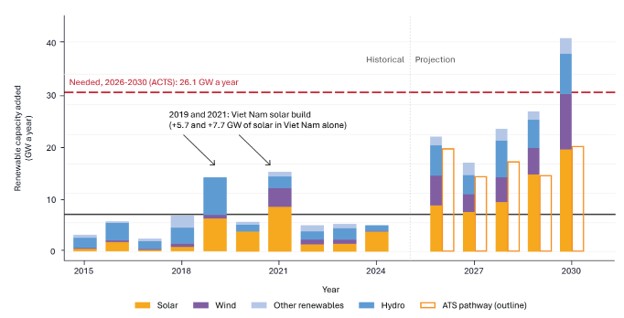
If deployment continues at its historical pace through 2027, the required annual additions could rise to around 55 GW thereafter. This would leave ASEAN with an increasingly demanding task of accelerating power plant construction, financing, permitting and grid connections within a shorter period.
Razib also emphasised that achieving the target should not depend on just one or two countries. Each ASEAN Member State has different energy systems, natural resource endowments and levels of infrastructure readiness. He therefore highlighted the importance of a regional approach that allows each country to contribute according to its own strengths.
One instrument that could support this approach is the ASEAN Power Grid (APG), a cross-border electricity interconnection network that enables power trade among ASEAN Member States. Countries with abundant renewable energy resources can supply electricity to their neighbours, while others can benefit from shared reserves and a more flexible power system.
However, this cooperation requires investment in transmission networks and energy storage, as well as faster permitting and grid connection processes. Electricity procurement and reliable offtake arrangements also need to be strengthened to make renewable energy projects more attractive to investors.
Investment Needs Reach USD 405 Billion Annually
Behind this acceleration lies a substantial financing requirement. Under the ACTS, ASEAN needs around USD 14.2 trillion in cumulative investment by 2060, equivalent to approximately USD 405 billion per year.
This is considerably higher than the annual requirements under the ATS, at around USD 279 billion, and the Baseline scenario, at approximately USD 222 billion.
These investments are not limited to power generation and grid infrastructure. They must also cover energy efficiency, electrification and fuel switching across industry, transport and buildings.
When we asked how much of this could be covered by government budgets, Razib explained that AEO9 does not prescribe a fixed allocation between public and private financing.
The appropriate mix will depend on each country's circumstances, the technology involved and the level of market development. However, he stressed, “What is clear is that public balance sheets alone will not be sufficient. Investment will need to come from governments, state-owned utilities, private investors, financial institutions and development partners.”
In this context, public and concessional finance play an important role in enabling private investment, particularly through supporting basic infrastructure, project preparation and risk reduction.
This is also reflected in the ASEAN Energy Investment Report 2026. Across emerging and developing economies outside China, commercial finance accounts for around 69 percent of energy investment.
Meanwhile, domestic public finance contributes around 29 percent, while state-owned enterprises account for approximately 44 percent. These figures refer to different financing categories within the investment structure and should not be added together as a single breakdown.
In ASEAN, investment in grids and energy storage is expected to reach USD 15.4 billion in 2026, close to the USD 20.7 billion projected for renewable power generation. Development finance also plays a role in reducing project risks. Between 2021 and 2024, guarantees and insurance accounted for around USD 275 million of the USD 509 million in private finance mobilised by multilateral development finance providers for the ASEAN energy sector.
Mobilising Private Capital to Close the Investment Gap
Even so, the investment gap remains substantial. ASEAN currently invests just over USD 100 billion annually in energy, far below the roughly USD 405 billion required each year under the ACTS. In broad terms, investment will eventually need to rise to around four times its current level.
For Razib, the central challenge is not how governments can fund the entire requirement through public budgets, but how public and concessional finance can be used strategically to attract a much larger pool of private capital.
One way to do this is through blended finance, guarantees and credit enhancement instruments that make previously high-risk projects more attractive to commercial investors.
This mobilisation also needs to begin early. Project preparation, permitting, grid connections and financial structuring can take years. Starting these processes sooner will give ASEAN a better chance of securing the investment needed to accelerate its energy transition.


