The Siam Tulip is a tropical ornamental plant characteristic of Thailand. The plant grows naturally in seasonal tropical forest landscapes of mainland Southeast Asia, especially Thailand. Wild populations of the Siam Tulip are commonly found in sandy soil areas and rocky grasslands.
The growth characteristics of the plant are influenced by changing tropical seasonal cycles. New shoots emerge above the ground as rainfall begins to increase. The green vegetation quickly fills open forest areas that previously dried out during the dry season.
The Siam Tulip lives in clusters from lowland areas to hilly regions. The grouped growth pattern forms dense clumps in its natural habitat. The emergence of young shoots marks the physical start of the annual growing period.
Not a True Tulip Despite Its Name
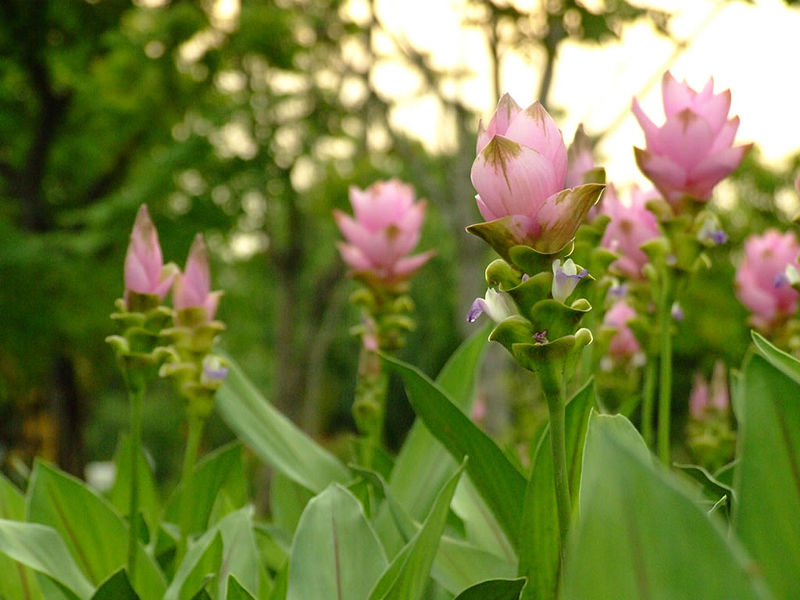
In terms of botanical taxonomic classification, the plant scientifically named Curcuma alismatifolia belongs to the Zingiberaceae family. The family includes various types of rhizomatous or spice plants. The plant is closely related to everyday plants such as turmeric and ginger.
The name tulip arises purely from the physical resemblance of the plant's outer organs to subtropical tulips. The pinkish-purple petal-like parts at the top are actually a structure of bracts. Bracts are protective leaf organs that undergo color modification.
The true flowers of the plant are very small and grow hidden inside the bract crevices. The thick protective leaf sheets store rainwater while shielding the flower crown. Underground, the root system develops into rhizomes within the soil.
The rhizomes function as storage organs for food and water reserves. The pseudostem grows upright, supporting stiff dark-green leaves. The physical height of a mature plant generally reaches about 40 to 60 centimeters.
Only Blooms When the Rainy Season Arrives
The life cycle of the perennial plant centers on tropical seasonal change patterns. During the dry season, the leaves and stems above ground wither completely. The drying of outer organs serves as an adaptation to preserve moisture within the rhizome.
The plant rhizome then undergoes a dormancy period below the soil surface for several months. The underground organ remains alive even when the topsoil layer is extremely dry. The resting phase ends only when rainwater rewets the root zone.
Initial rainfall stimulates the emergence of young shoots from the rhizome buds. Shoot growth occurs rapidly until an arrangement of protective leaves forms at the tip. The full blooming of bracts takes place from June to August.
The flowering phase lasts for approximately three months. After pollination ends, the plant produces generative seeds for population propagation. The outer parts of the plant then wither again as rainfall subsides.
Widely Found in the Forests of Chaiyaphum
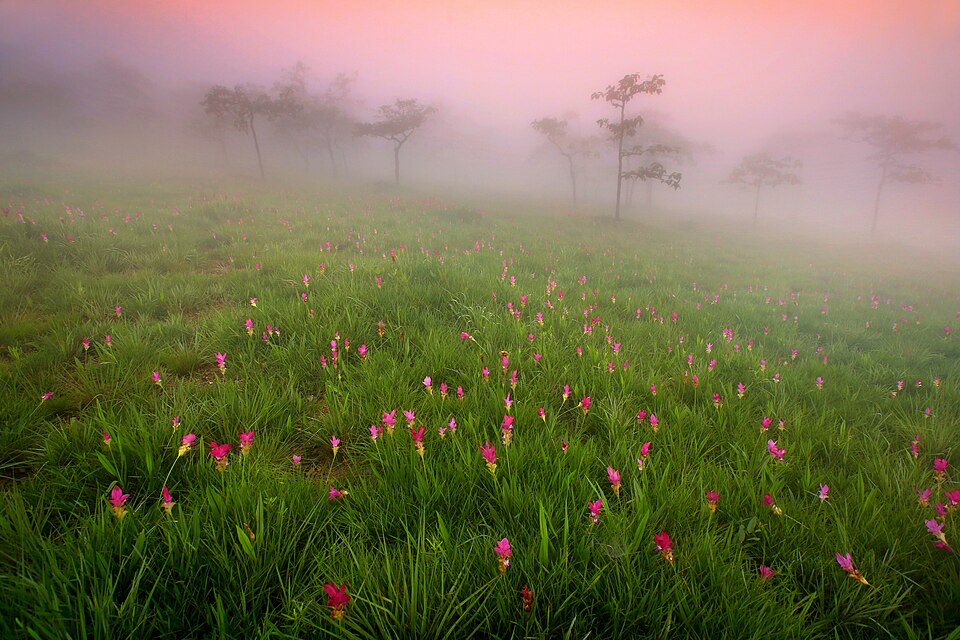
As an iconic flora of Thailand, natural populations of the Siam Tulip are most abundant in Chaiyaphum Province. The region features a landscape of rocky savanna grasslands in highland areas. The sandy soil characteristics in the hilly zones suit rhizome development well.
The native habitat of the Siam Tulip is protected within Pa Hin Ngam National Park. Additionally, wild populations of the plant are also distributed across Sai Thong National Park. The conservation areas protect wild flora from forest land-conversion threats.
The plant grows naturally between rocks and tropical forest trees. When the blooming period arrives, simultaneous flower displays transform the forest landscape into pink. The natural occurrence recurs regularly each year in its native habitat.
Natural reproduction of the plant in conservation areas occurs through two main mechanisms. Plants reproduce vegetatively through rhizome division underground. Additionally, seeds dropping onto moist soil establish new root systems around the main clump.
Reference:
Lening-Skomickova, J., Tran, H. D., Newman, M., V., & Bounmanivong, S. (2019). Curcuma alismatifolia. The IUCN Red List of Threatened Species 2019: e.T201883A132687665. https://dx.doi.org/10.2305/IUCN.UK.2019-3.RLTS.T201883A132687665.en