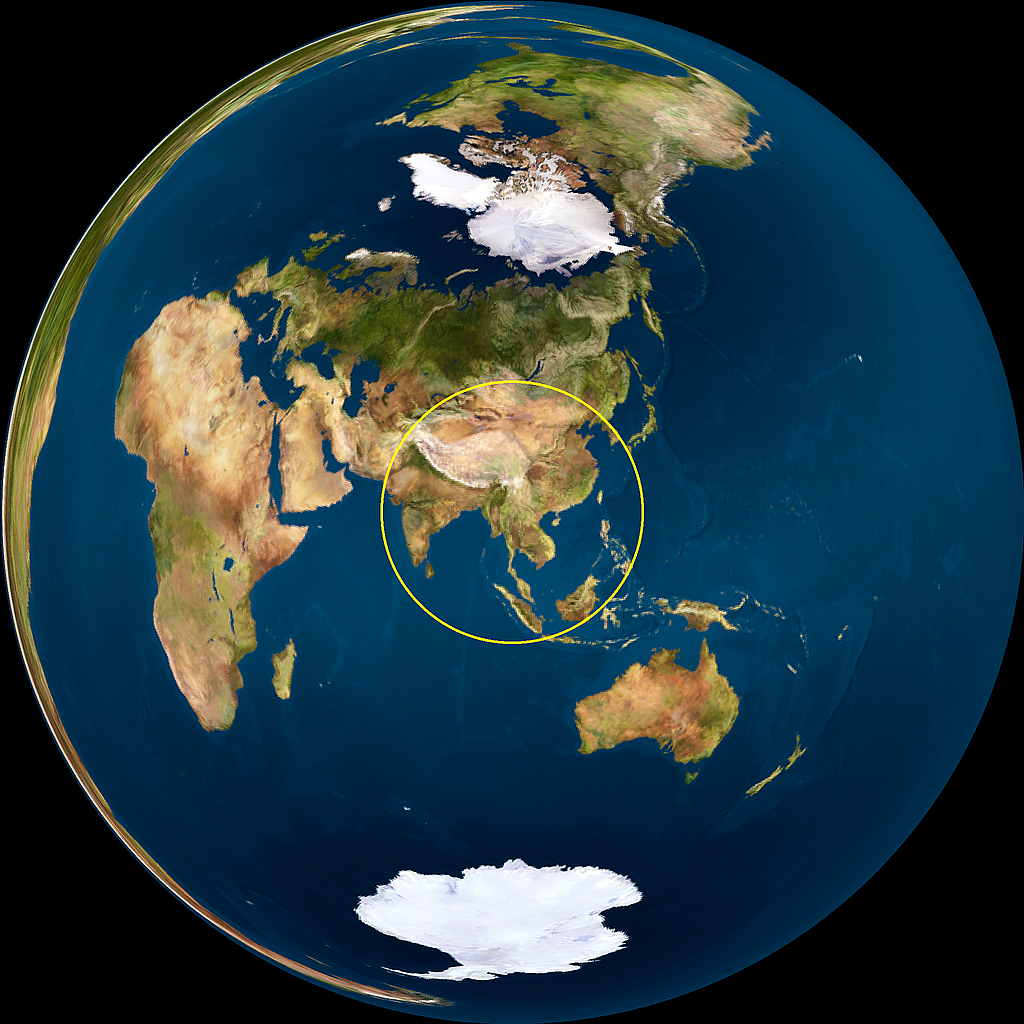
Half of the world’s people live inside a single circle. It has a radius of about 3,300 km, roughly the distance from Sydney to Perth, and it’s centered on northern Yunnan in China. Its edges sweep from northern India across southern China and into Southeast Asia.
It’s called the Valeriepieris circle, after a Reddit user of that name, the online handle of Ken Myers. Economist Danny Quah later recalculated it on a globe in 2015, placing the center near Mong Khet, Myanmar.
The northern Yunnan center comes from a 2024 study titled from a 2024 study titled “Valeriepieris Circles for Spatial Data Analysis” published in the journal Geographical Analysis, which placed it farther north, in Yunnan.
Plenty of the area inside is nearly empty, Tibet included, but the populated parts are dense enough to tip the count.
Two Countries, Over a Third of Humanity
India and China together had about 2.87 billion people in 2025, according to World Bank estimates. Against a world population of roughly 8.22 billion, that is about 35%.
India is the most populous country, at around 1.46 billion, and China follows with approximately 1.41 billion. Both have big cities, large farming regions and industrial corridors.
The rest of the region adds a lot more. In 2025, Indonesia had around 285.7 million people, Pakistan 255.2 million and Bangladesh 175.7 million. Further into Southeast Asia, the Philippines had about 116.8 million and Vietnam around 101.6 million.
Put side by side, these countries make up a dense band of population stretching across South, East and Southeast Asia. Much of that band falls inside the Valeriepieris circle, a fairly compact area holding a huge share of humanity.
Bangladesh Is Small, but Packed
Bangladesh covers approximately 148,460 square kilometers, less than Cambodia’s 181,040. Even so, Bangladesh had an estimated 175.7 million residents in 2025, according to the World Bank, against roughly 17.8 million in Cambodia.
That is nearly 10 times as many people in a smaller area.
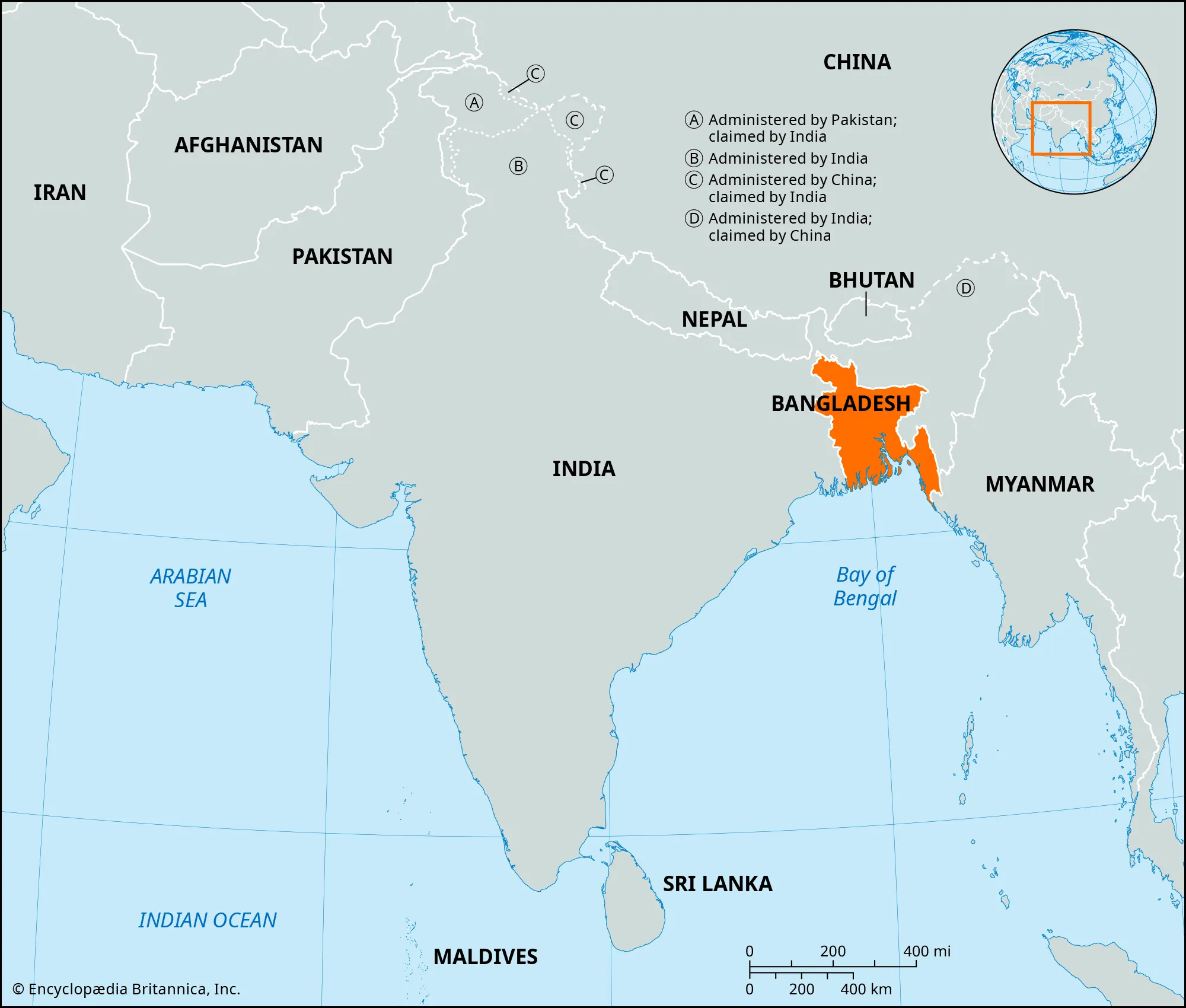
Part of the reason is geography. Much of Bangladesh sits in the Ganges-Brahmaputra-Meghna delta, where centuries of deposited sediment built wide alluvial plains. Combined with river networks and seasonal monsoon rains, that land supports farming and settlements that have been around for a very long time.
Rice has fed a large rural population, though soil quality, flooding and growing conditions differ from one part of the country to another. Still, the land doesn’t explain everything. Centuries of settlement, farming, trade and city growth also shaped where people ended up living.
Tibet Is Huge, but Few Live There
Tibet covers approximately 1.2 million square kilometers, nearly twice the size of Myanmar. But it had around 3.7 million residents in 2024, according to regional statistical figures, while Myanmar had approximately 54.5 million, according to World Bank estimates.
Tibet is the much larger of the two and has far fewer people.
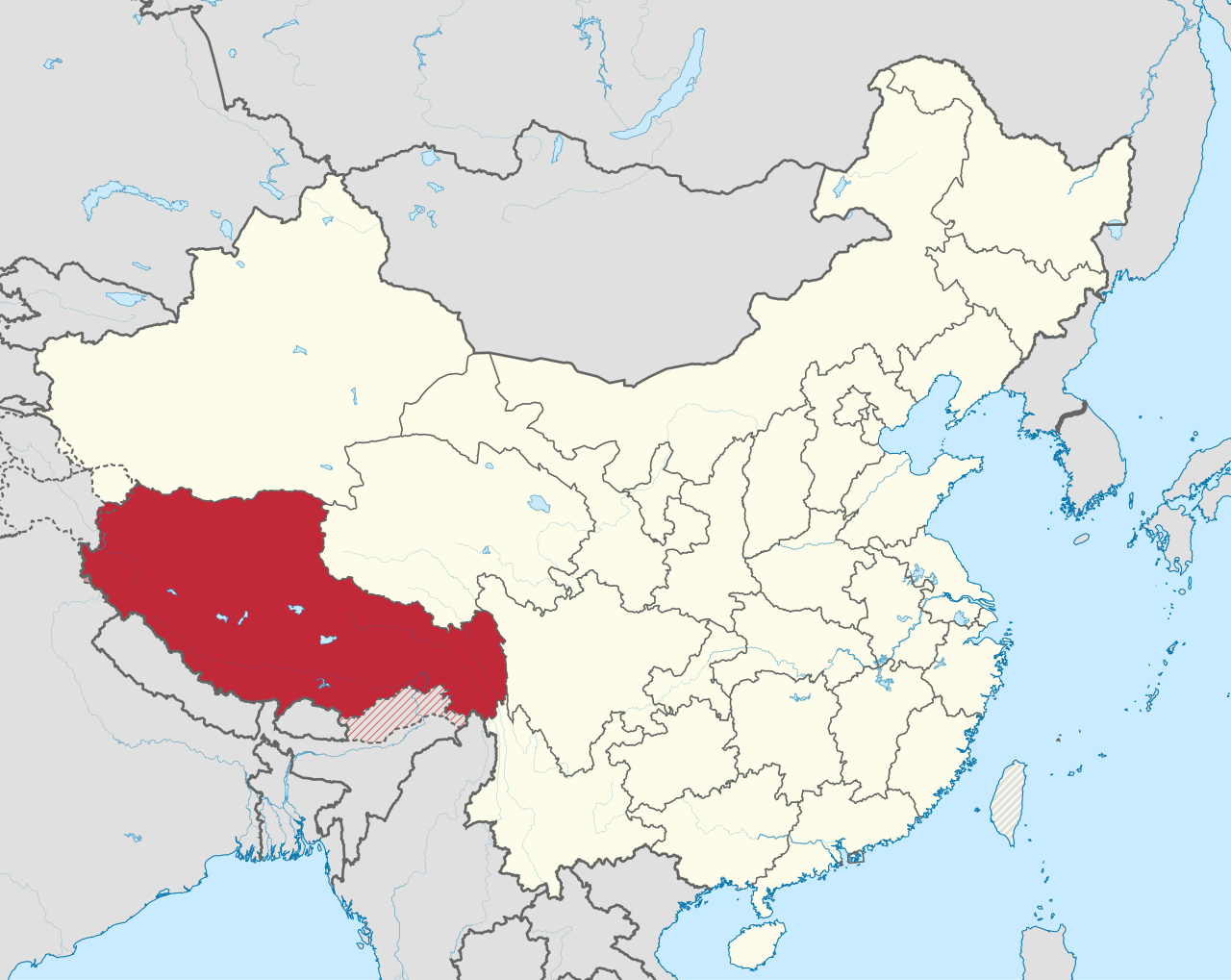
The main reason is the environment. The average elevation is above 4,000 meters, which means thin air, low temperatures and a short growing season. Mountains are rugged and arable land is scarce, so there are few places where intensive farming or large settlements can take hold.
Farming is concentrated where conditions are better, mainly in the valleys of the Yarlung Tsangpo River and its tributaries in southern Tibet. Most of the rest is grassland and other high-altitude terrain rather than cropland.
Tibet sits right next to some of the most crowded parts of Asia, yet elevation, climate, terrain and the amount of cultivable land set a hard limit on how many people can live there.
Half of Humanity Lives Inside One Circle
The 2024 study generalized the Valeriepieris idea so it could be applied to any share of a population and any region, and it came with a fast algorithm to compute the result. For the global calculation, the study used gridded population data from the Socioeconomic Data and Applications Center (SEDAC) at Columbia University.
The circle that came out has a radius of approximately 3,300 kilometers and is centered near 28.4° north latitude and 100.6° east longitude, in northern Yunnan province.
That doesn’t mean every part of it is crowded. Tibet falls inside the circle and is among the emptiest places in Asia. What matters is that the circle takes in enough major population centers to hold at least half of humanity.
Outside the circle, the rest of humanity is spread across a much larger area where density is lower on average, including deserts, polar regions, mountain ranges and large parts of the Americas and Africa.
So a fairly small share of the Earth’s surface holds a big share of its people, a pattern built up over thousands of years of settlement, agriculture and economic development.
Reference
Arthur, R. (2024). Valeriepieris circles for spatial data analysis. Geographical Analysis, 56(3), 514-529. https://doi.org/10.1111/gean.12383