Did you know that the first ever novel in the world was written in Japan? The Tale of Genji often earns the title of the world's first novel. A Japanese noblewoman wrote it about 1,000 years ago.
Her name was Murasaki Shikibu, and she served at the imperial court in Kyoto. She wrote most of the story in the early 11th century, centuries before the novel took off in Europe.
The book follows the life and loves of a prince named Hikaru Genji. It runs for 54 chapters and holds about 800 poems.
Some experts point to older prose works from ancient Greece and Rome. Still, many call Genji the first true novel because it explores its characters' thoughts and feelings in depth.
Who Was Murasaki Shikibu?
Historians do not know her real name. Murasaki probably comes from a character in her story, and Shikibu refers to a government office her father held.
Murasaki was born around 973 into a family of scholars and poets. By her own account, she learned Chinese by listening to her brother's lessons, and her father wished she had been a boy.
She married Fujiwara no Nobutaka around 998, and he died about three years later, leaving her with a baby daughter. It is believed that she began writing the story during these lonely years.
Her writing earned attention at court, and she joined the household of Empress Shōshi as a lady-in-waiting. She kept a diary there and shared chapters of her story with the women around her.
What the Story of the Novel Is About
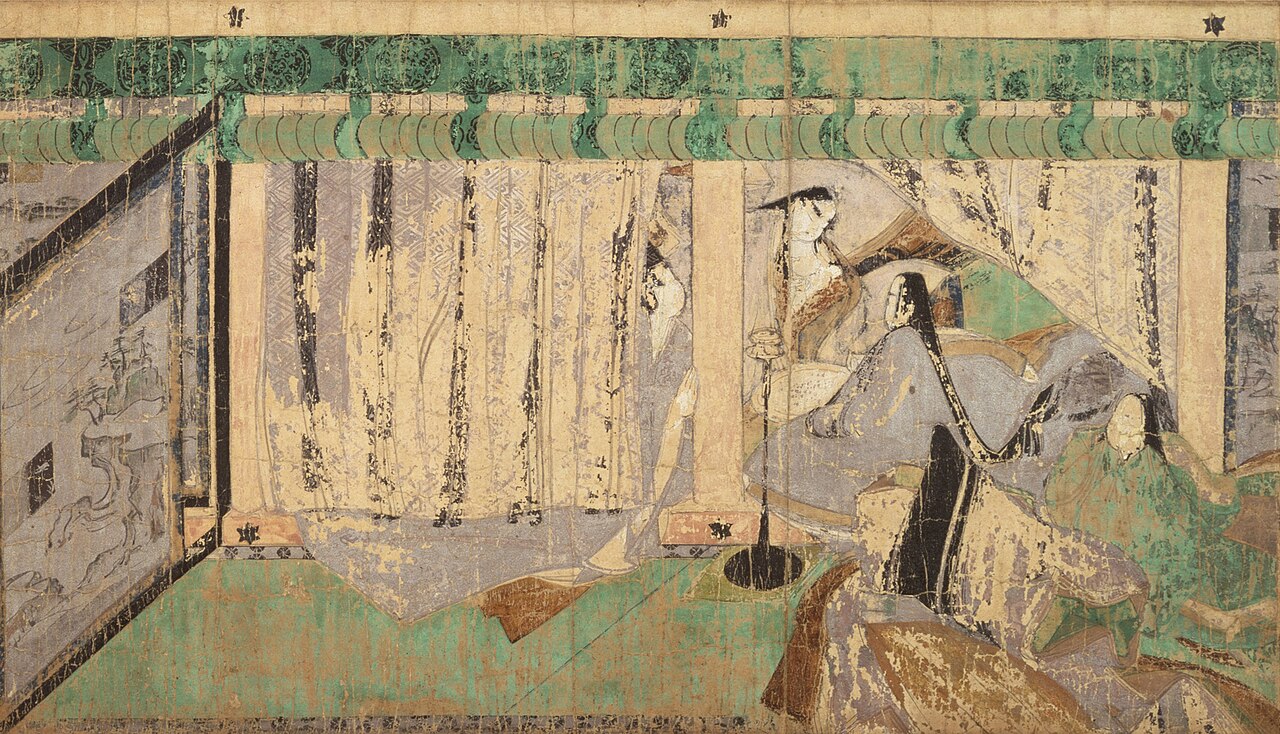
Genji is the son of an emperor and a low-ranking consort. His father removes him from the line to the throne and gives him the surname Minamoto, which makes him a commoner.
Genji grows into the most dazzling man at court and falls in love again and again. His deepest longing is for Fujitsubo, his father's wife, who looks like the mother he lost.
He later raises a young girl called Murasaki and marries her. After a scandal, he leaves the capital for the coast at Suma, but he returns and rises to great power.
Genji dies partway through the book, and the last ten chapters follow Kaoru, his supposed son, and Niou, his grandson. The story ends suddenly, and readers still argue about whether Murasaki meant it that way.
Fun Facts About the Book
Murasaki wrote in kana, the Japanese phonetic script. Men at court mostly wrote in Chinese, so her flowing Japanese gave the story a fresh, natural voice.
Few characters have personal names. The book calls people by their rank, their office, or the place where they live.
Murasaki's own manuscript did not survive, so later copyists kept the story alive. The oldest known illustrated scrolls of the tale date to the 12th century.
Arthur Waley published the first major English translation in six volumes between 1925 and 1933, though he left out one chapter and several passages. Later translators, including Edward Seidensticker, who produced the first complete English translation in 1976, and Royall Tyler, released unabridged versions.
Japan put a scene from the tale and a portrait of Murasaki Shikibu on the 2,000-yen note, first issued in 2000. The front of that note shows Shureimon, a famous gate in Okinawa.
Murasaki also kept a diary, and in it she criticizes Sei Shōnagon, the author of The Pillow Book. Sei served a rival empress, and Murasaki thought she showed off her talent too much.