In the tropical forests of the Philippines lives one of the heaviest bats on Earth. That mammal is the giant golden-crowned flying fox (Acerodon jubatus), also known as the golden-capped fruit bat.
The bat received its formal scientific name and description from naturalist Eschscholtz in 1831. Within mammalian classification, the animal belongs to the order Chiroptera and the family Pteropodidae.
Among bats across the Philippine archipelago, Acerodon jubatus stands out for its large body mass and long forearm bones.
Body Measurements of the Golden-Crowned Flying Fox
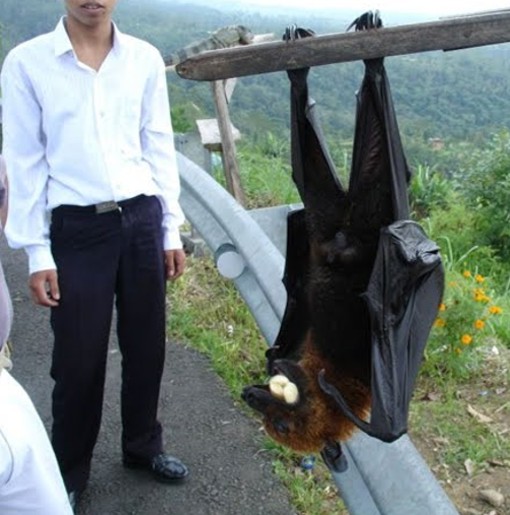
Adult individuals of Acerodon jubatus possess forearm lengths measuring between 165 and 215 millimeters. The measurement places the flying fox among the largest bats documented in the Philippines.
Body mass among mature individuals reaches up to 1.2 kilograms, or roughly 2.6 pounds. That weight ranks the fruit bat among the heaviest living bats worldwide.
A distinct patch of yellow-gold fur covers the crown of its head, contrasting with darker fur across its body. Populations across different Philippine islands also show significant geographic variation.
Visually, the giant golden-crowned flying fox closely resembles its relative, the large flying fox (Pteropus vampyrus). However, Acerodon jubatus emits a much stronger body odor than its close relative.
Beyond its physical traits, the fruit bat depends heavily on undisturbed woodland habitats across its native islands.
Lowland Forest Distribution Across the Philippines
The giant golden-crowned flying fox is endemic to the Philippine archipelago. Its natural range spans major islands including Luzon, Mindanao, Mindoro, Negros, and Bohol.
Despite its wide presence across the country, the mammal is absent from the Palawan faunal region. Populations are also missing from the northern Batanes and Babuyan island groups.
Within its distribution range, the bat generally occurs at elevations from sea level up to 1,100 meters. It operates as a forest specialist that selects primary forests and high-quality second-growth forests for foraging.
During daylight hours, colonies typically roost in trees or occasionally in mangroves on smaller islands. Roost sites are often located along steep slopes and cliff edges that remain difficult for people to access.
In those forest roosts, the bats consistently gather alongside other large fruit bats.
Shared Tree Roosting With Close Relatives
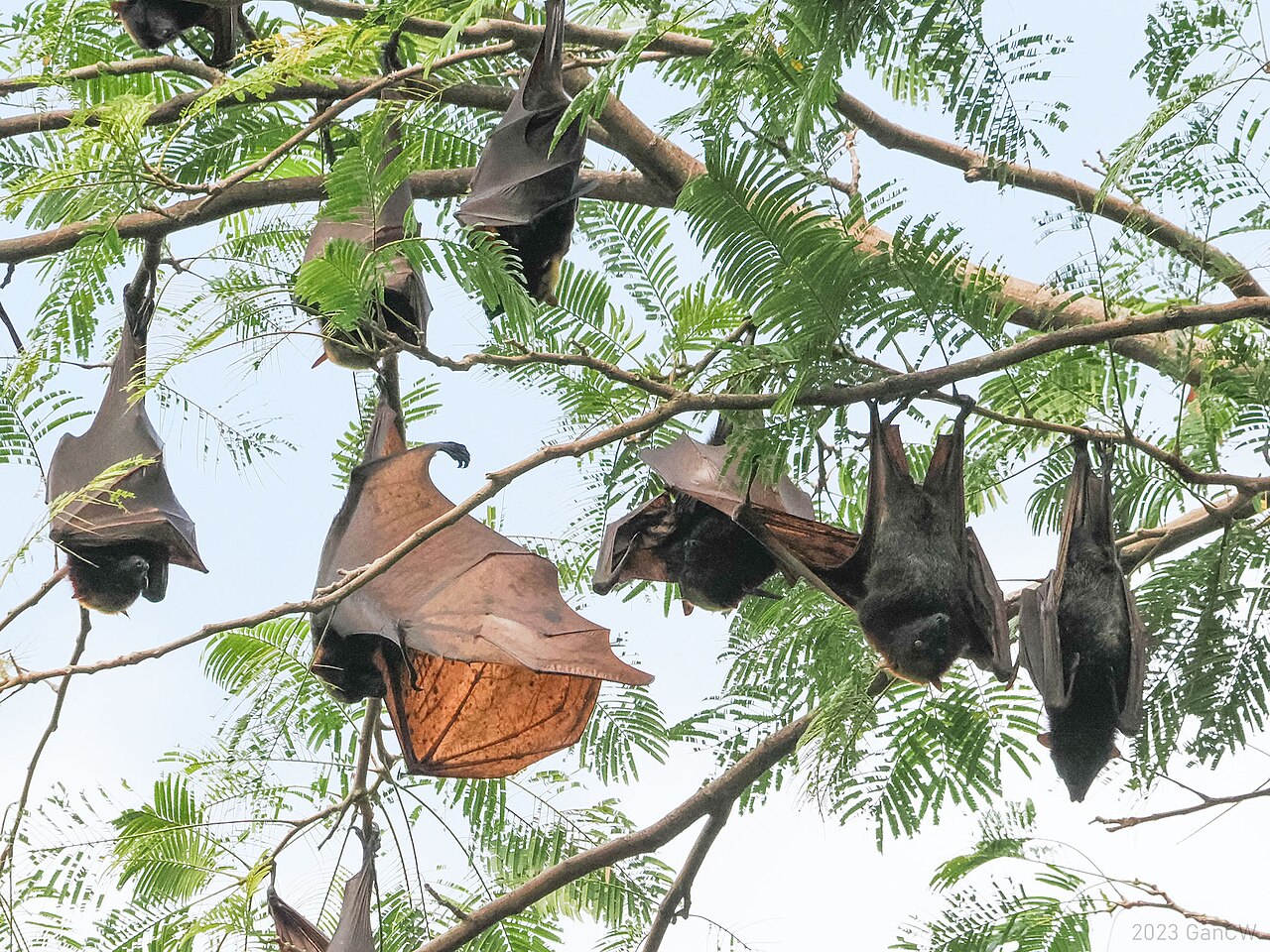
The giant golden-crowned flying fox is commonly found roosting alongside the large flying fox (Pteropus vampyrus). Occasionally, the small flying fox (Pteropus hypomelanus) also occurs in the same mixed roosts.
Within surveyed mixed colonies, Acerodon jubatus forms a small proportion of the total group. The fruit bat makes up roughly 5 to 20 percent of individuals in protected colonies, and often less than 2 percent in heavily disturbed sites.
Clear spatial separation occurs inside mixed roosting areas. Giant golden-crowned flying foxes roost deeper inside the forest away from the edge, whereas Pteropus vampyrus occupies the forest periphery.
Individuals show high fidelity to their established daytime roosting sites. At night, the bats travel several kilometers away from their roosts to forage.
Records from Biliran Island even document individuals foraging there from a roost located on neighboring Maripipi Island. Unlike Pteropus vampyrus, which regularly visits agricultural fruit farms, Acerodon jubatus rarely forages in orchards.
Instead, the fruit bat restricts its diet to fewer than 20 native forest trees, feeding mainly on wild hemi-epiphytic figs (Ficus) in forest canopies and along stream banks.
References:
Ingle, N. R., & Heaney, L. R. (1992). A key to the bats of the Philippine Islands. Fieldiana: Zoology, 69, 1–44. https://doi.org/10.5962/bhl.title.3504
Mildenstein, T., & Paguntalan, L. (2016). Acerodon jubatus. The IUCN Red List of Threatened Species, 2016, e.T139A21988328. https://doi.org/10.2305/IUCN.UK.2016-2.RLTS.T139A21988328.en