

Brunei Darussalam
The Land of Unexpected Treasures
Search
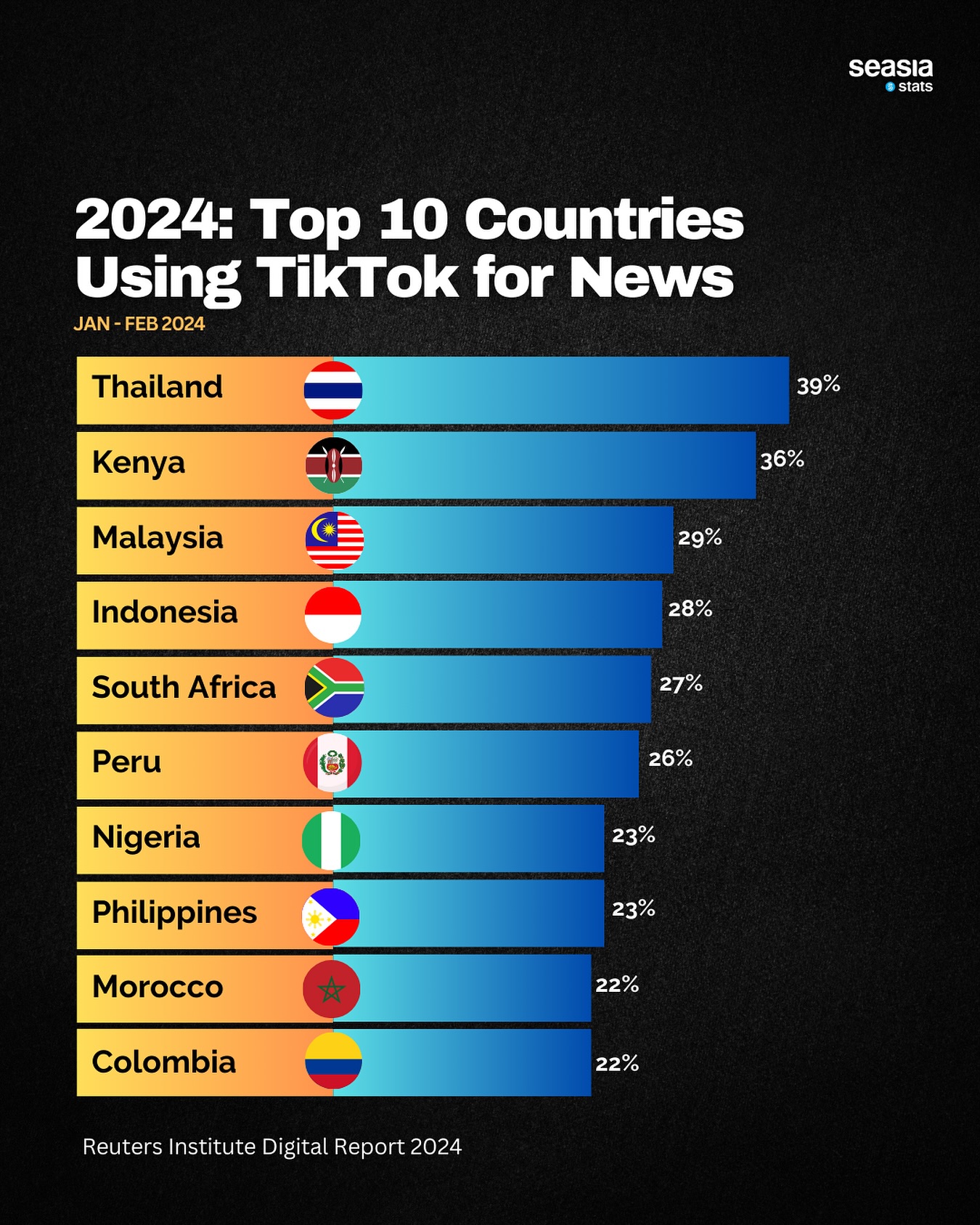
Recent analysis by Reuters has highlighted a concerning trend: among major social media platforms, TikTok is where users struggle the most to differentiate fake news from the truth. This is particularly alarming given TikTok’s growing role as a news source for users around the world.
Data from the 2024 edition of the Reuters Initiative’s Digital News Report reveals the widespread use of TikTok for news across various countries. The report surveyed 47 populations and found that:
In stark contrast, the platform is much less popular for news in the United States (9 percent) and several European countries. Only 4 percent of respondents in the United Kingdom, Austria, and Czechia, and a mere 3 percent in Denmark, reported using TikTok as a news source.
The popularity of TikTok as a news source among younger audiences has not gone unnoticed by politicians. For instance, Argentina’s President Javier Milei has leveraged the platform effectively, amassing around 2.2 million followers. This indicates TikTok's potential influence in shaping public opinion and disseminating information quickly.
However, this influence comes with significant challenges. The Reuters report points out that TikTok users have more difficulty distinguishing between real and fake news compared to other platforms. This issue is exacerbated by the platform’s algorithm, which prioritizes engaging content that might not always be accurate or verified.
The rise of TikTok as a major news source, especially in the Global South, presents both opportunities and risks. While it allows for broader and more rapid dissemination of information, it also increases the potential for the spread of misinformation. As TikTok continues to grow in influence, addressing the challenge of fake news will be crucial to ensuring that users can access reliable and accurate information.


The Land of Unexpected Treasures

Land of the Khmer

The Emerald of the Equator

The Land of a Million Elephant

Land of Indigenous Malay

The Land of the Golden Pagoda

Pearl of the Orient Seas

The Lion City

Southeast Asia Region

The Land of Smiles

A Nation of the 21st Century

The Land of Blue Dragon

Beyond Southeast Asia