

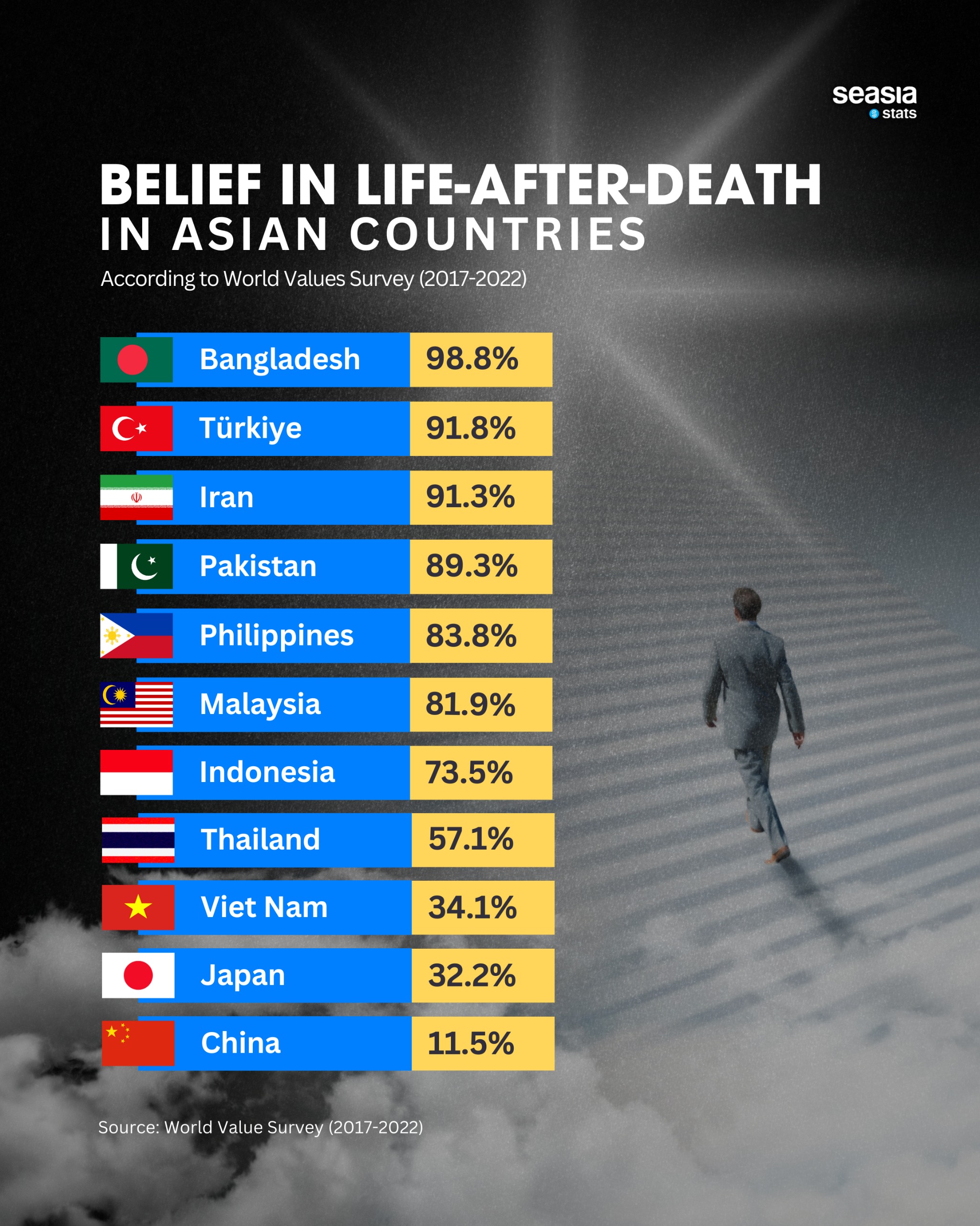
Despite rapid modernization and growing secularism in parts of Asia, belief in life after death remains deeply rooted in many countries. The World Values Survey (2017–2022) reveals that faith in an afterlife continues to shape the cultural and spiritual fabric of diverse Asian communities — though with striking differences across the region.
Bangladesh Tops the List with Near-Universal Belief
Leading the region is Bangladesh, where an overwhelming 98.8% of respondents said they believe in life after death. This near-universal figure reflects the strong religious and spiritual values ingrained in Bangladeshi society.
Following closely are Türkiye (91.8%) and Iran (91.3%), where cultural and religious traditions also emphasize the existence of an afterlife as part of their belief systems.
South and Southeast Asia Show Widespread Faith
Pakistan also reports high levels of belief at 89.3%, while the Philippines — a predominantly Catholic nation — shows 83.8% of respondents affirming belief in life after death.
In Southeast Asia, countries like Malaysia (81.9%) and Indonesia (73.5%) also demonstrate strong belief in the afterlife, consistent with the religious makeup of both nations. Thailand, where Buddhism influences concepts of reincarnation and karma, records 57.1% — lower but still significant.
Viet Nam, Japan, and China Reflect Lower Levels of Belief
There’s a sharp decline in belief in life after death in Viet Nam (34.1%) and Japan (32.2%), where secularism, cultural nuances, and philosophical traditions like Confucianism and Shintoism shape how people view life and death.
China, however, stands out as the most secular of all, with only 11.5% of respondents affirming belief in an afterlife — possibly reflecting decades of state atheism and a shift toward rationalist worldviews.
Spiritual Beliefs Still Resonate Across the Region
While levels of belief vary widely, one thing is clear: spirituality continues to play a significant role in many parts of Asia. For some, belief in an afterlife provides hope and moral guidance. For others, it reflects deep cultural or religious traditions passed down through generations.
This data offers a window into the region’s diverse spiritual outlooks — from the deeply devout to the largely secular — and underscores how ideas about life, death, and what comes after continue to evolve alongside modern life.


