

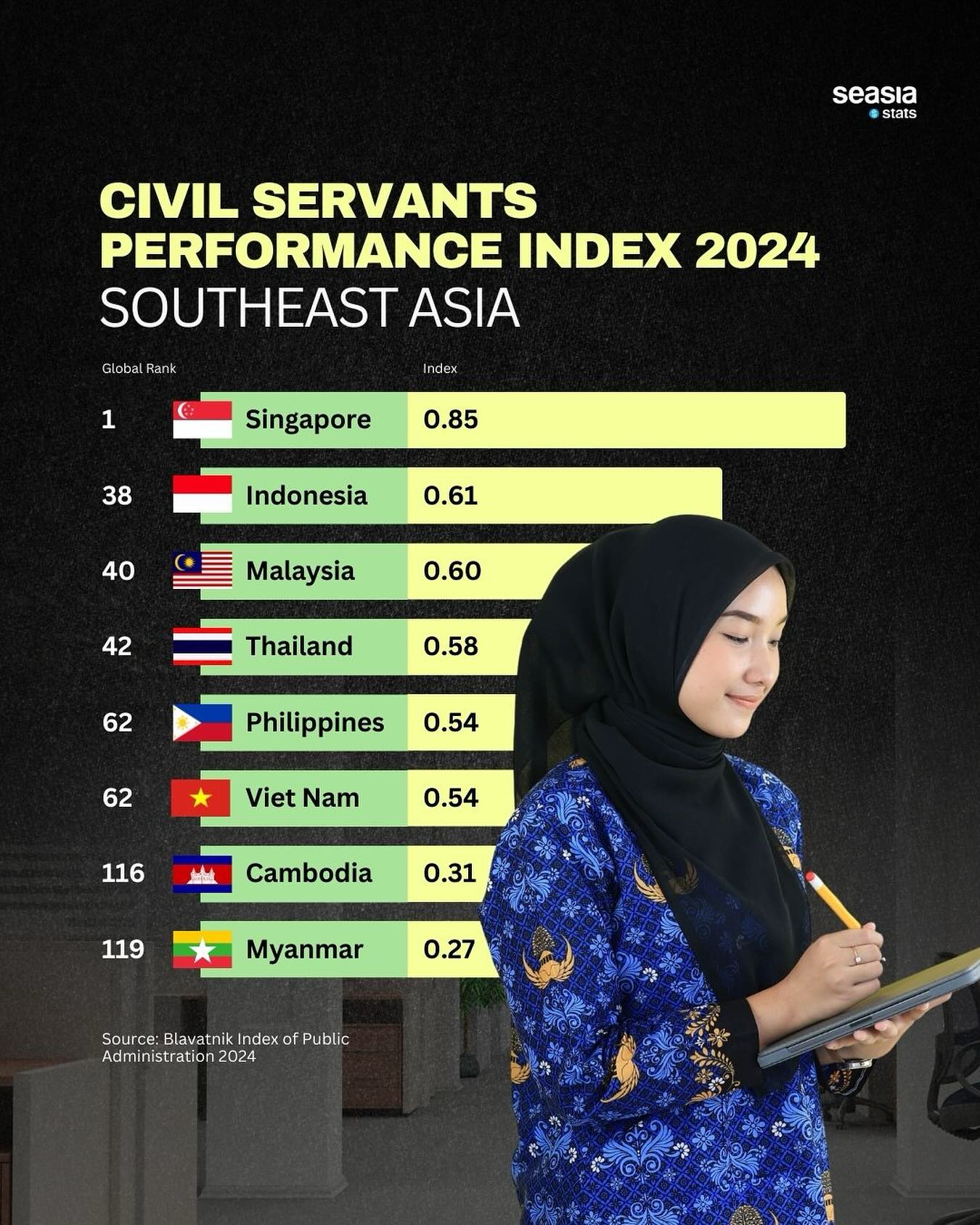
The Civil Servants Performance Index 2024 reveals significant disparities in public administration across Southeast Asia, with Singapore securing the top spot, both regionally and globally, with an impressive score of 0.85. This remarkable performance reflects Singapore’s long-standing reputation for efficiency, transparency, and effectiveness in governance. The city-state’s strong civil service is a cornerstone of its success, as it continues to set a global benchmark for good governance and administrative reforms.
Singapore’s public administration system is widely regarded for its merit-based recruitment, clear accountability structures, and a commitment to providing high-quality public services. The country’s performance highlights how effective civil service institutions can drive sustainable development, enhance public trust, and contribute to the overall success of governance.
Indonesia, Malaysia, and Thailand: Steady Progress with Challenges
Indonesia, Malaysia, and Thailand follow Singapore in the rankings, with scores of 0.61, 0.60, and 0.58, respectively. While these countries have made significant strides in improving civil service systems, they still fall far behind Singapore’s global benchmark. Indonesia, in particular, has made substantial progress in modernizing its public administration, but institutional reforms and capacity building remain ongoing challenges for the government.
Malaysia and Thailand also demonstrate steady progress in improving public administration effectiveness, although their systems are still hindered by bureaucratic inefficiencies and gaps in governance. Both countries continue to face challenges in implementing reforms, and there is room for growth in ensuring greater transparency, efficiency, and accountability in public services. Despite these challenges, these countries show potential for improvement and demonstrate a strong commitment to building more robust civil service systems.
Philippines and Vietnam: Room for Growth
The Philippines and Vietnam score 0.54 each, with a shared global rank of 62. These scores reflect moderate performance in their civil service systems, with areas for further reforms and capacity building. Both countries continue to face challenges related to bureaucratic inefficiency, corruption, and lack of access to high-quality public services, which limit the effectiveness of their public administration systems.
However, the Philippines and Vietnam have made notable strides in digital governance, decentralized governance, and public service delivery. These initiatives show promise for future improvements in governance, yet sustainable reform efforts are still required to enhance efficiency, transparency, and accountability within their civil service sectors.
Cambodia and Myanmar: Struggling with Public Administration Challenges
At the lower end of the Civil Servants Performance Index, Cambodia and Myanmar face considerable challenges in public administration effectiveness. With scores of 0.31 (ranked 116th) and 0.27 (ranked 119th), respectively, these nations experience serious governance issues, such as lack of transparency, political instability, and institutional inefficiencies that hinder public service delivery.
Cambodia and Myanmar's low rankings underscore the need for fundamental reforms in their public administration systems. Capacity building, institutional strengthening, and enhanced governance frameworks are critical for addressing widespread challenges in these countries. These efforts would help improve the effectiveness of their civil services, fostering public trust and contributing to sustainable development.
The Need for Stronger Civil Service Institutions in Southeast Asia
The wide disparity in the Civil Servants Performance Index reflects the diversity in governance capacity across Southeast Asia. While countries like Singapore have demonstrated exceptional administrative systems, others like Cambodia and Myanmar face challenges that hinder their governance potential. Strong civil service institutions remain a crucial foundation for effective governance, sustainable development, and public trust.
As Southeast Asia continues to experience economic growth, it is imperative for countries to focus on strengthening their civil service systems. This includes investing in professional development, institutional reforms, and technological innovation to enhance the efficiency and effectiveness of public administration. Ultimately, the success of Southeast Asia’s nations depends on their ability to create strong, efficient civil service institutions that can support good governance and social progress.


