

Brunei Darussalam
The Land of Unexpected Treasures
Search
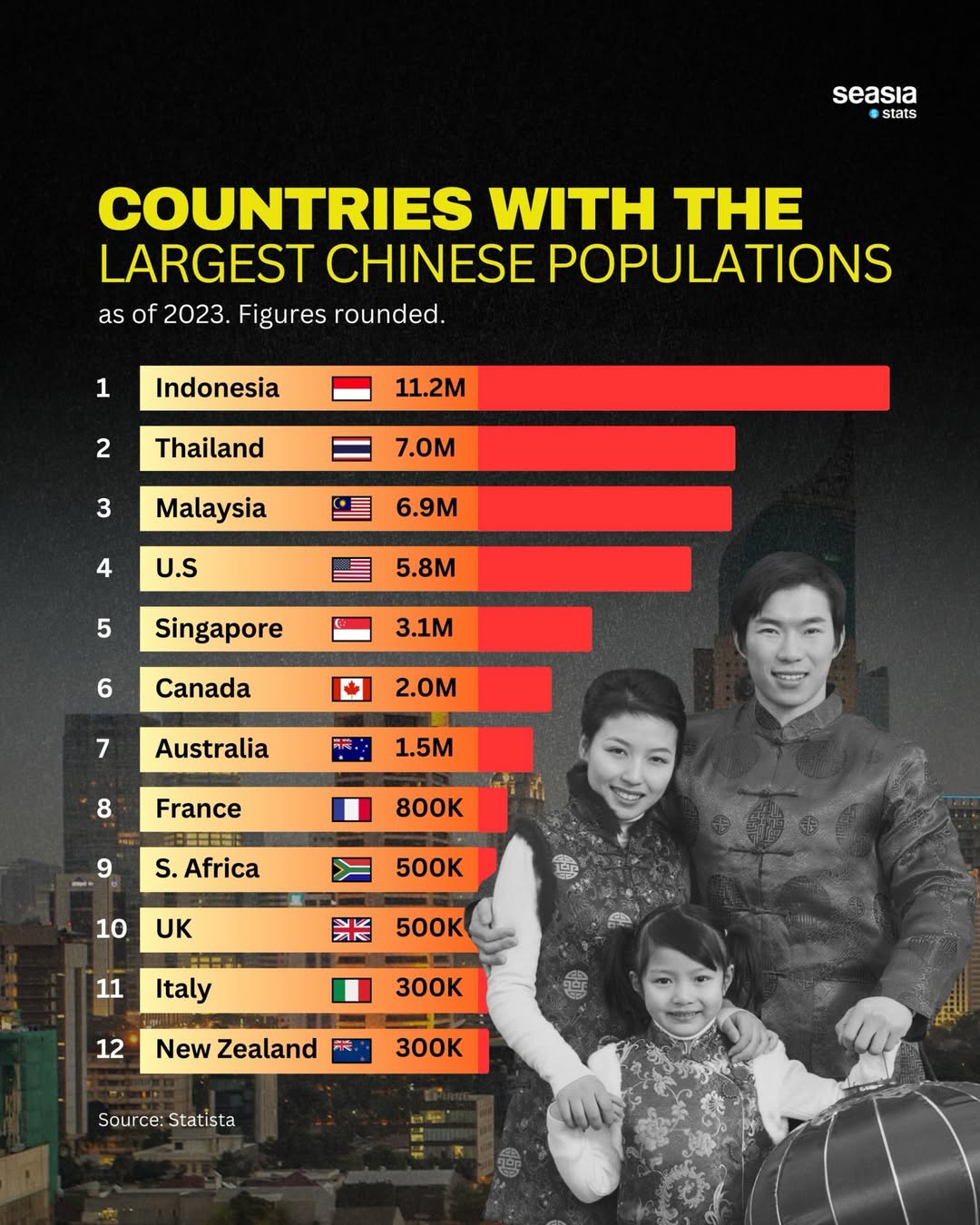
Across continents and centuries, the Chinese diaspora has become one of the world’s most influential global communities. From bustling Southeast Asian ports to modern Western cities, people of Chinese descent have shaped trade networks, cultures, and economies. The latest 2023 figures from Seasia Stats and Statista highlight just how extensive this presence is—and how deeply Southeast Asia remains its historical and demographic heartland.
Southeast Asia is home to the largest concentration of overseas Chinese populations anywhere in the world. At the forefront is Indonesia, which hosts approximately 11.2 million people of Chinese descent—the largest such population outside mainland China. The roots of this community stretch back centuries, with early migrants arriving through maritime trade routes and later waves settling during colonial and post-colonial periods.
Thailand ranks second globally, with about 7.0 million ethnic Chinese. Over generations, this community has become deeply integrated into Thai society, playing prominent roles in politics, business, and cultural life. Meanwhile, Malaysia follows closely with 6.9 million people of Chinese descent, where Chinese Malaysians form a vital pillar of the country’s multicultural identity—particularly in commerce, education, and urban development.
Singapore stands apart in Southeast Asia. With around 3.1 million ethnic Chinese residents, they form the majority of the population, accounting for over three-quarters of the nation’s residents. The country’s language, education, and economic systems reflect strong Chinese cultural influences blended with global modernity.
Beyond these major hubs, smaller but significant Chinese communities exist throughout Southeast Asia. The Philippines has a long-established Chinese-Filipino population that has been central to retail and entrepreneurship, while Vietnam’s Hoa community contributes strongly to commerce and regional trade networks. Myanmar and Cambodia also host historic Chinese merchant communities, often concentrated in key urban centers.
While Southeast Asia remains the largest center, the Chinese diaspora extends far beyond Asia. The United States ranks fourth globally with around 5.8 million Chinese Americans, reflecting decades of immigration waves tied to education, technology, and entrepreneurship. Canada follows with 2.0 million, while Australia hosts about 1.5 million residents of Chinese descent.
In Europe, France leads with approximately 800,000, followed by the United Kingdom and Italy with around 500,000 and 300,000 respectively. These communities are often more recent, with migration increasing significantly over the past few decades.
Smaller but notable Chinese populations are also found in South Africa (500,000) and New Zealand (300,000), illustrating the truly global reach of the diaspora. These communities often act as bridges between local economies and Chinese trade networks, reinforcing global business ties.
The Chinese diaspora’s influence extends well beyond population figures. Across Southeast Asia, ethnic Chinese communities have historically played a major role in trade, banking, and entrepreneurship. From Jakarta’s financial districts to Bangkok’s wholesale markets and Kuala Lumpur’s business hubs, their presence has shaped regional economic growth.
Culturally, the diaspora has also left a lasting imprint—visible in festivals like Lunar New Year, culinary traditions, and the blending of Chinese customs with local identities. In countries like Malaysia and Indonesia, these hybrid cultures have become part of national heritage.
Today, the Chinese diaspora continues to evolve. Younger generations are increasingly globalized, multilingual, and digitally connected. At the same time, their historical roots in Southeast Asia remain strong, maintaining the region’s status as the global epicenter of overseas Chinese communities.
As migration patterns shift and global economies transform, one thing remains clear: the Chinese diaspora will continue to be a powerful force linking continents, cultures, and markets across the world.


The Land of Unexpected Treasures

Land of the Khmer

The Emerald of the Equator

The Land of a Million Elephant

Land of Indigenous Malay

The Land of the Golden Pagoda

Pearl of the Orient Seas

The Lion City

Southeast Asia Region

The Land of Smiles

A Nation of the 21st Century

The Land of Blue Dragon

Beyond Southeast Asia