

Brunei Darussalam
The Land of Unexpected Treasures
Search
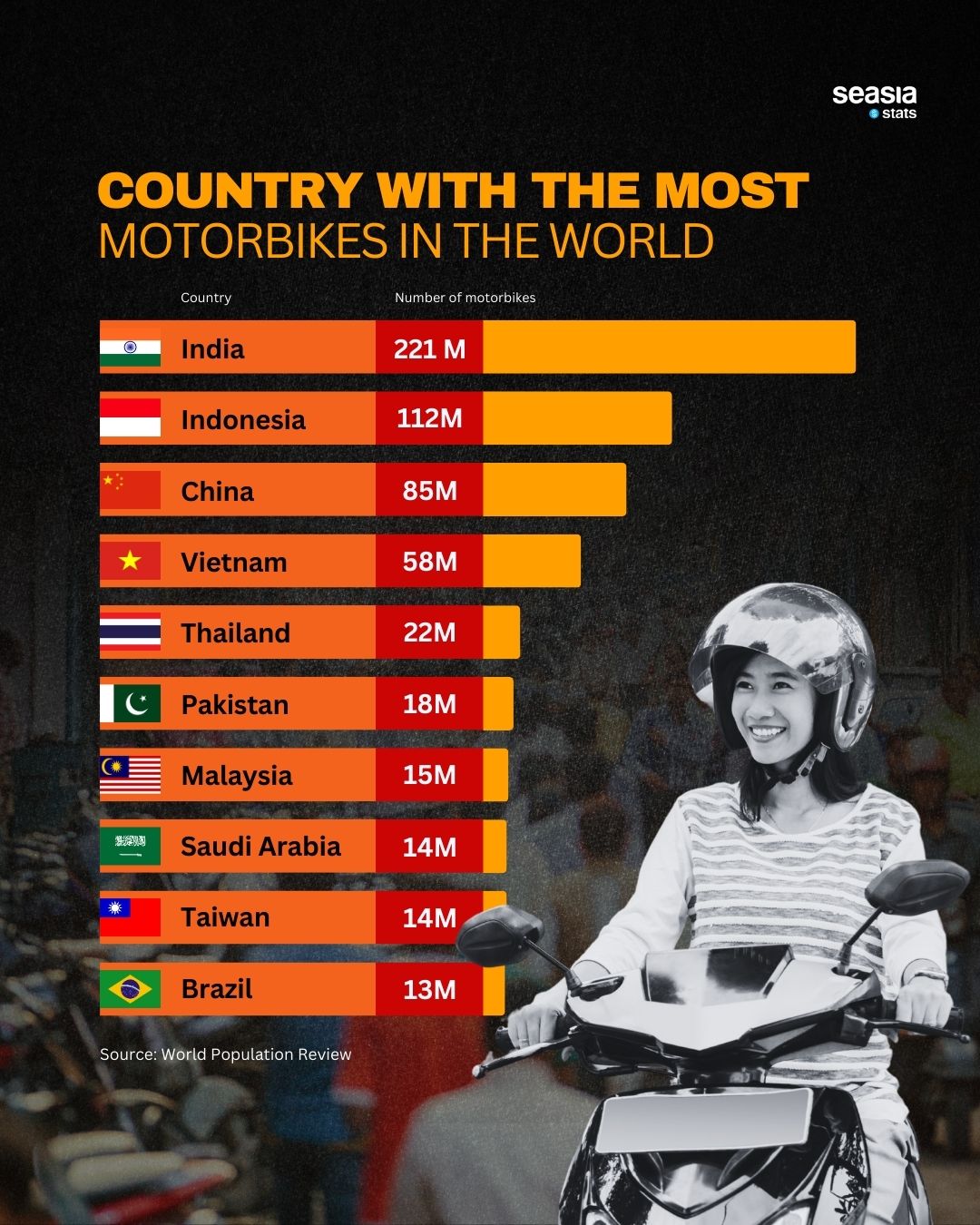
Motorcycles are more than just a practical way to get around in many countries—they are part of the cultural fabric, particularly in India. According to recent figures from World Population Review, India is the world’s largest market for motorcycles, with a staggering 221 million motorbikes on the road. This number reflects the nation’s vast population and the practicality of motorcycles in navigating the country’s often congested urban areas.
In India, motorcycles are used for everything from personal transport to small businesses, such as delivery services. With over 1.3 billion people, India’s growing middle class and expanding urbanization make motorbikes an affordable and essential option for daily life, particularly in cities where traffic congestion can make car ownership impractical for many.
Not far behind, Indonesia ranks second with 112 million motorcycles, reflecting the country’s heavy reliance on two-wheelers. Much like in India, motorcycles in Indonesia aren’t just for personal transport—they’re often used for a variety of purposes. In fact, motorcycles in Indonesia frequently serve as family vehicles, delivery services, and even make-shift street food stalls.
In densely populated cities like Jakarta, motorcycles have become the most practical solution for navigating the often-choked streets. As the nation’s economy grows and its middle class expands, motorcycle ownership is projected to continue rising, further cementing the country’s love affair with two-wheelers.
China, despite its massive population, places third in motorcycle ownership with 85 million motorbikes. While this number is large, it is relatively low compared to India and Indonesia. In many Chinese cities, cars and public transport dominate, especially in the urbanized regions. The country’s growing infrastructure of metro systems, buses, and car ownership options make motorbikes less essential for everyday life, particularly in major cities like Beijing and Shanghai.
However, motorbikes remain popular in rural areas and smaller cities, where they provide an affordable and convenient alternative to cars. Even so, China's love for technology and innovation has led to a rise in electric motorcycles, reflecting the country's push toward greener transportation solutions.
In Viet Nam, motorcycles are deeply embedded in daily life. The country ranks fourth globally with 58 million motorbikes, with scooters being the preferred choice for most families. In cities like Ha Noi and Ho Chi Minh City, motorcycles provide an essential form of transport for the masses, helping to navigate the narrow streets and heavy traffic.
Motorbikes in Viet Nam are often seen carrying entire families or used for businesses such as street food vendors, deliveries, and ride-hailing services. The nation’s affordable motorcycle market and ease of use make it a vital part of Viet Nam’s vibrant economy and culture.
Southeast Asia, as a region, has fully embraced motorcycles, with countries like Thailand, Malaysia, and Taiwan also appearing on the list. Thailand, with 22 million motorcycles, is another country where motorcycles are vital for everyday life, particularly in its urban and rural settings. Malaysia, with 15 million, and Taiwan, with 14 million, show that even smaller countries in the region rely heavily on two-wheelers.
Motorcycles have become ingrained in the culture of Southeast Asia, offering affordable mobility in densely populated cities and rural areas alike. The region's rapid urbanization, combined with rising middle-class incomes, has helped fuel the continued popularity of motorcycles.
Interestingly, Brazil is the only non-Asian country to make it into the top 10, with 13 million motorcycles on the road. While it may not rival the top Asian nations, Brazil’s position on the list highlights the global reach of motorcycles as an affordable and practical mode of transportation. In Brazil’s urban areas, motorcycles offer a solution to traffic congestion, while also supporting small businesses that rely on quick delivery services.
Motorcycles have become essential for millions of people worldwide. With India and Indonesia leading the way, and countries like China and Vietnam following closely behind, it’s clear that two-wheelers offer more than just a ride—they provide freedom, mobility, and economic opportunity. As the world continues to urbanize, the role of motorcycles in global transportation will only grow, changing the way we move, work, and live.


The Land of Unexpected Treasures

Land of the Khmer

The Emerald of the Equator

The Land of a Million Elephant

Land of Indigenous Malay

The Land of the Golden Pagoda

Pearl of the Orient Seas

The Lion City

Southeast Asia Region

The Land of Smiles

A Nation of the 21st Century

The Land of Blue Dragon

Beyond Southeast Asia