

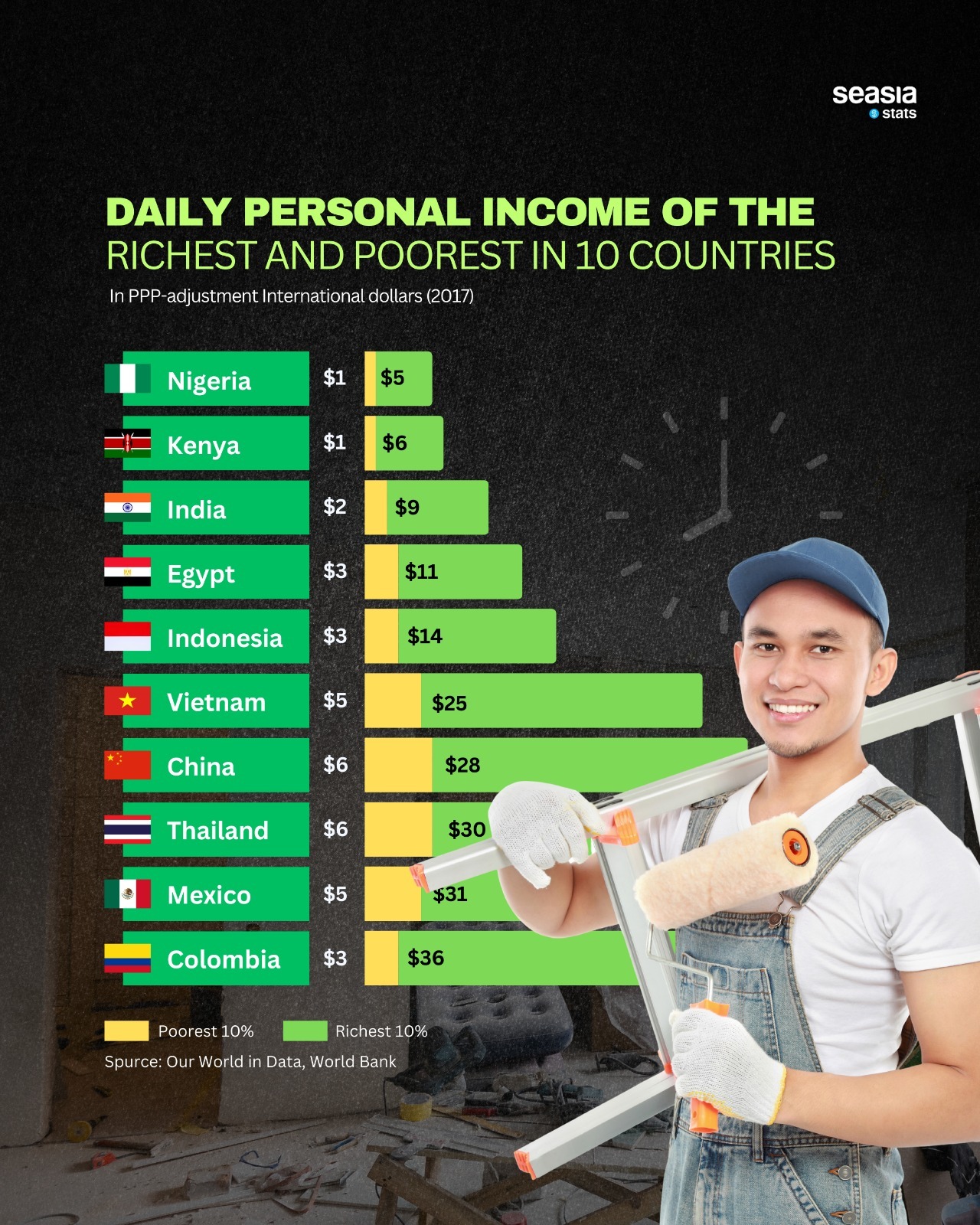
Imagine what one dollar can buy in your country—and now imagine that being your entire daily income. For millions across the world, this is a harsh reality. A recent dataset visualized by Seasia Stats, using 2017 PPP-adjusted figures from Our World in Data and the World Bank, compares the daily income of the richest and poorest 10% in 10 countries. The gaps are as jarring as they are revealing.
Africa and South Asia: Stark Gaps at the Bottom
Nigeria and Kenya top the list in terms of inequality, where the poorest earn just $1 a day, while the richest take home around $5–6. In India, the wealthiest earn $9 daily, while the poorest make $2—a small amount, yet double that of Kenya or Nigeria.
Southeast Asia: Steady Gains, But Gaps Persist
In Indonesia, the richest 10% earn $14 per day, compared to $3 for the poorest. Viet Nam and Thailand show wider upper-income margins, with the richest earning $25 and $30 respectively. Even then, the poorest 10% in Thailand only earn $6, showing that progress is not equally felt.
Latin America and China: Rising Prosperity, Unevenly Shared
Mexico and Colombia present some of the highest numbers for the top 10%—$31 and $36 respectively. But their bottom 10% still earn just $3–5. Meanwhile, China continues its rapid growth, with the wealthiest earning $28 a day and the poorest at $6, marking one of the more balanced extremes on this chart.
What This Tells Us
These income gaps aren’t just numbers—they reflect access to food, housing, education, and health. For countries aiming to grow equitably, the challenge isn’t just to raise GDP, but to ensure that rising tides actually lift all boats.


