

Brunei Darussalam
The Land of Unexpected Treasures
Search
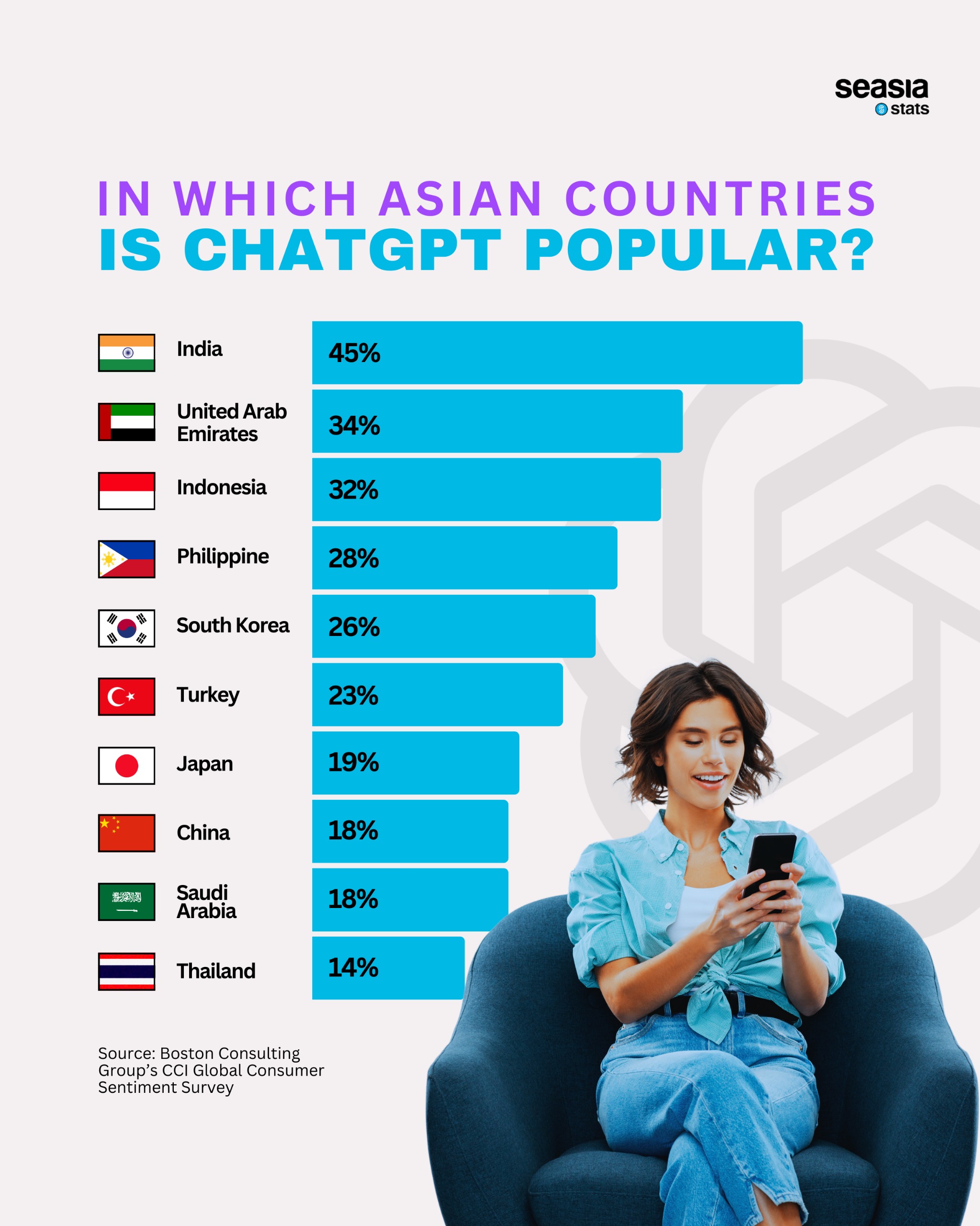
A recent survey by Boston Consulting Group’s CCI Global Consumer Sentiment Survey sheds light on ChatGPT's growing presence across Asia. The survey reveals significant variations in adoption rates, with India leading the charge and other countries showing varying levels of interest in AI technology.
India emerges as the clear leader with a remarkable 45% adoption rate. This figure highlights India’s strong embrace of ChatGPT and its potential for AI technology to disrupt various sectors, from customer service to education and business.
The UAE follows closely with a 34% adoption rate, reflecting the country’s tech-savvy population and high investment in AI technologies. The UAE's growing infrastructure and innovation-driven economy play a significant role in the increasing use of AI tools.
Indonesia ranks third, with a 32% adoption rate, indicating a significant interest in AI within the country. As one of Southeast Asia's largest markets, Indonesia is seeing an uptick in AI adoption, with AI tools like ChatGPT having the potential to enhance business efficiency, education, and communication.
The Philippines stands at 28%, showing a steady acceptance of AI technologies. The country’s growing digital infrastructure and openness to technological advancements are contributing factors to this increasing adoption rate.
South Korea, known for its strong tech industry, comes in at 26%. The country’s emphasis on innovation and technology adoption supports the gradual but steady use of ChatGPT.
These figures illustrate the diverse levels of AI adoption across Asia. India leads the way, showcasing significant enthusiasm for AI tools, while countries like the UAE, Indonesia, and the Philippines also show growing adoption rates. In contrast, countries like Japan, China, and Thailand reflect comparatively lower adoption, but this could change as AI technology becomes more embedded in daily life.
As AI continues to evolve, it will be interesting to observe how these trends develop and shape the future of AI interactions across the region.


The Land of Unexpected Treasures

Land of the Khmer

The Emerald of the Equator

The Land of a Million Elephant

Land of Indigenous Malay

The Land of the Golden Pagoda

Pearl of the Orient Seas

The Lion City

Southeast Asia Region

The Land of Smiles

A Nation of the 21st Century

The Land of Blue Dragon

Beyond Southeast Asia