

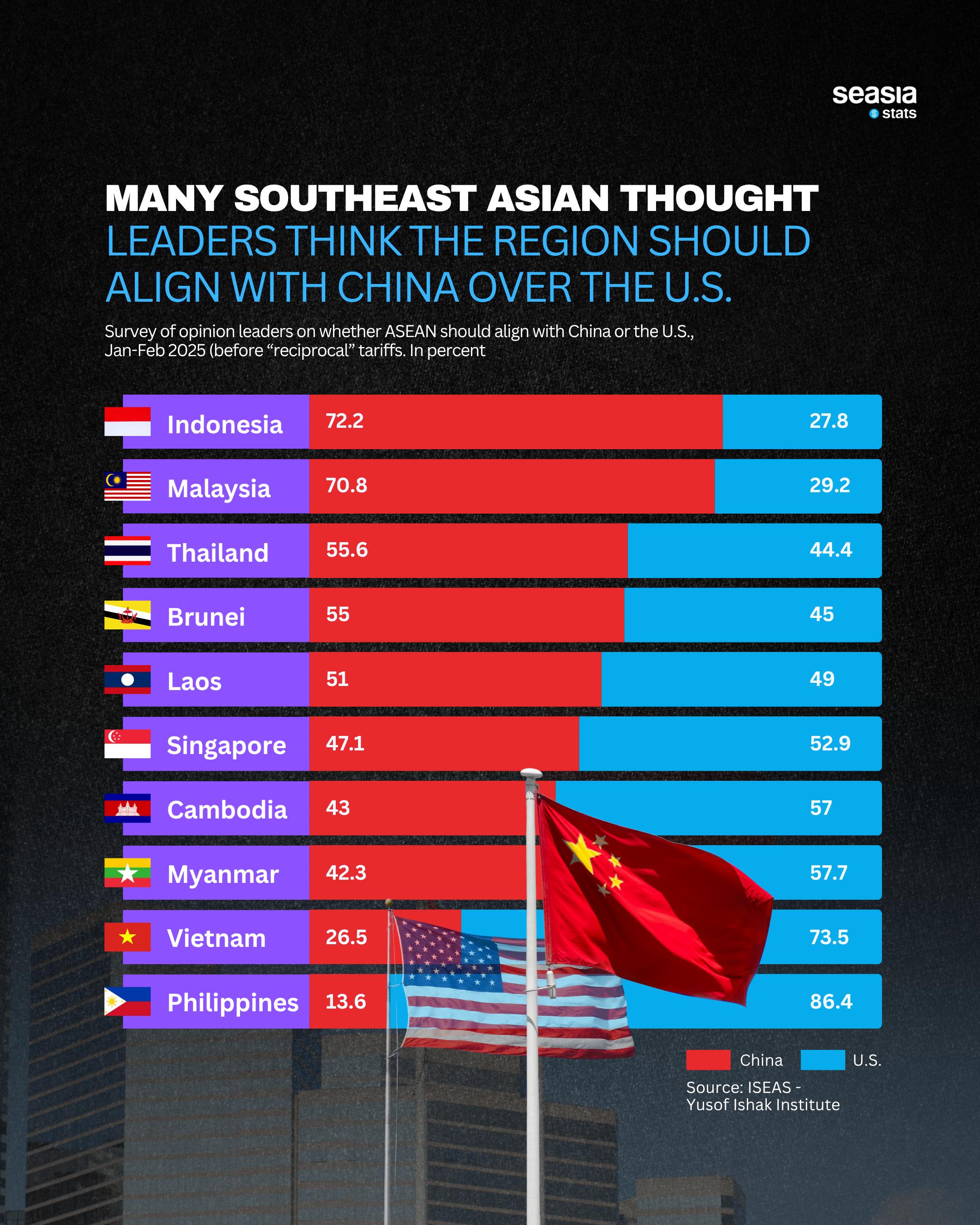
In an era marked by intensifying U.S.–China rivalry, Southeast Asia finds itself in a uniquely strategic position. A recent survey by the ISEAS–Yusof Ishak Institute, conducted just before the reciprocal tariff exchange in early 2025, paints a compelling picture: many of ASEAN’s opinion leaders favor deeper alignment with China over the United States.
The findings reveal that 72.2% of Indonesian thought leaders prefer aligning with China, followed closely by 70.8% in Malaysia. Thailand (55.6%), Brunei (55%), and Laos (51%) also show a majority leaning eastward. These numbers underscore China’s increasing diplomatic and economic influence across the region, particularly through infrastructure projects, trade, and investment flows.
Diverging Views: The U.S. Still Has Strongholds
However, the picture isn’t uniform across ASEAN. Singapore (52.9%), Myanmar (57.7%), Vietnam (73.5%), and the Philippines (86.4%) show stronger support for the United States. These nations appear to prioritize military alliances, democratic governance, or economic diversification that isn’t overly reliant on Beijing. The Philippines, in particular, reflects a dramatic shift in sentiment, likely influenced by maritime disputes in the South China Sea.
This divide highlights the non-monolithic nature of ASEAN. Countries weigh strategic alignment differently depending on domestic politics, economic dependencies, and historical ties. For some, China’s rise represents opportunity; for others, a threat.
Navigating the Indo-Pacific’s Tightrope
What this survey really captures is a region walking a tightrope. Southeast Asia is increasingly caught in the gravitational pull of two competing giants. The question isn’t just "China or the U.S.?" — it's how to maintain sovereignty, economic growth, and peace in an era of polarized global leadership.
Rather than choosing sides outright, many ASEAN nations might continue practicing what’s been dubbed “hedging”—a strategy of engagement with both superpowers while avoiding overt alignment. The outcome of this balancing act will shape not only ASEAN’s collective future, but also the stability of the broader Indo-Pacific region.
As the U.S. and China continue their tug-of-war, ASEAN’s internal diversity may become both a strength and a strategic challenge—one that demands nuance, diplomacy, and unity more than ever before.


