

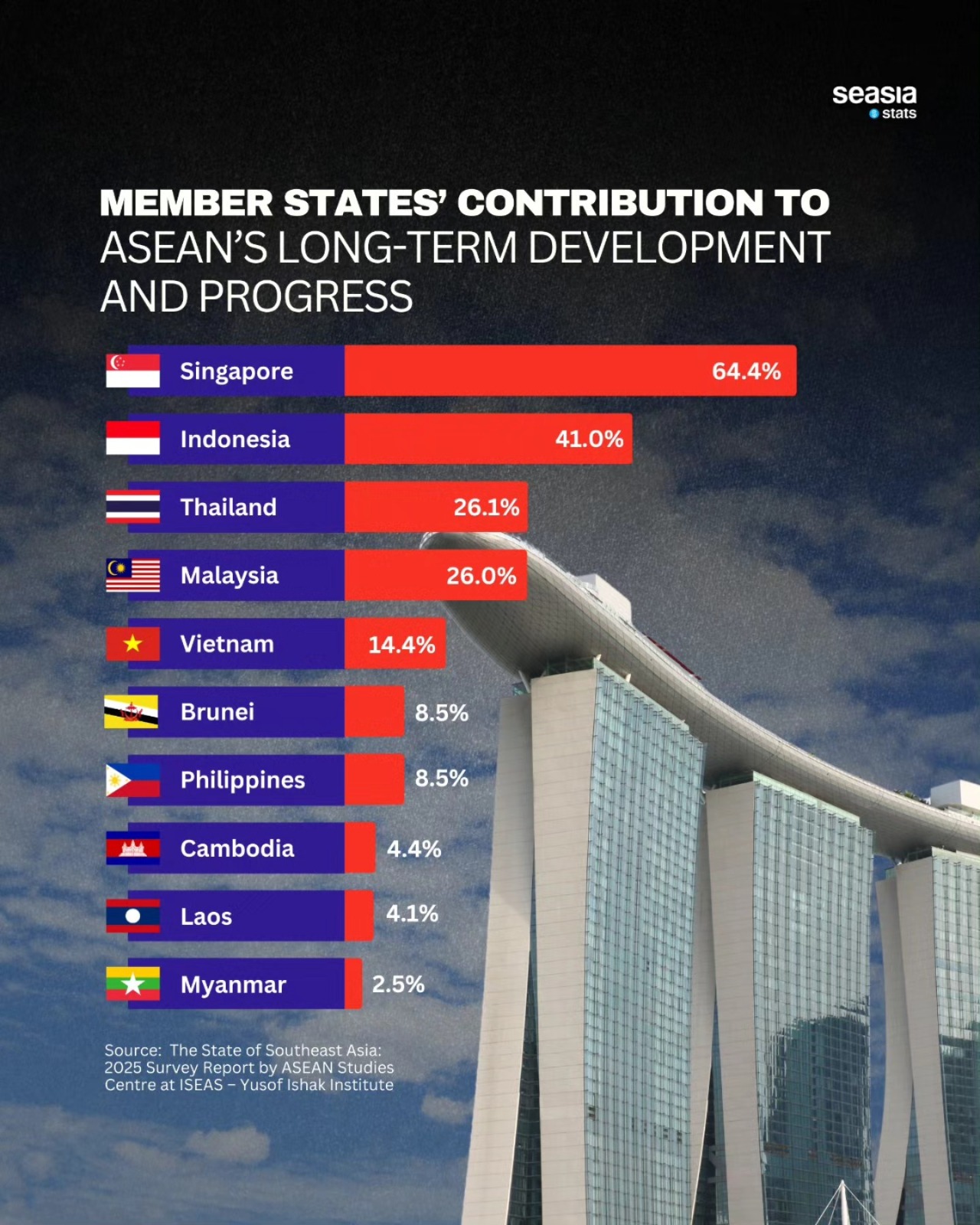
ASEAN’s journey toward regional progress relies not just on collective decisions but also on the active contributions of individual member states. According to The State of Southeast Asia 2025 Survey Report by the ASEAN Studies Centre at ISEAS – Yusof Ishak Institute, Singapore is perceived as the top contributor to the bloc’s long-term development — with Indonesia securing a strong second.
The findings offer a revealing look at how each member state is seen in terms of shaping ASEAN’s future — whether through economic strength, policy leadership, innovation, or diplomacy.
Singapore Takes the Top Spot — By a Wide Margin
With 64.4% of respondents naming Singapore as a key driver of ASEAN’s development, the city-state stands far above the rest. Known for its consistent leadership in finance, digital innovation, and regional diplomacy, Singapore continues to play an outsized role despite its small size.
Its reputation for efficiency, rule of law, and long-term planning also boosts its credibility as a model nation in the region.
Indonesia’s Regional Clout Secures Second Place
Indonesia, Southeast Asia’s largest economy and most populous nation, comes in second at 41.0%. Its position reflects its growing global influence and its role in steering ASEAN discussions on regional security, energy, and sustainability — especially during its recent chairmanship.
As the de facto political heavyweight of ASEAN, Indonesia’s voice is crucial in setting long-term strategic directions for the bloc.
Thailand, Malaysia, and Viet Nam Round Out the Midfield
Thailand and Malaysia are closely matched, with 26.1% and 26.0% of respondents recognizing their contributions, respectively. Both nations have long histories of engagement in ASEAN matters and are considered reliable economic and diplomatic actors in the region.
Meanwhile, Viet Nam, recognized by 14.4% of participants, continues to rise as a manufacturing hub and active voice in regional policy debates — especially in areas like trade and maritime affairs.
Lower Tiers Reflect Smaller Economies and Internal Challenges
Brunei Darussalam and the Philippines were each recognized by 8.5% of respondents, suggesting a moderate but notable role in ASEAN’s progress. In contrast, Cambodia (4.4%), Laos (4.1%), and Myanmar (2.5%) were viewed as the least influential in terms of long-term development — a likely reflection of both economic scale and internal governance issues.
These figures reflect not just hard power but also perception — how each state is seen in its ability to contribute meaningfully to ASEAN's future.
Perception Matters in Regional Progress
While actual contributions can be measured in trade, policy, and cooperation, perceived contribution is just as telling. It reveals which nations are trusted to lead, to innovate, and to build consensus — all crucial for ASEAN’s ambitions to remain central and cohesive in an increasingly competitive Indo-Pacific.
As Southeast Asia faces shared challenges ahead, these rankings serve as a reminder that influence isn’t just about size — it’s about leadership, consistency, and trust.


