

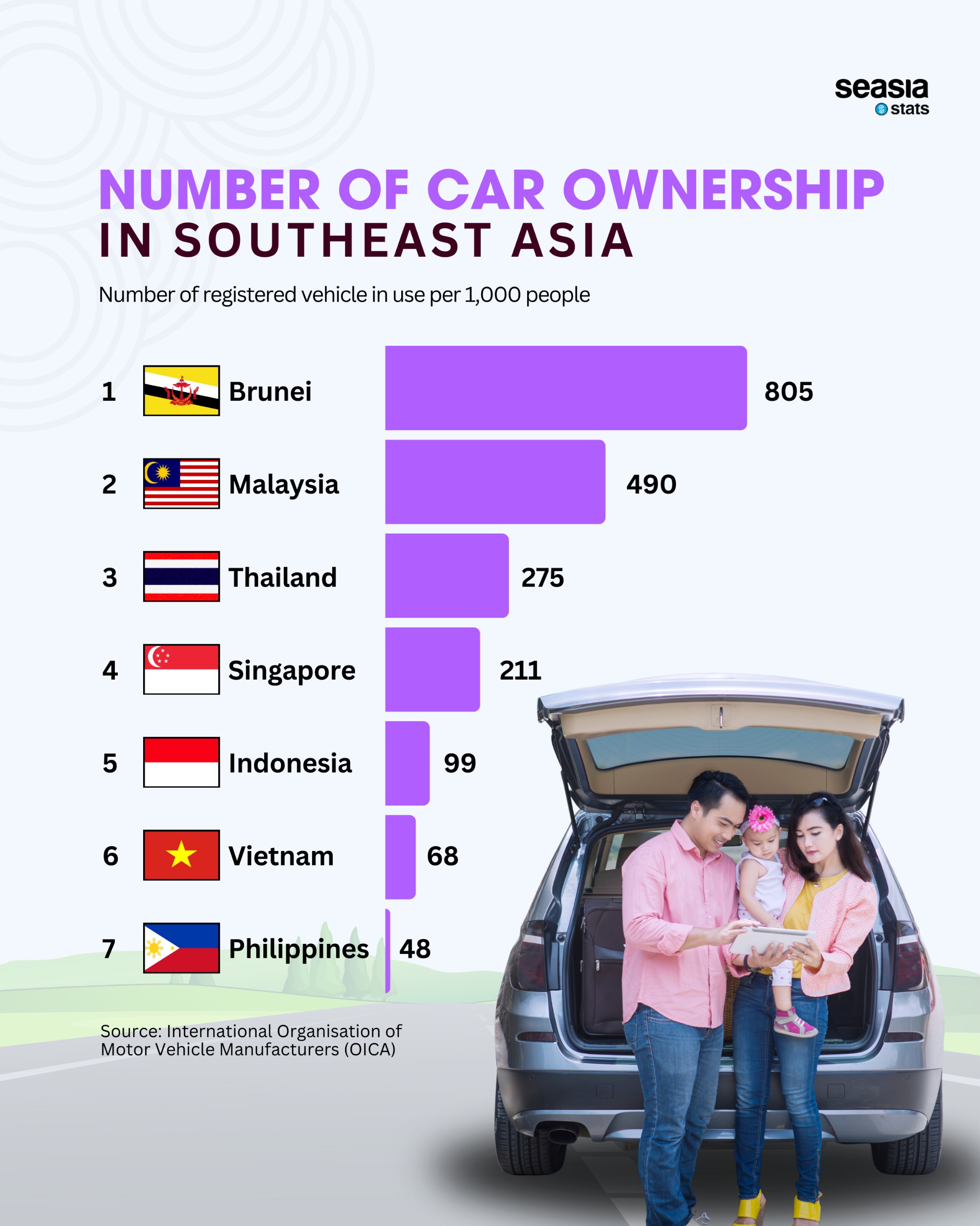
Car ownership varies significantly across Southeast Asia, reflecting economic conditions, infrastructure, and cultural preferences. Some countries have high vehicle ownership rates due to strong purchasing power and automotive industries, while others rely more on public transportation and alternative mobility solutions. Here’s a look at the number of registered vehicles per 1,000 people across the region.
Brunei Darussalam: The Highest Car Ownership Rate
With 805 vehicles per 1,000 people, Brunei Darussalam leads the region in car ownership. The country's high income levels, affordable fuel prices, and low population density contribute to a strong preference for personal vehicles over public transport.
Malaysia: A Thriving Automotive Industry
Malaysia ranks second with 490 vehicles per 1,000 people. A well-developed automotive sector, rising incomes, and strong local car brands like Proton and Perodua drive high car ownership in the country.
Thailand: A Growing Car Market
Thailand, known for its strong automotive manufacturing industry, has 275 vehicles per 1,000 people. Many residents prefer personal vehicles due to long commuting distances and an expanding road network.
Singapore: Strict Regulations on Car Ownership
Despite its advanced economy, Singapore has 211 vehicles per 1,000 people due to government policies that regulate car ownership. High vehicle taxes, the Certificate of Entitlement (COE) system, and efficient public transportation encourage residents to rely on buses and trains instead of private cars.
Indonesia: Rising Middle Class, Increasing Car Ownership
Indonesia has 99 vehicles per 1,000 people, a number that continues to grow as the country experiences urbanization and economic expansion. While many still rely on motorcycles and public transport, car ownership is expected to rise in the coming years.
Viet Nam: Emerging Car Market
With 68 vehicles per 1,000 people, Viet Nam is witnessing steady growth in car ownership, fueled by a rising middle class and improving infrastructure. However, motorcycles remain the dominant mode of transportation in major cities like Hà Nội and Hồ Chí Minh City.
The Philippines: Public Transport Dominates
At 48 vehicles per 1,000 people, the Philippines has the lowest car ownership rate in the region. Many residents depend on jeepneys, buses, and trains due to congested urban areas and economic constraints.
The Future of Car Ownership in Southeast Asia
Car ownership in Southeast Asia is shaped by government policies, urban development, and economic growth. While some nations embrace personal vehicle use, others prioritize public transport and alternative mobility solutions. As the region continues to develop, trends in electric vehicles, ride-sharing, and infrastructure improvements will play a crucial role in shaping the future of mobility.


