

Brunei Darussalam
The Land of Unexpected Treasures
Search
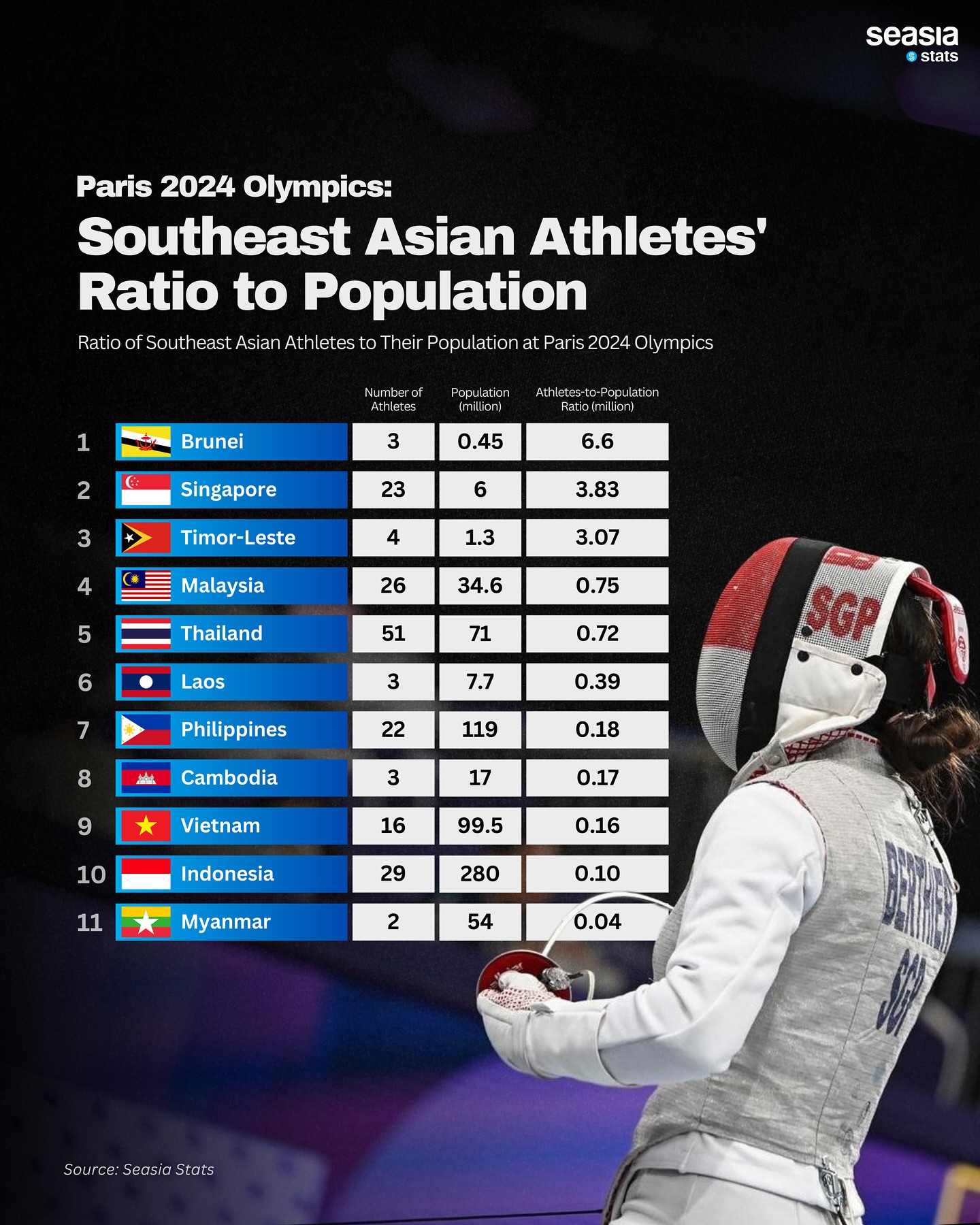
As the Paris 2024 Olympics progresses, an analysis of Southeast Asian nations' athlete-to-population ratios provides intriguing insights into the representation of these countries on the global stage. The ratio, which compares the number of athletes to the total population, reflects how each nation’s Olympic participation scales with its demographic size.
Brunei Darussalam
Brunei Darussalam leads Southeast Asia with the highest athlete-to-population ratio. Despite sending only 3 athletes, the country's small population results in a high ratio of 6.6. This notable representation highlights Brunei Darussalam's strong focus on Olympic participation relative to its size.
Singapore
Singapore follows with a ratio of 3.83. The country's substantial athlete contingent relative to its population reflects its robust sports programs and support systems for Olympians.
Timor-Leste
Timor-Leste’s ratio of 3.07 showcases its significant Olympic representation given its population size, emphasizing the country’s dedication to sports despite its smaller scale.
Malaysia
Malaysia’s ratio of 0.75 reflects its moderate representation, with a larger athlete pool spread over a relatively larger population.
Thailand
Thailand’s ratio of 0.72 highlights a significant Olympic presence relative to its population, showcasing its strong sports culture.
Laos
Laos has a ratio of 0.39, indicating a modest level of Olympic participation relative to its population.
Philippines
The Philippines, with a ratio of 0.18, reflects a relatively lower representation of athletes compared to its large population.
Cambodia
Cambodia’s ratio of 0.17 is similar to that of the Philippines, indicating limited Olympic representation relative to its population.
Viet Nam
Viet Nam’s ratio of 0.16 highlights a lower athlete representation compared to its sizable population.
Indonesia
Indonesia has the lowest ratio of 0.10, reflecting a lower level of Olympic representation relative to its large population.
Myanmar
Myanmar’s ratio of 0.04 is the lowest in Southeast Asia, with just 2 athletes representing a large population base.
The athlete-to-population ratios for Southeast Asian nations at the Paris 2024 Olympics reveal diverse levels of representation and participation. Brunei’s high ratio underscores its significant Olympic focus relative to its size, while countries like Myanmar and Indonesia show lower ratios, reflecting the challenges they face in scaling Olympic participation to their larger populations. These figures provide a snapshot of how each country’s Olympic efforts align with its demographic profile.


The Land of Unexpected Treasures

Land of the Khmer

The Emerald of the Equator

The Land of a Million Elephant

Land of Indigenous Malay

The Land of the Golden Pagoda

Pearl of the Orient Seas

The Lion City

Southeast Asia Region

The Land of Smiles

A Nation of the 21st Century

The Land of Blue Dragon

Beyond Southeast Asia