

Brunei Darussalam
The Land of Unexpected Treasures
Search
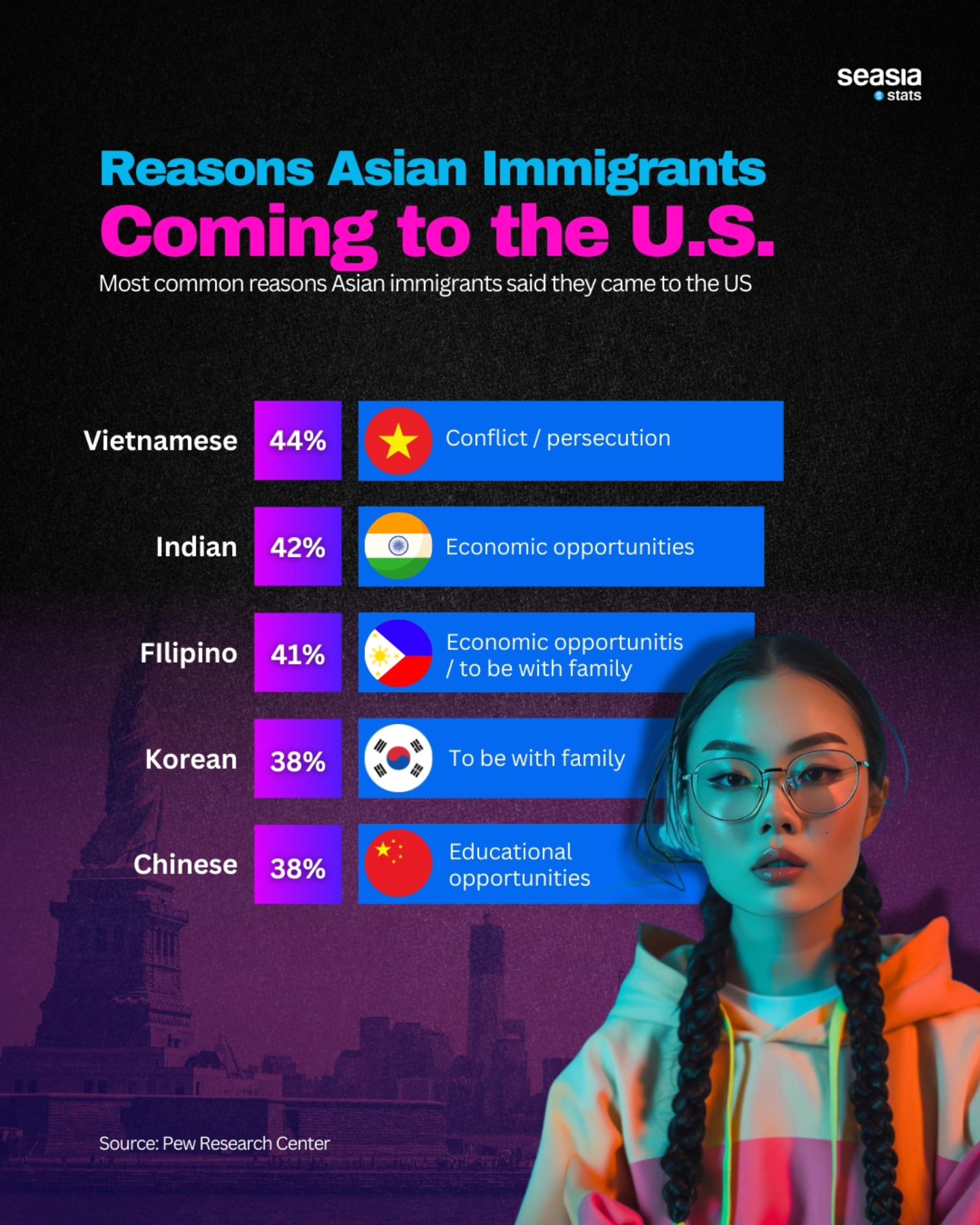
A survey by the Pew Research Center revealed that Asian immigrants to the United States have a variety of reasons for relocating, though some motivations overlap across different countries. The reasons for migration can be distinct, depending on factors such as educational, economic, familial, or political influences. Here's an overview of the key factors driving immigration from specific Asian countries:
China
For Chinese immigrants, educational opportunities were the leading reason for relocation, with 38 percent citing this as their primary motivation. This aligns with the fact that Chinese students make up the largest group of international students in the U.S. Many Chinese immigrants are attracted to the U.S. for advanced studies and career prospects. Family reunification followed closely as a reason, with 31 percent of Chinese immigrants seeking to be reunited with family members already in the U.S.
India
Indians were primarily driven by economic opportunities, with 42 percent indicating this as their main reason for immigration. India’s rapidly growing economy has provided many opportunities for skilled workers, but the U.S. is often seen as offering better prospects for high-paying jobs, especially in fields like technology and medicine. As a result, the U.S. has become a popular destination for Indian professionals. Indian immigrants also prioritize education, with many coming to pursue higher education and settle thereafter.
Viet Nam
Vietnamese immigrants have a unique history tied to escape and refuge. The largest group of Vietnamese immigrants came to the U.S. to escape conflict and persecution, with 44 percent citing this as their main reason for migration. The U.S. served as a refuge for those fleeing the aftermath of the Viet Nam War. Family reunification was the second-most common reason for Vietnamese migration, with 29 percent of immigrants indicating this factor.
Philippines
For Filipinos, both economic opportunity and family reunification were significant motivators, with 41 percent citing the former and another 41 percent indicating family as a reason for moving. The historical connection between the U.S. and the Philippines, dating back to the early 20th century after the U.S. annexed the Philippines, has contributed to sustained immigration from the country. Many Filipinos initially moved for employment opportunities, particularly in healthcare and other service sectors.
South Korea
South Korean immigration to the U.S. has deep historical roots, particularly during and after the Korean War. The largest portion of South Korean immigrants (38 percent) moved to the U.S. to reunite with family, followed by 28 percent seeking educational opportunities. The ties between South Korea and the U.S. were strengthened during the war and continued through later migration waves, making family reunification a strong driver for many South Koreans.
Across the board, a significant portion of Asian immigrants expressed a willingness to move to the U.S. again. Nearly three-quarters of all surveyed immigrants stated that, if given the chance, they would relocate to the U.S. once more. However, the percentage was lower among Indian immigrants, with two-thirds expressing this sentiment. Additionally, 15 percent of Indians mentioned that they would prefer to remain in their home country if given the choice, reflecting a shift in attitudes as India continues to grow economically.
The survey reveals that while educational and economic factors dominate the motivations for immigration, family reunification also plays a central role across various Asian countries. For some groups, such as Vietnamese immigrants, the U.S. also represents a place of refuge and safety. These diverse reasons contribute to the varied experiences of Asian immigrants in the U.S., shaping the immigrant landscape of the nation.


The Land of Unexpected Treasures

Land of the Khmer

The Emerald of the Equator

The Land of a Million Elephant

Land of Indigenous Malay

The Land of the Golden Pagoda

Pearl of the Orient Seas

The Lion City

Southeast Asia Region

The Land of Smiles

A Nation of the 21st Century

The Land of Blue Dragon

Beyond Southeast Asia