

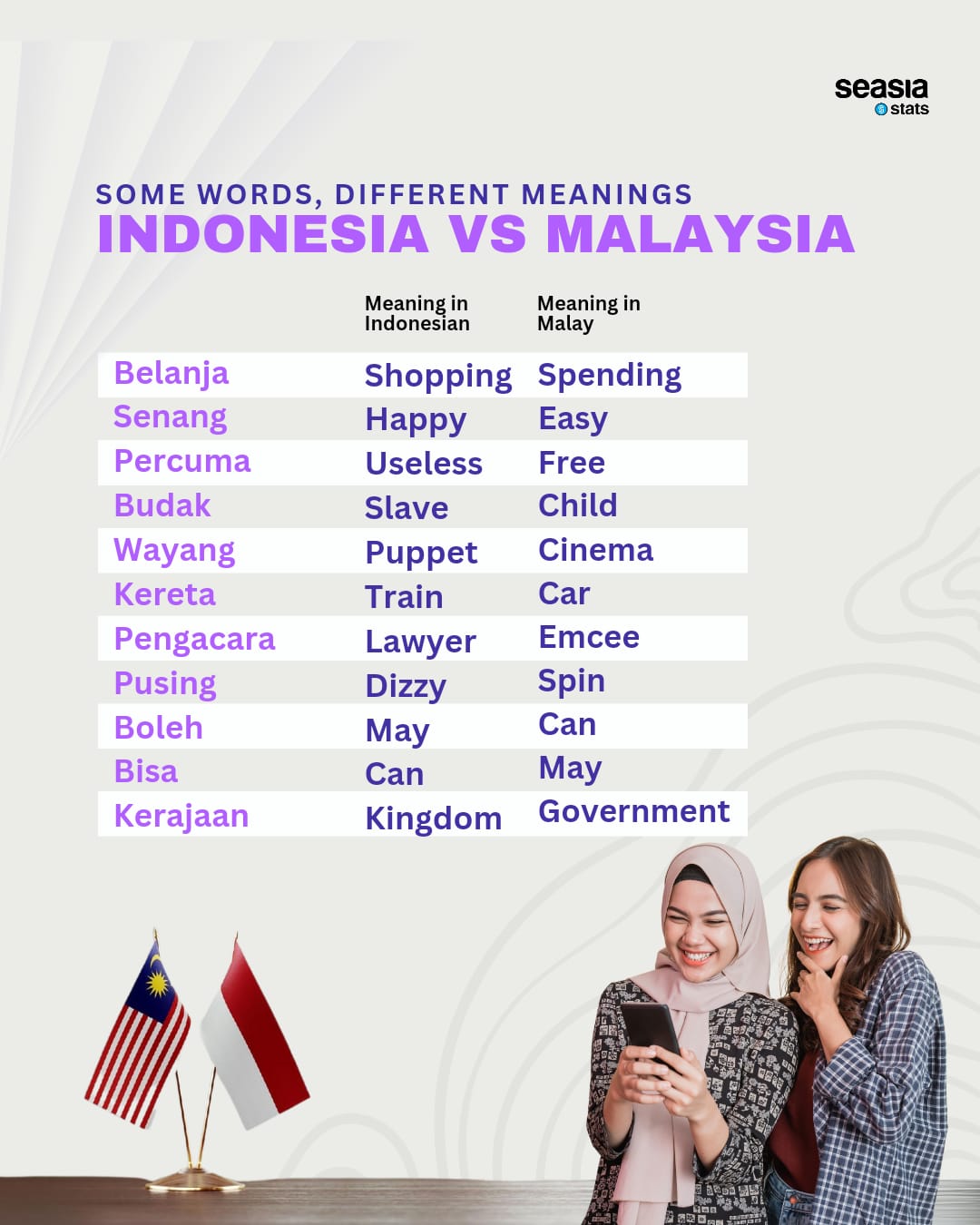
Indonesian and Malay are two closely related languages that stem from the same linguistic roots, making them mutually intelligible to a large extent. Speakers of both languages can generally understand each other in casual conversation, and many words are interchangeable. However, despite the shared origins, there are significant vocabulary differences where identical words carry distinct meanings in each language. These differences can lead to interesting—and sometimes humorous—misunderstandings.
Everyday Words with Different Meanings
Some words in Indonesian and Malay are similar in form but carry very different meanings. For example, in Indonesian, the word "Belanja" means shopping, while in Malay, it refers to spending money. Similarly, the word "Senang" in Indonesian means happy, but in Malay, it means easy. Although these words may not cause major communication breakdowns, they can shape the context of a conversation, and speakers may need to adjust their interpretation accordingly.
Words with Drastic Differences in Meaning
Other words have more significant differences that can lead to confusion. For instance, the term "Budak" means slave in Indonesian but refers to a child in Malay. Similarly, "Kereta" is used by Indonesians to refer to a train, but in Malay, it means car. Another notable example is "Pengacara," which means lawyer in Indonesian, while in Malay it refers to an emcee. These shifts in meaning can sometimes require clarification, particularly in professional or formal settings, as the intended meaning might be misunderstood.
Functional Words with Flipped Meanings
Interestingly, functional words like "Boleh" and "Bisa" can also create confusion, as their meanings are reversed between the two languages. In Indonesian, "Bisa" means "can" or "able to," and "Boleh" means "may" or "allowed to." In contrast, in Malay, the meanings of these words are flipped—"Boleh" means "can," while "Bisa" means "may." These subtle differences can cause moments of confusion in daily exchanges, especially for those who are more accustomed to one language over the other.
Bridging the Linguistic Gap
Despite these vocabulary differences, the overlap in grammar and sentence structure allows for smooth communication between Indonesian and Malay speakers. In many cases, words can be intuitively understood, and speakers can adjust their language depending on context. This mutual intelligibility, along with the flexibility to clarify meanings when necessary, helps bridge any linguistic gaps and allows both sides to engage in meaningful conversation with minimal difficulty.


