

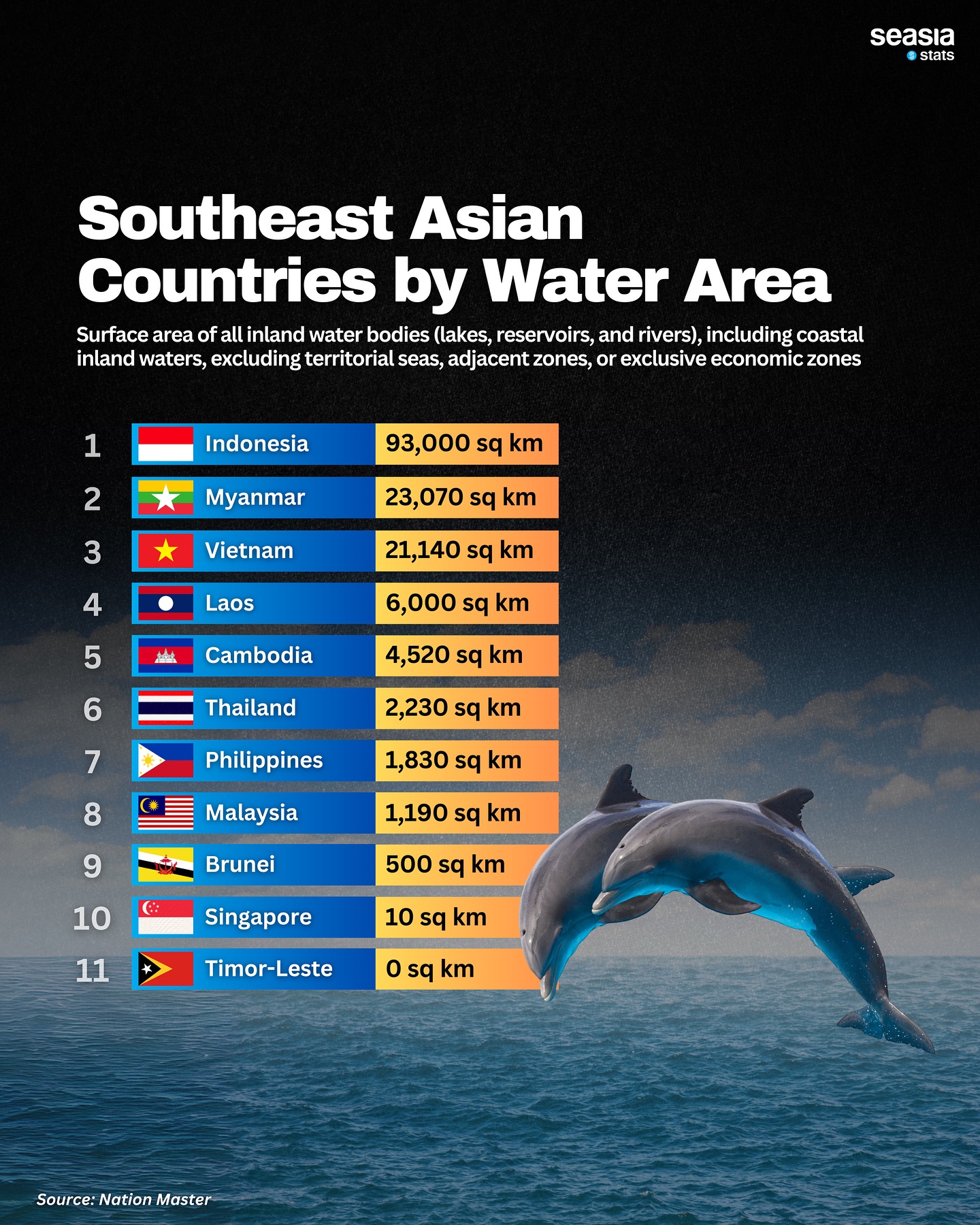
In Southeast Asia, when considering the water area of countries based on the surface area of inland water bodies, Indonesia emerges as the leader with a substantial 93,000 square kilometers. This vast expanse includes lakes, reservoirs, rivers, and coastal inland waters within the country's borders.
Following Indonesia, Myanmar holds a significant water area of 23,070 square kilometers, contributing to its geographical diversity and resources. Vietnam comes next with 21,140 square kilometers of water area, a crucial component for its agricultural and economic activities, especially in the Mekong Delta region.
Laos follows with 6,000 square kilometers of inland water, supporting its landlocked geography with rivers like the Mekong forming essential lifelines. Cambodia trails closely with 4,520 square kilometers, similarly reliant on its water resources, particularly from the Mekong River.
Thailand's water area is measured at 2,230 square kilometers, while the Philippines has 1,830 square kilometers. These figures underline the importance of water resources in these countries for various purposes, including agriculture, transportation, and livelihoods.
Malaysia and Brunei have comparatively smaller water areas, with Malaysia having 1,190 square kilometers and Brunei with 500 square kilometers. However, these figures are still significant for these nations' ecosystems and economic activities.
Singapore, being a city-state, has a minimal water area of just 10 square kilometers. Despite its small size, Singapore has effectively managed its water resources to ensure sustainability and security.
Lastly, East Timor, though situated in the Southeast Asian region, does not have any reported inland water bodies, highlighting its unique geographical characteristics compared to its neighbors.
These figures provide insights into the distribution and significance of water resources across Southeast Asian countries, emphasizing their importance for the region's development and sustainability.


