

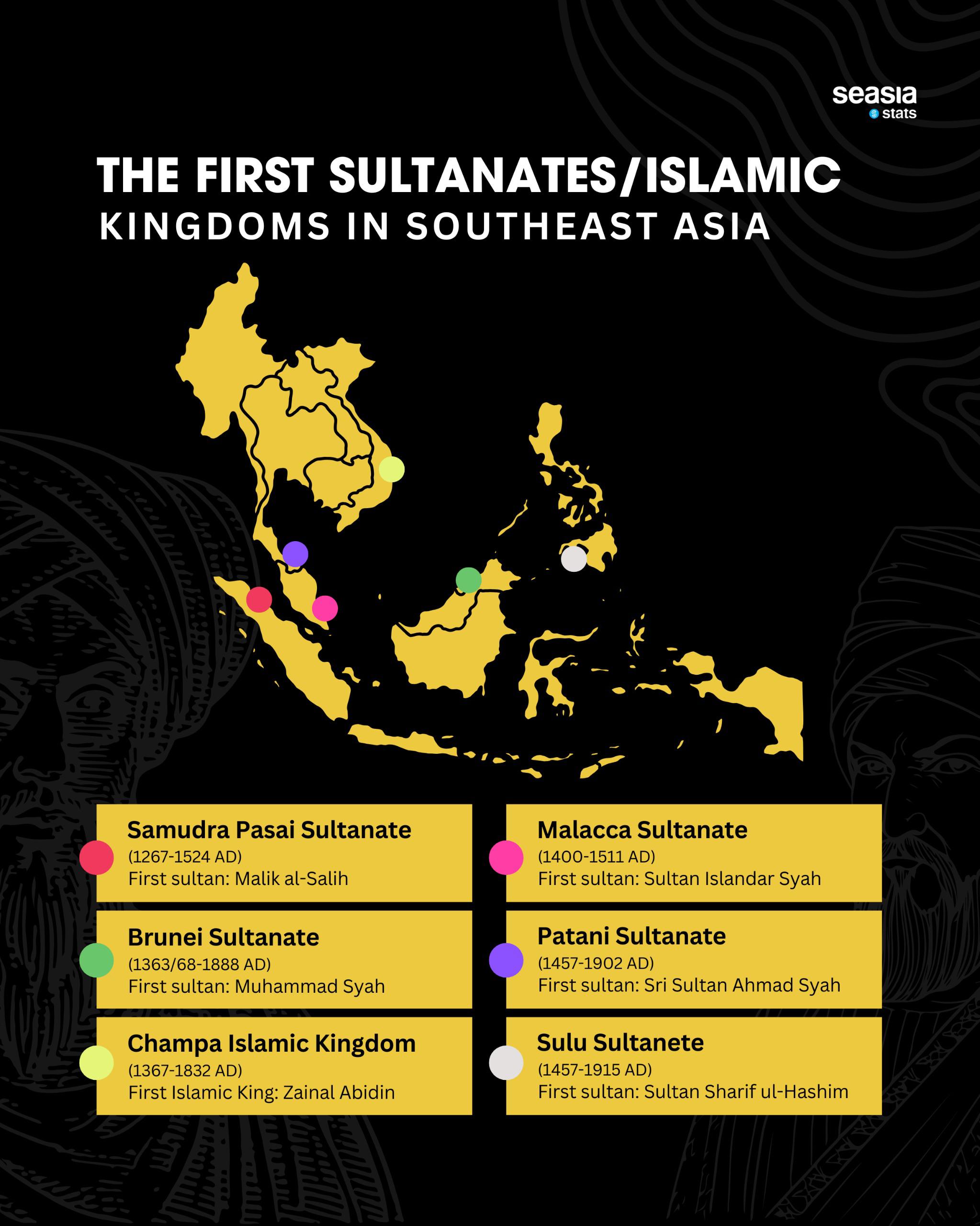
Southeast Asia’s early Islamic sultanates played a pivotal role in shaping the region’s religious, cultural, and political evolution. These kingdoms not only spread Islam but also established thriving trade networks, governance systems, and scholarly institutions that continue to influence Southeast Asia today.
1. Samudra Pasai Sultanate (1267–1524 AD)
- First Sultan: Malik al-Salih
- Location: Northern Sumatra, Indonesia
Recognized as the earliest Islamic kingdom in Southeast Asia, Samudra Pasai became a significant hub for trade and Islamic scholarship. It was instrumental in introducing Islam to the region, attracting scholars from the Middle East and fostering the use of Jawi script in religious and administrative texts.
2. Brunei Sultanate (1363/68–1888 AD – Present Day)
- First Sultan: Muhammad Syah
- Location: Borneo (Present-day Brunei Darussalam)
Founded in the 14th century, the Brunei Sultanate expanded into a maritime power with influence over Borneo, the Sulu Sea, and the southern Philippines. It remains one of the world’s oldest surviving monarchies, continuing as the modern Brunei Darussalam, where Islam remains central to governance and society.
3. Champa Islamic Kingdom (1367–1832 AD)
- First Islamic King: Zainal Abidin
- Location: Present-day Central and Southern Viet Nam
The Champa Kingdom had long been a Hindu-Buddhist state, but by the 14th century, Islamic influence grew under King Zainal Abidin. Champa became a gateway for Islam in mainland Southeast Asia, connecting it to the wider Islamic world through trade and migration. However, Viet Namese expansion in the 19th century led to its annexation.
4. Malacca Sultanate (1400–1511 AD)
- First Sultan: Sultan Iskandar Syah
- Location: Malay Peninsula (Present-day Malaysia)
The Malacca Sultanate was one of the most powerful trading empires in Southeast Asia, strategically located along the Malacca Strait. It played a crucial role in Islamizing the Malay Archipelago, influencing governance, legal systems (Hukum Kanun Melaka), and cultural practices. The Portuguese conquest in 1511 marked its decline but not the end of its influence.
5. Patani Sultanate (1457–1902 AD)
- First Sultan: Sri Sultan Ahmad Syah
- Location: Southern Thailand
Patani became a prominent center of Islamic learning and trade, with strong ties to the Ottoman Empire and the wider Muslim world. It flourished culturally and economically but faced increasing pressure from Siamese (Thai) expansion, leading to its eventual decline and incorporation into modern Thailand.
6. Sulu Sultanate (1457–1915 AD)
- First Sultan: Sultan Sharif ul-Hashim
- Location: Southern Philippines and parts of Borneo
The Sulu Sultanate emerged as a dominant force in regional trade, maritime control, and Islamic propagation. It maintained strong diplomatic and economic ties with China, the Ottoman Empire, and neighboring sultanates. The arrival of Spanish and later American colonial forces led to its decline, but its legacy persists among the Moro people of the Philippines.
Enduring Legacy of the Early Sultanates
These Islamic sultanates not only advanced Islam but also strengthened Southeast Asia’s connections to global trade, scholarship, and governance. Their legacies endure in:
- Architecture: Mosques, palaces, and calligraphy.
- Legal Systems: Islamic law in governance and trade.
- Cultural Practices: Language, literature, and traditions.
While some sultanates declined due to colonialism and regional conflicts, their historical contributions remain integral to Southeast Asia’s identity and heritage.
Source: Historical records and sultanate chronologies.


