

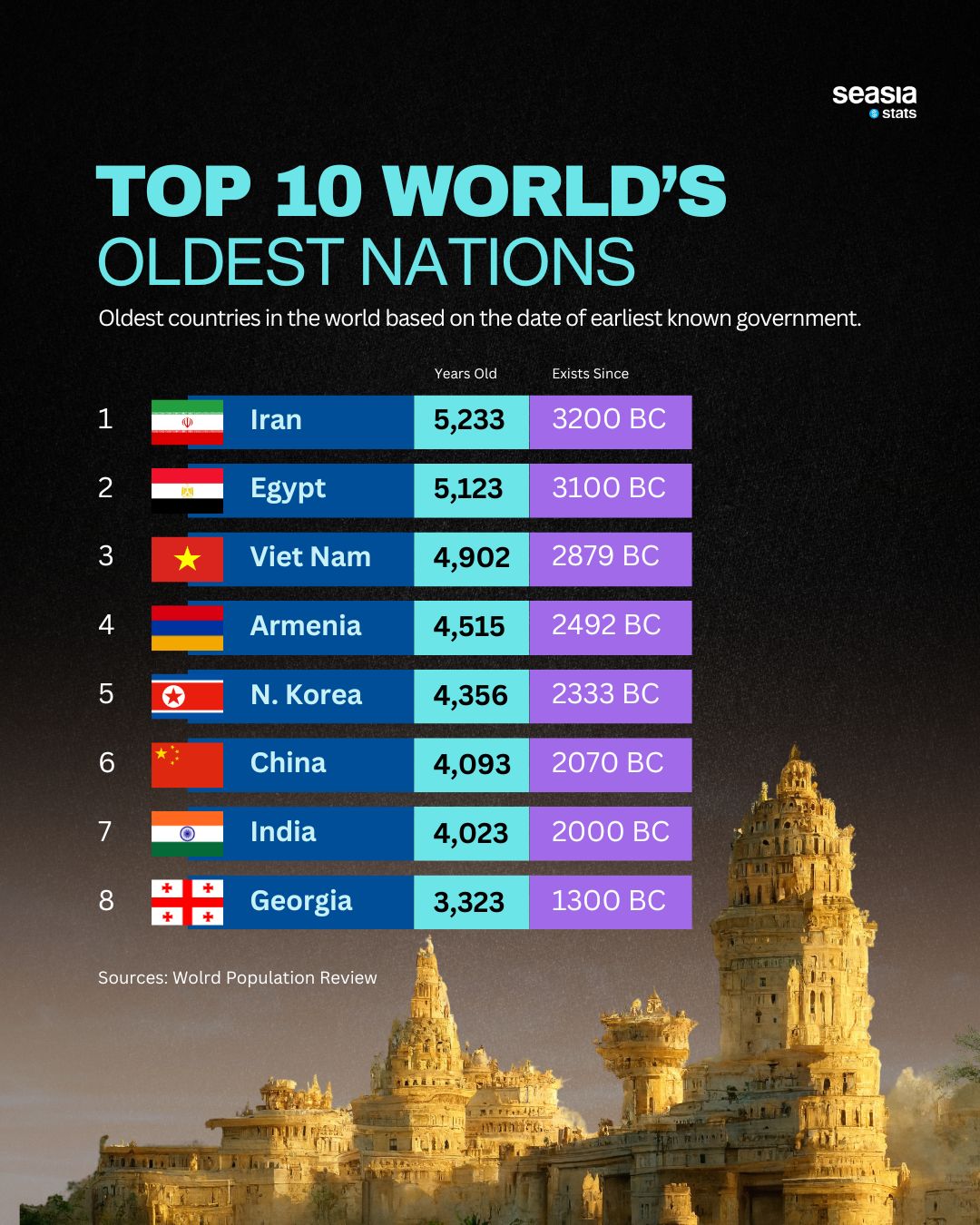
Civilization has deep roots — and these ten countries represent the earliest organized governments in human history. According to World Population Review, the timeline of national formation stretches back over 5,000 years, revealing not only the birth of ancient societies but also the continuity of culture, governance, and identity that endures today.
Iran: The Cradle of Governance
Topping the list is Iran, with its first known government tracing back to around 3200 BC, making it 5,233 years old. The ancient Elamite and later Persian civilizations laid the foundation for complex administrative systems, literature, and architecture, influencing regions far beyond modern-day Iran’s borders.
Egypt and Viet Nam Follow Closely
Egypt ranks second, with its earliest government emerging around 3100 BC, a period that saw the unification of Upper and Lower Egypt. From pharaohs to monumental pyramids, Egypt’s political and cultural legacy remains unmatched.
Viet Nam, with an earliest known government dating back to 2879 BC, takes third place — a significant entry that positions Southeast Asia within the timeline of ancient civilizations. With nearly 5,000 years of recorded governance, Viet Nam reflects deep continuity in cultural identity and nationhood.
Ancient Asia and the Caucasus Represented
Other entries include:
-
Armenia (2492 BC) – Among the earliest Christian civilizations, rooted in the South Caucasus.
-
North Korea (2333 BC) – Tracing back to the founding of Gojoseon, the first Korean kingdom.
-
China (2070 BC) – With the Xia Dynasty recognized as the first in a long and complex imperial lineage.
-
India (2000 BC) – Anchored in the Indus Valley Civilization and Vedic traditions.
-
Georgia (1300 BC) – A crossroads of Europe and Asia, rich in ancient kingdoms and mythologies.
Each of these countries contributed vastly to early urban planning, legal systems, metallurgy, language, and philosophical traditions.
Why This List Matters
These “oldest nations” are more than just dates — they embody how people organized, ruled, and envisioned society millennia ago. Despite wars, colonization, and modern borders, many of these civilizations preserved a cultural-political thread that still exists today.
They remind us that while technology evolves rapidly, the foundations of governance and identity often stretch back farther than we think — shaping the modern world in profound, often overlooked ways.


