

Brunei Darussalam
The Land of Unexpected Treasures
Search
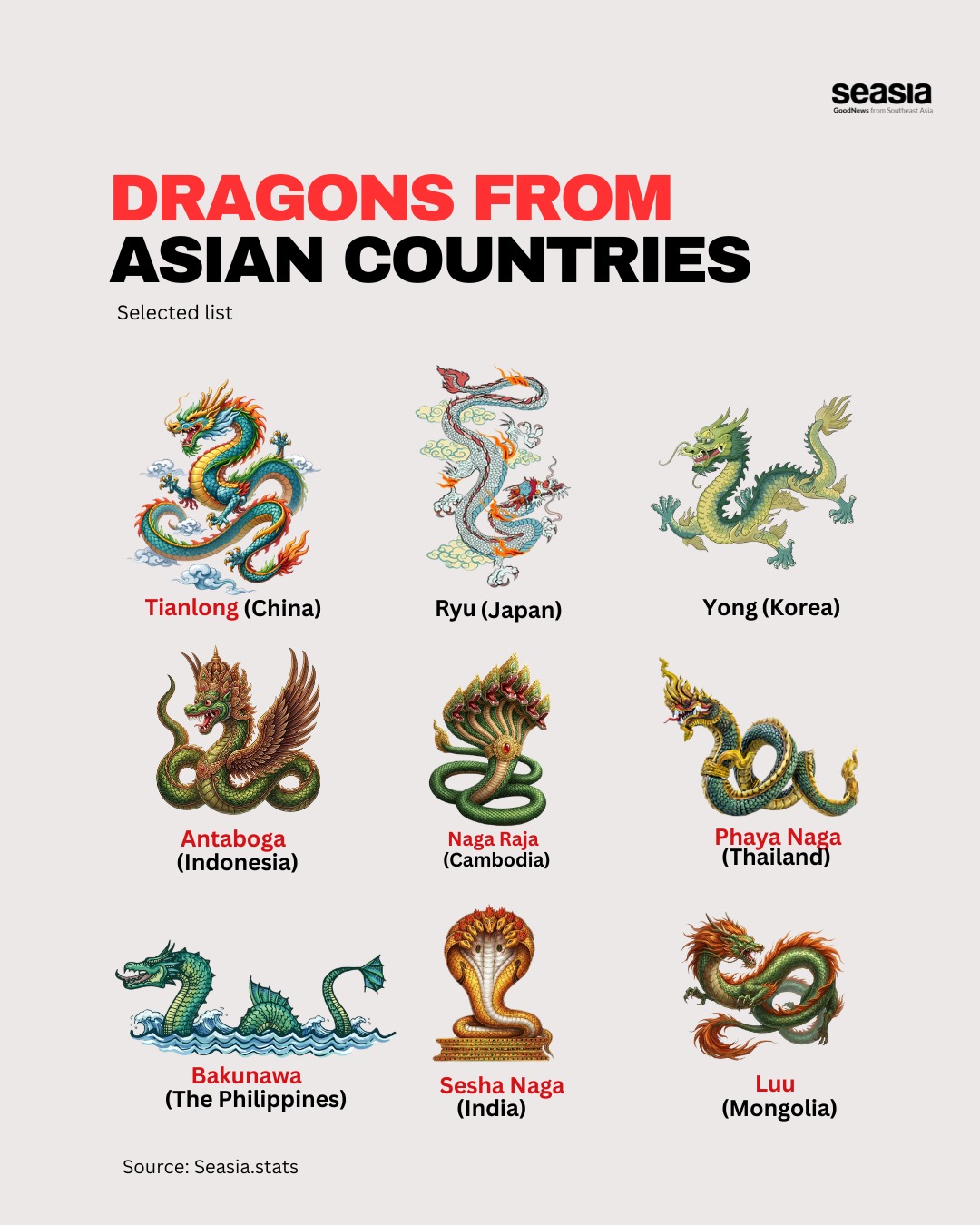
Across Asia, dragons are not fearsome villains—they are revered protectors, bringers of rain, and guardians of cosmic balance. From imperial courts to village rivers, these serpentine beings have shaped spiritual life, art, and identity for centuries. A compilation by Seasia Stats highlights how each region has its own interpretation of the dragon, revealing a rich tapestry of mythologies that connect heaven, earth, and water.
In East Asia, dragons are majestic, wingless, and deeply tied to the sky and weather. China’s Tianlong, or “Heavenly Dragon,” is perhaps the most iconic—an embodiment of imperial authority and divine order. In ancient China, the emperor was often described as the “son of the dragon,” symbolizing the ruler’s connection to the cosmos.
Japan’s Ryu and Korea’s Yong follow similar forms—long-bodied, four-legged serpents associated with rain, rivers, and clouds. These dragons are benevolent deities, believed to govern seasonal cycles and agricultural fertility. Even the number of claws on their feet—five for China, four for Korea, three for Japan—reflects layers of cultural symbolism and historical hierarchy.
Further south, the dragon transforms into the Naga—a sacred serpent deity central to Hindu and Buddhist traditions. In Indonesia, Antaboga is a primordial world-serpent from Javanese mythology, said to reside in the underworld and represent the foundation of the earth itself. In Bali and Java, naga imagery appears in temple architecture and ritual art, symbolizing protection and balance.
Cambodia’s Naga Raja, the “King of Nagas,” is a multi-headed serpent frequently seen in Angkorian temples, bridging the human and divine worlds. This same imagery extends across mainland Southeast Asia: in Laos, naga statues line the Mekong River; in Thailand, the Phaya Naga is believed to dwell beneath the river’s surface, emerging in legends and festivals as a symbol of luck and protection.
India’s Sesha Naga, often depicted with multiple cobra heads, is said to support the universe on its coils. In Hindu cosmology, Sesha serves as the resting place of Lord Vishnu, emphasizing the naga’s role as a cosmic stabilizer and divine servant.
In maritime Southeast Asia, dragon myths take on oceanic forms. The Philippines’ Bakunawa is a massive sea serpent from Visayan folklore, famous for swallowing the moon and causing eclipses. These myths once inspired ancient rituals where communities would create loud noises to “drive away” the serpent and restore the moon.
Elsewhere in the region, Vietnam’s dragon legend of Lạc Long Quân connects the Vietnamese people to a dragon lineage, while Malaysia and Brunei share naga-influenced folklore tied to rivers and royal symbolism. These myths highlight the deep connection between water, fertility, and life in Southeast Asia’s riverine and coastal civilizations.
In the steppes of Mongolia, the dragon appears as Luu—a sky and thunder spirit. Its roar is believed to be the sound of spring storms, signaling renewal after the long winter. Unlike the water-bound naga, Luu embodies the heavens and seasonal transformation, linking nomadic life with the rhythms of nature.
Despite their regional differences, Asian dragons share a unifying theme: they are protectors, not destroyers. They govern rain and rivers, uphold cosmic order, and symbolize wisdom, strength, and prosperity. From the Mekong to Mount Fuji, from Angkor Wat to the Philippine seas, dragons remain a living part of Asia’s cultural imagination.
In a rapidly modernizing world, these ancient serpents continue to inspire festivals, art, and national identity—reminding us that mythology still flows through the rivers and skies of Asia today.


The Land of Unexpected Treasures

Land of the Khmer

The Emerald of the Equator

The Land of a Million Elephant

Land of Indigenous Malay

The Land of the Golden Pagoda

Pearl of the Orient Seas

The Lion City

Southeast Asia Region

The Land of Smiles

A Nation of the 21st Century

The Land of Blue Dragon

Beyond Southeast Asia