


When people think of countries with thousands of islands, Indonesia and the Philippines often come to mind. But did you know that neither of them tops the global list?
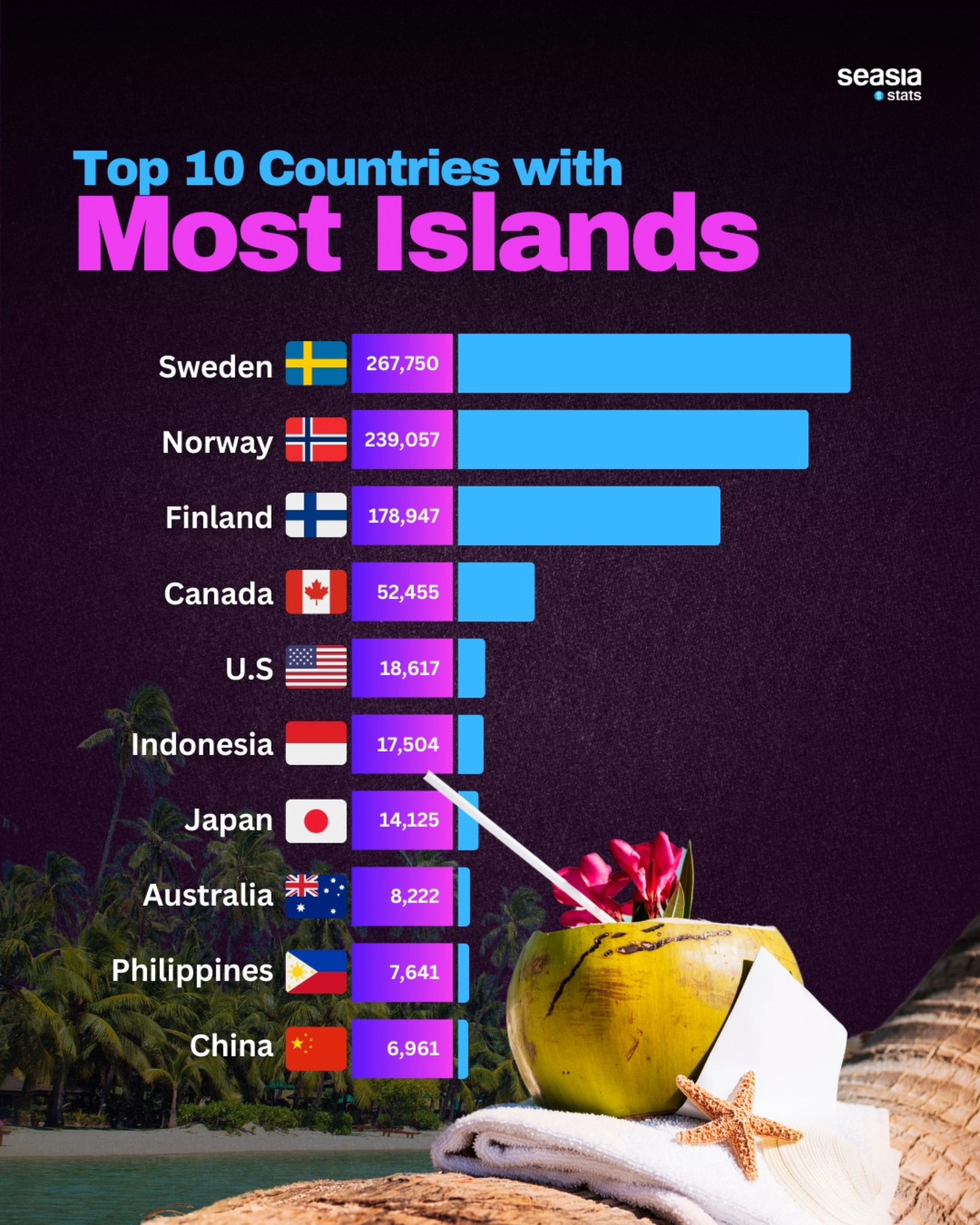
According to the latest data compiled by Seasia Stats, Sweden surprisingly takes the crown with an astonishing 267,750 islands, followed by Norway and Finland, proving that being a northern nation doesn’t mean having less coastline.
In fact, these Scandinavian countries dominate the chart with their countless small landmasses scattered across icy fjords and inland lakes.
Meanwhile, Canada ranks fourth with over 52,000 islands, a natural result of its vast landmass and rugged terrain. The United States follows with over 18,000 islands, from the tropical beauty of Hawaii to the wild coastline of Alaska.
And then comes Indonesia, the world’s largest archipelagic state, with 17,504 islands. It may not have the most islands by number, but it remains unmatched in biodiversity, cultural variety, and population spread across its territories. Close behind is Japan with over 14,000 islands, many of which are uninhabited volcanic islets.
Australia, known more for its vast desert interior than its archipelagic features, still manages to have 8,222 islands, many of them off the coast of Queensland. The Philippines, with 7,641 islands, ranks ninth, but remains one of the most archipelagic nations in terms of inhabited islands and cultural dispersion.
China rounds out the top 10 with 6,961 islands, reflecting a complex coastline dotted with both major cities and marine sanctuaries.
Why This Matters Beyond the Numbers
At a glance, this list might look like trivia. But island count reflects more than geography, it ties into everything from culture and connectivity to tourism and climate resilience.
Take Indonesia and the Philippines, for example. These countries may not lead in raw numbers, but their islands are central to their identity.
From Bali to Palawan, from Raja Ampat to Siargao, these islands are global travel magnets, biodiversity hotspots, and homes to millions.
In contrast, many islands in Sweden or Norway are small, remote, and uninhabited. They are counted through detailed cartographic surveys, while tropical nations sometimes underreport smaller or changing landmasses due to erosion, sea-level rise, or administrative challenges.
A Rising Concern: Defining an "Island"
Interestingly, how each country defines and counts its islands varies. Some count even the tiniest rocks that emerge at low tide, while others only consider inhabited or officially named landmasses. Indonesia’s own official island count has changed over time due to updated surveys and geographic audits by its Geospatial Information Agency (BIG).
So while Sweden may dominate the list in terms of sheer numbers, countries like Indonesia and the Philippines dominate in cultural diversity, language variation, and ecological richness across their archipelagos.
Final Thoughts
Whether you're sailing past the icy skerries of Scandinavia or island-hopping across the tropics of Southeast Asia, one thing’s clear, the world’s islands are more than just dots on the map. They are homes, lifelines, sanctuaries, and symbols of national identity.
And for Southeast Asians, it’s a proud reminder: even if we’re not number one in count, we’re definitely number one in soul.



